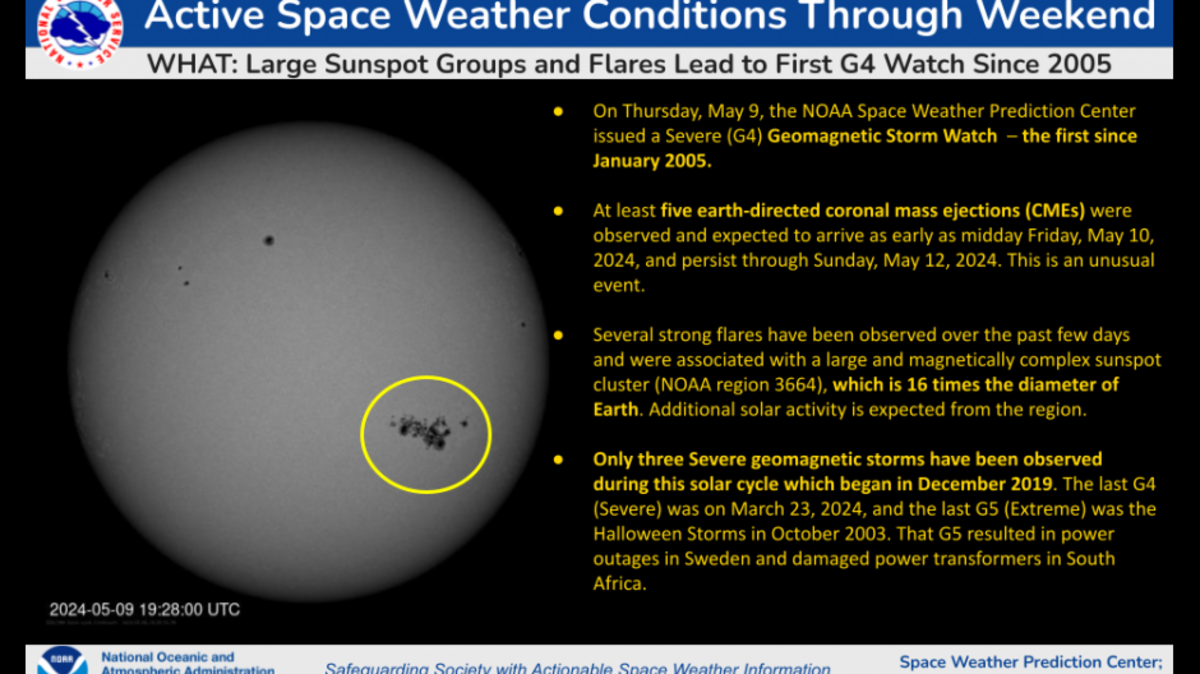
NOAA’s Space Weather Prediction Center Thursday issued its first severe geomagnetic storm watch since 2005. It’s in effect from late Friday through Sunday. Power grids, the internet and GPS systems could be affected.
National Oceanic and Atmospheric Administration
Unusually strong solar storms headed toward Earth could disrupt communications systems and other infrastructure this weekend, while also creating a heavenly show that may be visible all the way to North Carolina.
In other words, your GPS might not work, so find a place where you can see the open sky, and look up.
NOAA’s Space Weather Prediction Center Thursday issued its first severe geomagnetic storm watch since 2005. It’s in effect from late Friday through Sunday.
NOAA says at least five coronal mass ejections have been observed since Wednesday, meaning the sun’s corona expelled large amounts of plasma and magnetic field, which the agency refers to as a magnetic clouds that travel through space and can cause solar storms, NOAA says.
The agency says a solar or geomagnetic storm is disturbance of the Earth’s magnetosphere, the area around the planet that’s controlled by its magnetic field.
Are we in danger?
The most likely impacts from a severe solar storm are to systems that rely on radio frequencies. NASA says that during geomagnetic storms some radio frequencies are absorbed and others are reflected, resulting in fluctuating or disrupted signals.
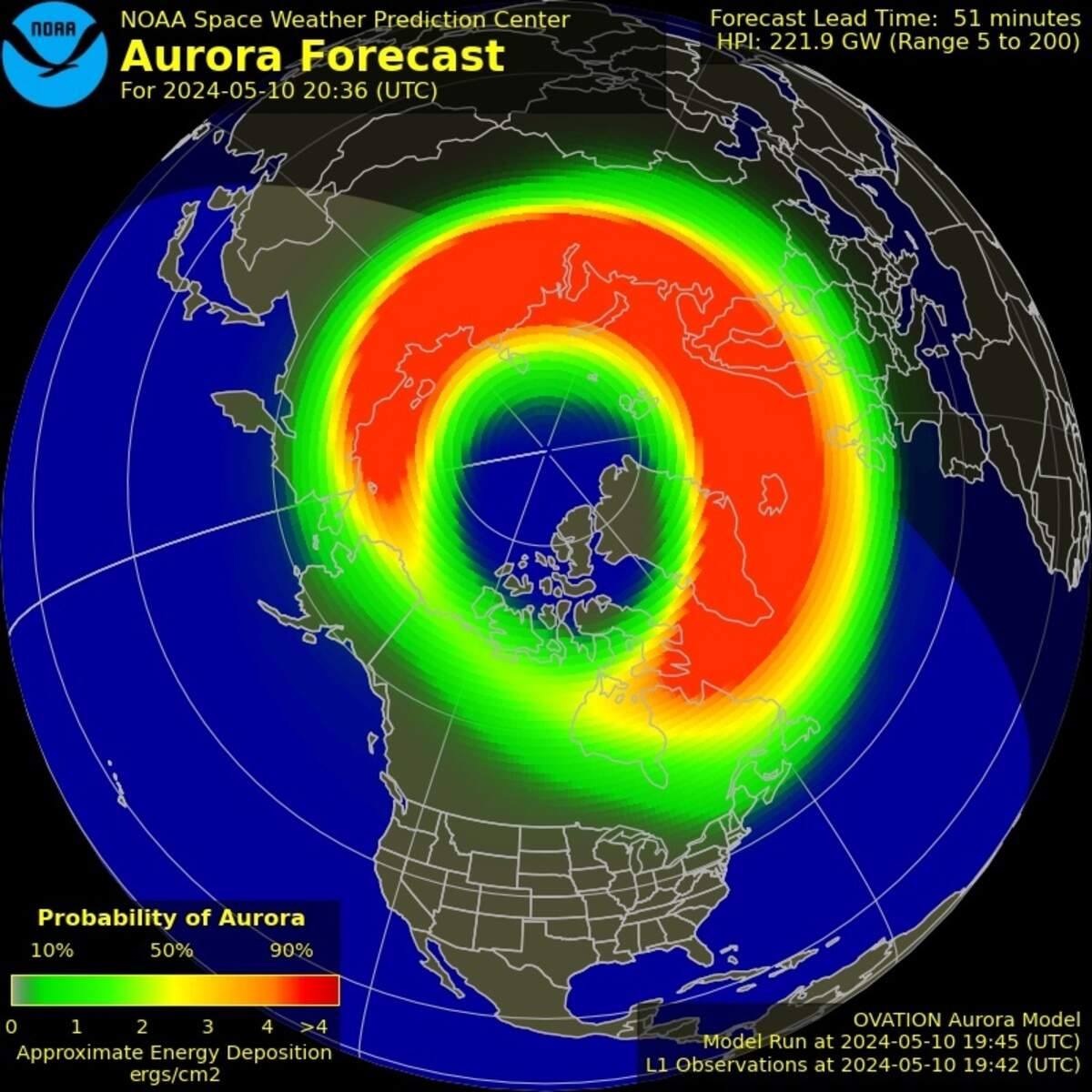
The Space Weather Prediction Center issues aurora forecasts for the northern and southern hemispheres, which project out up to 90 minutes at a time based on current solar storm conditions. Skies should clear enough Friday night to make the show visible in North Carolina. National Oceanic and Atmospheric Administration
How to see the northern lights in NC
As the charged particles ejected from the sun hit the Earth’s magnetic field, they create auroras, also called northern lights. They’re not visible in the daytime but can be spectacular at night.
This event is likely to create auroras visible in many areas of the U.S., including North Carolina. Cloudless skies make for the best viewing.
The Space Weather Prediction Center issues aurora forecasts for the northern and southern hemispheres, which project out up to 90 minutes at a time. Auroras are based on current geomagnetic storm conditions.
An aurora doesn’t need to be directly overhead, and can be seen from more than 600 miles away if it’s bright and conditions are right.
The National Weather Service forecast for Raleigh, Durham and Chapel Hill shows partly cloudy skies Saturday night.
For the best viewing, get as far away from bright lights as possible, and find some open sky. Look toward the north.
The lights are even more intense in photographs, even those taken with a smart phone. The camera lens can pick up colors and intensity the naked eye can’t perceive.
This story was originally published May 10, 2024 at 4:13 PM.