
Triangle temperatures begin a dive toward record lows; some relief expected Saturday
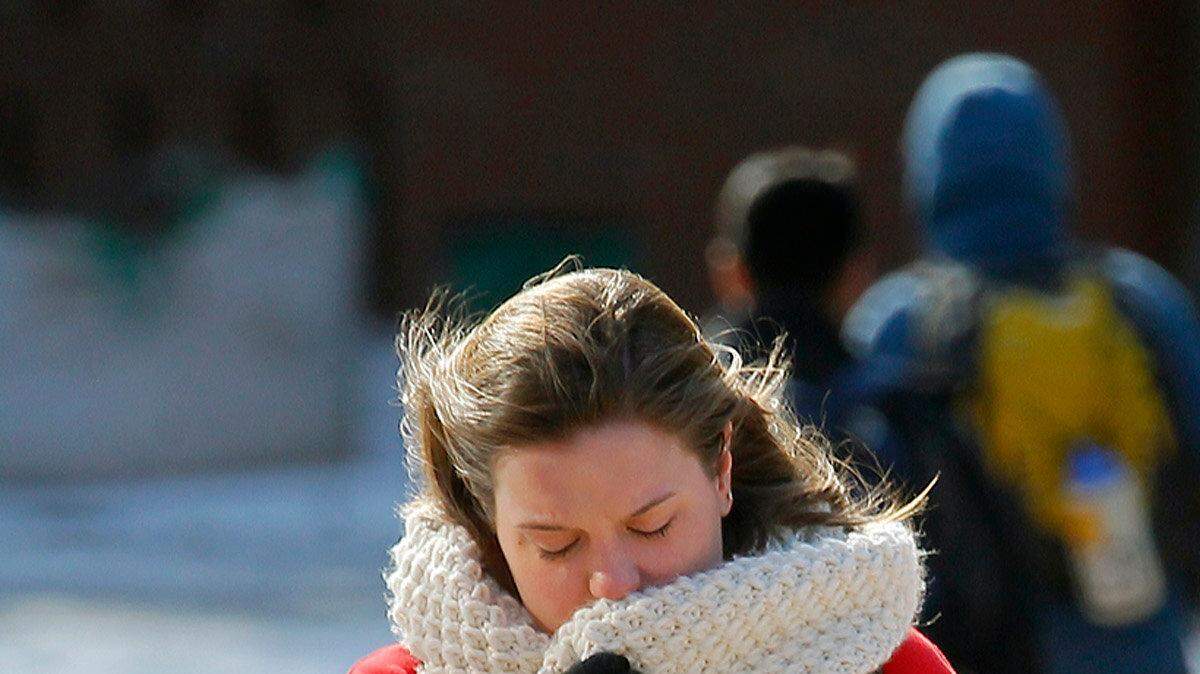
Yes, it’s another (flash-frozen, record-breaking) groundhog day. The same icy streets. The past-capacity homeless shelters. In many places, a fourth day of stir-crazy kids home from school.
And a near certainty of two more temperature records. While the near-zero low long forecast for Friday morning has been getting all the attention, the crews charged with clearing the Triangle’s roads know that the other record, the high in the low 20s, is their real problem, because it will lock in another day of the concrete-like coating on many residential streets, just as it did Thursday.
“Right now, there really isn’t anything effective that we can do, because you can’t really plow it, and the salt doesn’t work below about 24 or 25 degrees,” Chris McGee, Raleigh’s transportation field services manager, said Thursday afternoon.
At temperatures just below freezing, even ice can be scraped and is vulnerable to salt. Low-temperature ice is a different beast entirely. It renders the plows on the trucks really good for only one thing.
“Well, if the truck gets out of hand, you can drop the plow and hope that stops it,” McGree said.
Temperatures were predicted to hit 9 degrees just before midnight Thursday. That would set a record low for Feb. 19, beating the previous record of 11 in 1979. Then it was expected to continue falling and easily beat the record for Feb. 20 of 13 degrees, also set in 1979.
At the National Weather Center’s Raleigh office, the consistency of the low temperatures all week led forecaster Scott Sharp to ask an inquiring reporter for patience while he sorted out the various records for cold this week and checked behind himself.
“My days are starting to blend together,” he said.
A matter of life and limb
The prolonged stretch of sub-freezing temperature threatened more than commutes and the school calendar. It also was a matter of life and limb.
Between Monday and Thursday afternoon, WakeMed had treated more than 150 people with weather-related injuries, including falls, motor vehicle accidents and sledding accidents. It also had treated three cases of hypothermia.
Under “white flag” rules that take effect in sub-freezing weather, Wake County homeless shelters were taking in everyone, even beyond their normal full capacity.
Normally the white flag applies at night, but it was so cold that the shelters had been open 48 hours straight and were expected to remain open another 48 or so, said Bill Hoetzlein, the case management team leader at the South Wilmington Street Center in Raleigh.
On Wednesday night, the South Wilmington Street Center housed 74 men beyond its normal capacity of 234 and expected to shelter more Thursday night, Hoetzlein said.
Shelter leaders met Wednesday with county emergency management officials, who noted that there are designated buildings for overflow if standard shelters exceed their licensed capacity. At South Wilmington Street, that is 360 people. Hoetzlein said he had never seen that and didn’t expect it even in such extraordinary weather.
On Thursday afternoon, Duke Energy repeated calls for customers to reduce their electricity use on Friday, particularly between 5 a.m. and 10 a.m., to help reduce stress on the electrical grid caused by the high demand for heating.
The company has generation capacity for all its needs, but sudden spikes in demand are problematic and can cause isolated outages, Duke said.
Garbage collection suspended
As if further proof were necessary that the residential streets in Raleigh remain a problem, the city decided to suspend all solid waste collection until Tuesday, in part because of the bad streets and in part because the savage cold had led some trucks to break down.
The unusual extended period of below-freezing temperatures followed a storm that dropped mainly sleet, resulting in a particularly dense coating that’s stubbornly difficult to melt. The thinness of the coating is deceptive. The equivalent of just snow would have been 7 to 10 inches, said Chris Hohmann, chief meteorologist at ABC11.
Instead, it became something for which there probably isn’t a word, except maybe “frustrating.”
“It’s hard to move off the streets; it’s hard to plow; it’s hard to walk on,” Hohmann said. “Basically it’s like cement.”
Raleigh has about 40 trucks equipped with plows and salting gear, and with more than 1,000 miles of streets, about all the city could do Wednesday before things got really cold was try to clear the main thoroughfares and streets in and out of neighborhoods, McGree said.
In Cary, though there were still the inevitable icy spots, the town had been able to scrape all the streets, even small residential ones, said Scott Hecht, the town’s public works director.
Concern about water-line breaks
The other record temperature, the low, signaled big trouble for another group of workers – those who respond to water-line breaks and ice-shattered water meters, Hecht said.
Often those breaks will be on homeowners’ side of the pipeline, so it’s their responsibility to fix. But the town needs to be ready to move quickly to help by shutting down the water supply, Hecht said, and also be in place to deal with water main breaks.
Sometimes a homeowner won’t spot a break for hours, until they find that their water pressure is down. Meanwhile, their yard might flood.
The thaw that will likely reveal many of those ruptures is finally expected to start midday Saturday, Hohmann said. There is at least a slight chance that more wintry mix will start then, but it should turn rapidly to rain.
Temperatures are forecast to stay above freezing for two days and rise to the high 50s Sunday, close to normal for this time of year.
That, Hohmann said, will surely clear away most of the ice.
However, it’s expected to turn unseasonably cold again next week. While Hohmann said he doesn’t have much confidence in them, according to some forecasts it could snow again Tuesday.
And again next Saturday. Staff writer Ron Gallagher contributed.
This story was originally published February 19, 2015 at 8:01 AM with the headline "Triangle temperatures begin a dive toward record lows; some relief expected Saturday."