
NC used to encourage voting. Now it suppresses it.
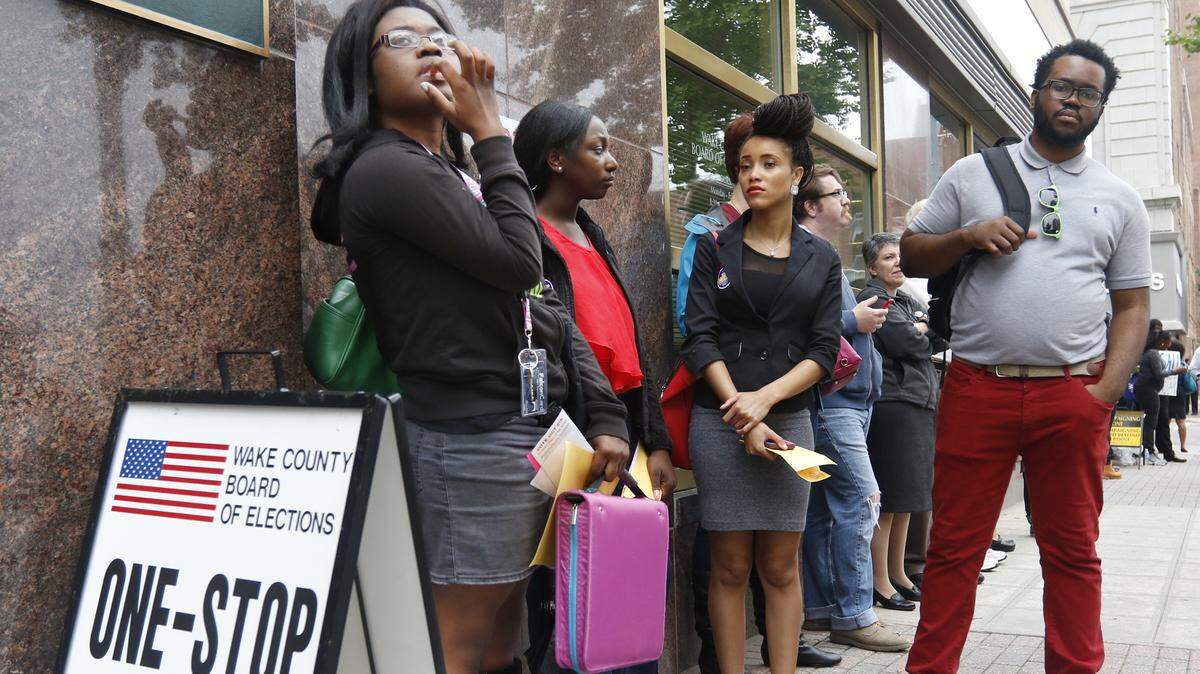
If North Carolina’s Republican leaders spent as much time responding to voters as they do trying to stifle them, their party would have a broader base and better prospects this November.
Republicans took control of the General Assembly in 2011 after campaigning on a jobs platform in the aftermath of a deep recession. Seven years later, the national economy is surging and there’s a shortage of workers not jobs, though North Carolina has managed to under-perform in that area. The national unemployment rate is 3.8 percent. North Carolina’s is 4.3 percent.
But the jobs Republican lawmakers are really focused on are their own. They’ve spent years building walls around their districts through extreme gerrymandering, trying to make it harder for African-Americans, young people and old people to vote and battling in court, usually unsuccessfully, when their tactics are challenged as violations of voting and civil rights.
It’s exhausting to keep up with the voter suppression, but these lawmakers never tire of it. They're pushing a constitutional amendment to require a photo ID to vote and they just passed a law to alter the state’s early voting process.
The new law’s main effect will be to eliminate early voting on the Saturday before the November election, a day that has been shown to be popular with African-Americans voters. But the bill goes further. It requires that all county elections boards keep all their weekday early voting sites open from 7 a.m to 7 p.m. That eliminates local flexibility and will drive up the costs of operating early voting sites. The result will be fewer sites and less opportunity to vote, especially in rural counties with large African-American populations, who tend to vote Democratic.
It’s dispiriting to watch the flag-waving Republican Party devote so much energy to limiting a right that patriots died to protect. And it’s especially hard to see it in North Carolina, a Southern state that had overcome the legacy of Jim Crow to rank among the nation’s leaders in ballot access.
Gary Bartlett was at the center of the transformation. From 1993 to 2013 he served as executive director of the State Board of Elections. During that period, the nation and state made great strides in making it easier to vote. The National Voter Registration Act, also known as the Motor Voter Act, took effect on Jan. 1, 1995. It required states to invite people to register to vote when they apply or renew a driver’s license or apply for public assistance.
“We were very proud in North Carolina that when it took effect we were the first Southern state to be in compliance,” Bartlett says.
North Carolina was also the third state in the nation to adopt a statewide voter registration system and was leading state for registering voters through public assistance agencies. Early voting and no-excuse absentee voting were approved in the early 2000s and turnout increased sharply in presidential elections, setting a modern state record of 69.5 percent in 2008.
Those days of encouraging more people to vote are gone.
“The biggest thing is you try to ensure that people can be enfranchised to register and vote without having obstacles put in front of them and to me it just seems like (Republican lawmakers) are trying to do one test after another,” Bartlett says.
Now a consultant on voting practices, he heads the Ranked Choice Voting Resource Center. Ranked choice allows voters to rank candidates in order of preference to create an “instant runoff” in elections with more than two candidates. The process encourages candidates to reach out to a broader electorate and is in use in 10 states.
It is not an election law change likely to come to North Carolina. But Bartlett still can dream of fair elections in which the merits of the candidate weigh more than his or her affiliation.
“I hope we can get back to letting the best candidates win,” he says. “I know that’s sort of like Peter Pan but it should be all about the voters."
This story was originally published June 22, 2018 at 8:13 AM with the headline "NC used to encourage voting. Now it suppresses it.."