
Dad sits, vacant eyed, in a wheelchair. I wonder how long this can last.
My siblings and I transitioned my father to hospice care last month. Then a funny thing happened: He decided he wasn’t ready to die.
It’s a lesson my siblings and I should have learned from having kids: You can plan all you want, but there are some things we mortals cannot control. Including the way the people we love enter this world – and leave it.
My dad’s decline over the last seven months has been precipitous. A few weeks before he turned 94 in December, he was still exercising every day, still planting a garden at his retirement home, still playing bridge. He was still having a daily attitude adjustment at 5 p.m., reading the newspaper cover to cover, and watching PBS.
But after successful heart surgery in October, the surgical site got infected; then he had a fall, then another infection, and another. Now there are times he can scarcely catch his breath. His speech is halting and he aged two decades seemingly overnight.
Sometimes he sits, vacant eyed, in a wheelchair, and I wonder how long this can last. How long it should.
But then he lifts his head off his chest and tells us, “I’m going to bounce back from this. I’m going to do it.”
I do not doubt his steely resolve. I just can’t imagine why he wants to live this way. He and my mom had always said they would not want to be the gape-mouthed horror show kept alive beyond their time. He did not hesitate to mercifully have my mother’s ventilator removed.
But this instinct to survive is tenacious and, sometimes, surprising.
Dr. Nortin Hadler is an emeritus professor of medicine at the UNC School of Medicine and author of the remarkable book, “Rethinking Aging.” Hadler describes a patient of his, a member of the Hemlock Society who “had contemplated the process of dying in the abstract for decades.” This patient, confronted with a debilitating lung disease, chose to be admitted to the ICU over and over, never telling Hadler it was time for less aggressive interventions.
Hadler writes that his patient finally “died by millimeters, never willing or able to say ‘enough is enough.’”
It was death by millimeter for my father too, until mid-June, when he signed the paperwork for hospice. He did not want any more trips to the hospital, only to get weaker and weaker. He did not want any more invasive, painful, humiliating tests and treatments.
We were sad but relieved. He’d been on such a steep downward slope, we planned a prayer service for the end of June secretly fearing he wouldn’t make it.
But sometimes the spirit is more powerful than the frail body that contains it, more strident than the peppiest of pacemakers.
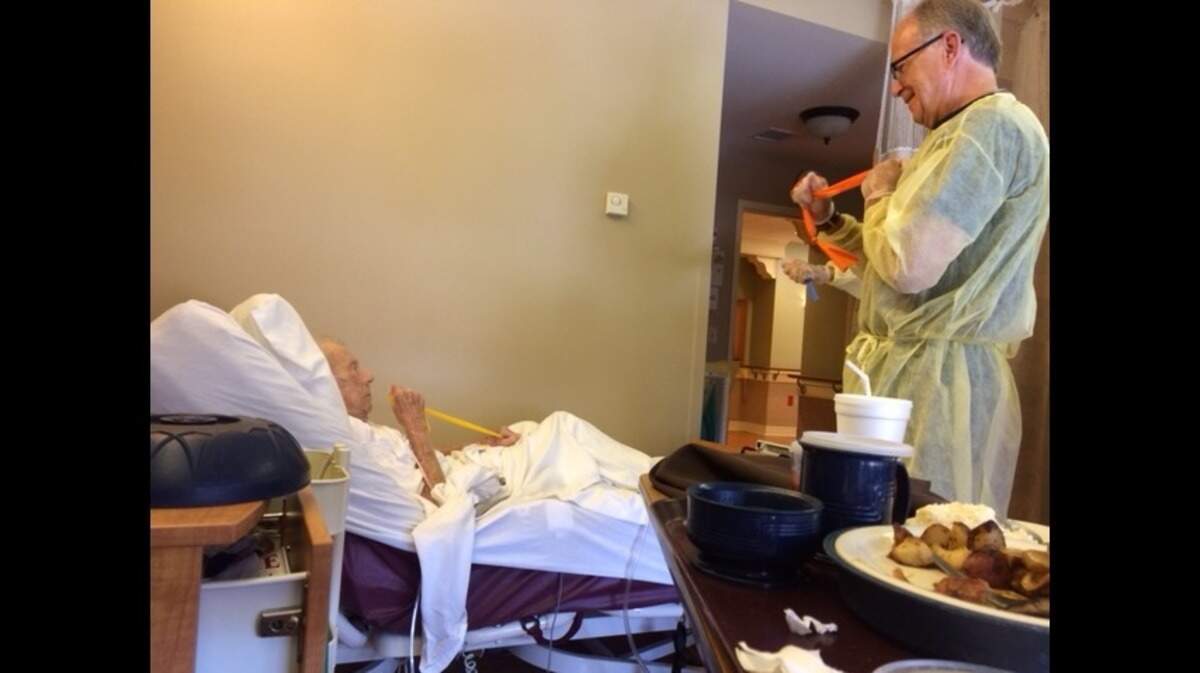
So on the day after a service of last rites (his second), there we were — three of his kids gathered at his bedside, wearing yellow quarantine gowns and latex gloves because of yet another infection. And there was Dad, lying on what is supposedly his death bed — flexing exercise bands my oldest brother brought him, as my brother counted off like some surreal Jane Fonda. I watched in wonder.
Afterward, my father fell into a deep, rattling sleep, his face pale as his pillowcase, gaunt in the gathering dusk. About an hour later, though, he awoke, his voice as clear as a bell:
“Well, Ruthie, what do you think? You want a martini or a Manhattan?” My brother and I chuckled.
Some choices are not easy; some are simply not ours to make.