
Edmisten hears echoes of Watergate in Russian probe
On Rufus Edmisten’s desk in his Raleigh law office is a plaque that reads: “Good friends and good memories.”
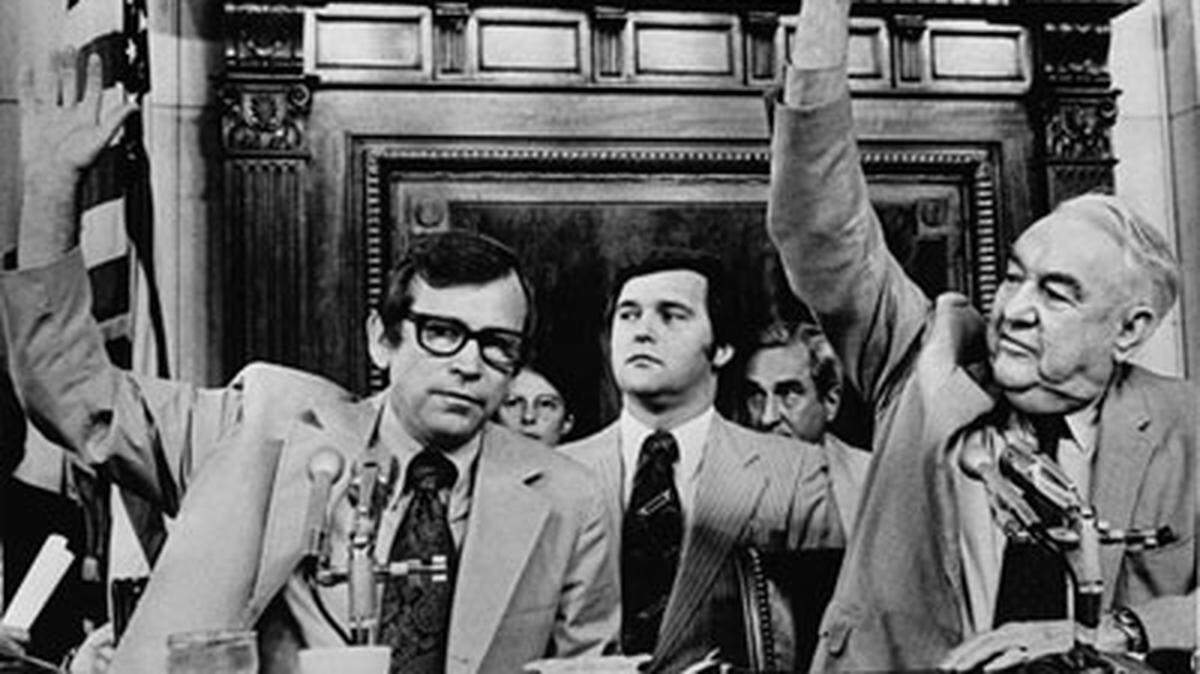
Lately the former North Carolina attorney general has been living that sentiment as he recalls the headiest days of his career, the days when he was a 32-year-old attorney serving as deputy chief counsel of the U.S. Senate’s Watergate Committee.
Edmisten got the job through his ties to the committee’s Democratic chairman, North Carolina Sen. Sam Ervin. All the senators on that historic committee are dead, save former Connecticut Sen. Lowell Weicker. But many of the young staffers for the committee are still around.
A group of them gathered in Edmisten’s Salisbury Street office last week to look back on the day Edmisten rode in a police car down Pennsylvania Avenue to serve a subpoena on President Richard Nixon on July 23, 1973. White House counsel Leonard Garment took the subpoena – the first ever served by a congressional committee on a president. As he departed, Edmisten handed Garment a pocket-size copy of the Constitution saying, “You may need one of these down here, too.”
The reunion party, covered by WRAL’s Tar Heel Traveler, was a typically buoyant Edmisten affair complete with cocktail napkins that said “You are served” and a bartender in a Nixon mask. But these days Edmisten, 77, is doing more than reminiscing. He’s recognizing the past in the present as another president wrestles with a special counsel with his presidency in the balance.
“This has been a week of pondering about what’s happened and where we are headed,” he said.
The parallels between then and now are striking: a break in at the Democratic National Committee, hush payments, secret tape recordings and an investigating Senate committee led by the senior senator from North Carolina. But Edmisten thinks the investigation into possible collusion with the Russians by the Trump campaign could trump the historic 1970s scandal.
“I think they’re trying to outdo Watergate,” he said of President Trump’s advisers and associates and the president himself. They seem not to have learned the fundamental lesson of Watergate: the coverup can be worse than the crime.
“If some of the people around Trump would read the Nixon-Watergate playbook, they wouldn’t be doing this foolishness. Instead they are expanding on it,” he said.
A big difference between the two presidential investigations, Edmisten said, is that during Watergate the opposing party had control of Congress and Democrats and Republicans there were more willing to work together. Now Republicans control Congress and many are unwilling to press for answers.
“The House and Senate have been complicit in having as their first priority the protection of the president,” he said.
Given that background, Edmisten gives a passing grade to North Carolina’s Republican Sen. Richard Burr for his handling of the Russian investigation as chairman of the Senate Intelligence Committee.
“I think Burr has done as good as he could under the circumstances,” he said. “At least his committee came out and said there was Russian meddling.”
What worries Edmisten the most isn’t that he’s hearing echoes of Watergate in the Russian probe, but that politics overall has lost a legacy of Watergate — strict limits on campaign contributions and donor disclosure requirements. Now the contribution limits are gone or easily circumvented and money from undisclosed donors is pouring into campaigns and obligating candidates to an extent the public cannot measure.
Edmisten blames it on the Supreme Court’s Citizens United decision that allowed corporations and unions to spend unlimited amounts in support of or opposition to candidates. He called it the “worst decision since Dred Scott,” the 1857 high court ruling that upheld slavery and pushed the nation toward the Civil War.
As Watergate reforms faded, Edmisten recalled his counterpart on the Watergate Committee, the late minority counsel Fred Thompson, who later became a senator from Tennessee, asking him: “Did we waste our time?”
Much has been lost, Edmisten said, “But we did produce accountability at some point. We at least presented a situation where not even a president can refuse a lawful court order.”
Now he may see if the standard his trip down Pennsylvania Avenue established will survive another test.
Barnett: 919-829-4512, nbarnett@newsobserver.com
This story was originally published July 27, 2018 at 9:03 AM.