
A clear day on a hog farm — but contention is still in the air
After I wrote a recent column on North Carolina’s industrial hog farms, a reader wrote: “Your opinion piece shows you have never stepped foot on a NC hog farm and didn’t bother to make an effort to inform your foolish opinion.”
I did make an effort to inform my opinion, but he was right about the hog farm. So last Thursday I stepped foot on one.
I went to a Duplin County farm at the invitation of Morris Murphy, who raises hogs, cattle, turkeys and a variety of crops. Murphy, 58, no relation to the pork baron Wendell Murphy of Rose Hill, has a 1,500-acre farm on Piney Grove Road in Alberston, about 85 miles southeast of Raleigh. He, his son, his brother and a nephew raise 15,000 hogs. Their homes are near the hog houses and the fields where waste is sprayed when the open-air waste lagoons get near full.
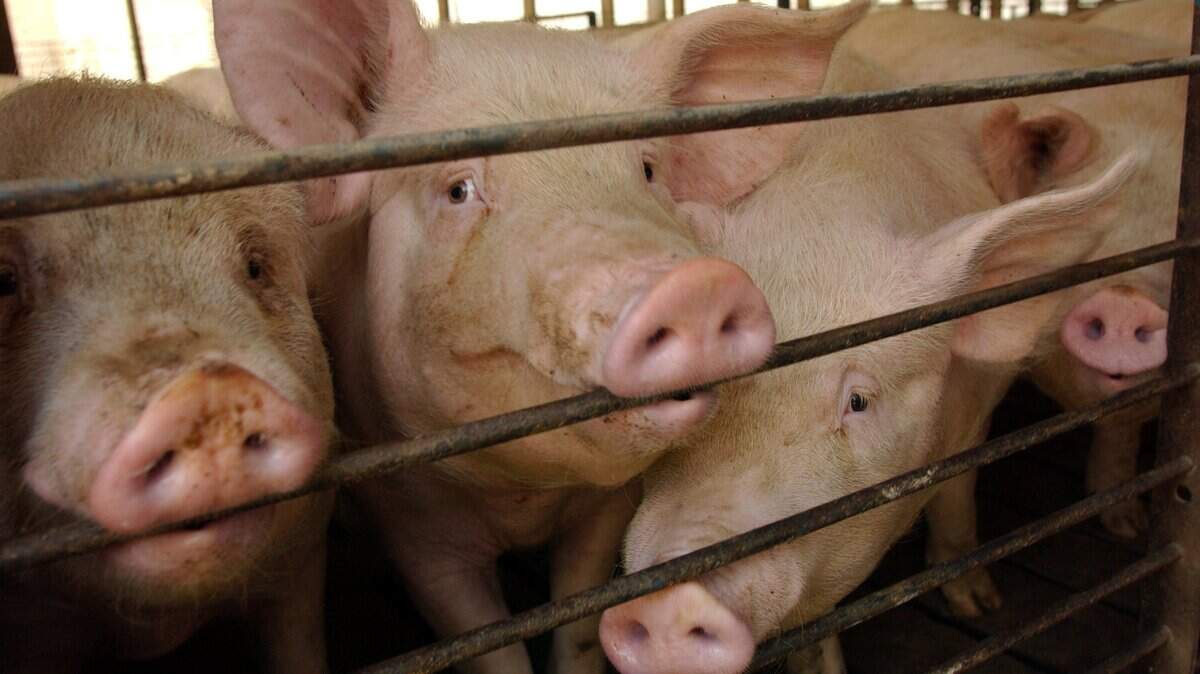
I visited on a clear, hot day. I didn’t smell any hog waste odor at Murphy’s house. The air was free of odor as we took a golf cart tour of the property. But when we pulled up between two of the open air lagoons, the smell was there. And when we came near the exhaust fans blowing air out of hog houses that hold 880 hogs each, there was a stench. And when I stepped into a hog house and saw the multitude of pale swine, some marked with paint as ready for slaughter, the air was thick with their smell.
These hogs don’t belong to Murphy. He raises them under contract with Smithfield Foods, the world’s largest hog producer. He invited me down to counter claims made in dozens of lawsuits filed against Smithfield Foods by neighbors of various contract farmers. The neighbors say hog-waste smell, swarms of flies, and trucks carrying hogs alive and dead are ruining their quality of life. Murphy’s farm is not involved in the lawsuits.
The plaintiffs won the first two cases and juries awarded them a total of $75 million in damages, though a state law limiting punitive damages will sharply reduce that amount. A third trial is underway in federal court in Raleigh.
Murphy, who has attended the current trial, said that the version of hog farming described in court testimony hasn’t been his experience. He said, “I’m proud of raising hogs and how I have treated the environment.”
Murphy said the nuisance suits have been brought on by lawyers who encouraged neighbors to sue even though they’ve lived near the farms for decades. He said jurors have sided with the plaintiffs because the judge hasn’t allowed them to visit a hog farm.
If jurors in earlier cases had visited Murphy’s farm, they might have drawn a different conclusion about what it’s like living next to a hog farm. But one visit for me or for jurors is hardly a fair test. There are more than 2,200 farms raising a total of 9 million hogs on an industrial scale in North Carolina. And there are are 365 days in a year. Between those numbers there’s a lot of room for variation.
Murphy’s farm may be well-run and relatively odor-free, but the process of disposing of waste into lagoons and also spraying waste is an inherently dirty business and there’s plenty of evidence of the nasty results. Other states require more sophisticated and costly ways of processing millions of tons of hog waste, but Smithfield Foods, taking advantage of weaker regulations, is doing it on the cheap in North Carolina.
Rick Dove, a senior adviser for the Waterkeeper Alliance and a longtime critic of the way North Carolina hog farms operate, said a hog farm’s smell depends on the activity on the farm, the weather and the wind, but when the smell carries, it’s powerful. Dove said neighbors “could go 10 days and they have no problems and then they go out and get hit with this stuff and it will about knock them to the ground.”
Murphy said such talk is an exaggeration, even when it comes as neighbors’ testimony. “I know they’re under oath and have to tell the truth and they’ll have to deal with that in their own way,” he said.
In the two cases decided so far, jurors have believed the neighbors. And if that keeps up, Smithfield Foods may have to deal with hog waste in North Carolina in something other than its own way.
Barnett: 919-829-4512, nbarnett@newsobserver.com
This story was originally published July 30, 2018 at 11:06 AM.