
This Raleigh lawyer was one of the last living allies of a white supremacist UNC professor
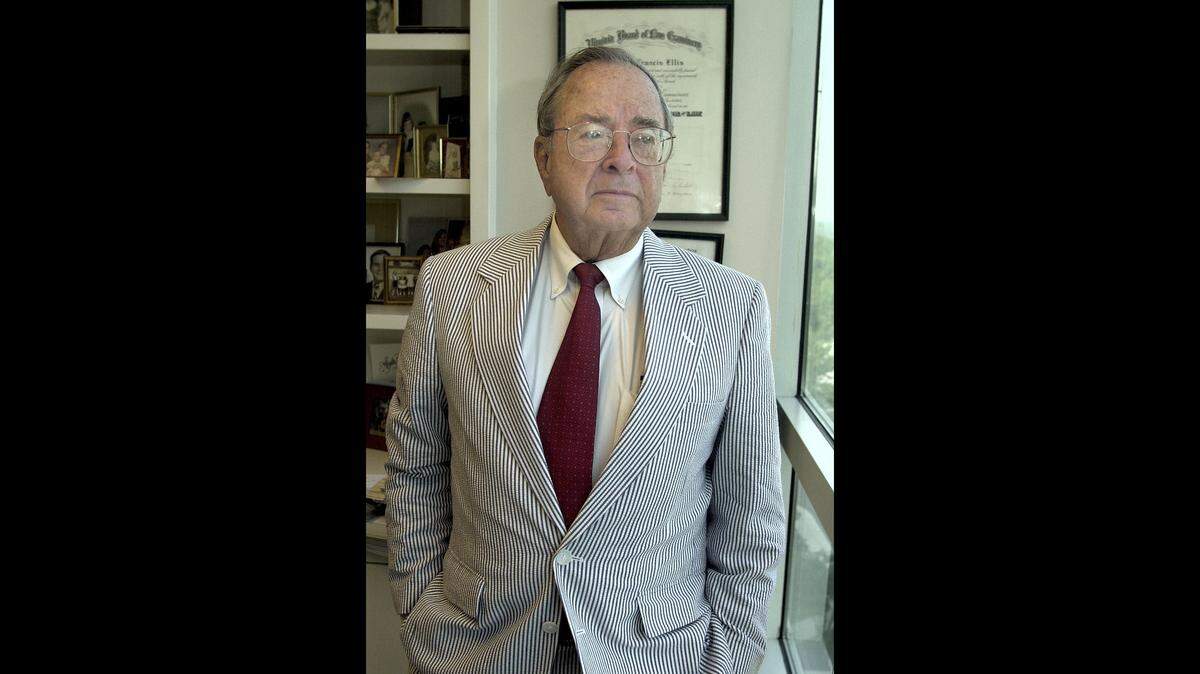
The recent death of Raleigh lawyer and political strategist Tom Ellis at 97 marked the passing of perhaps the last prominent North Carolinian who once advocated for the white supremacist views of Wesley Critz George of Chapel Hill.
George, who had a PhD in zoology, was among the leading segregationists in North Carolina in the 1950s, at least in part because he seemingly gave scientific credence to those who opposed integration. He was a long-time faculty member at the UNC School of Medicine, former chairman of the Department of Anatomy, and former president of the N.C. Academy of Science. He retired from teaching in 1961 and died in 1982.
George believe blacks were biologically inferior to whites and that “the protoplasmic mixing of the races” would diminish the white race, hurting its ability to survive.
“As good citizens, we should do all we can to insure that ten generations and more from now we shall have a breed of people in this country capable of maintaining American civilization,” George wrote in 1956. “Integration and amalgamation of the two races is not the way to insure having such a breed of people.”
George was founding president of the Patriots of North Carolina in 1955. It had a board of prominent white men (and a few white women) and quickly became the state’s largest and most influential segregationist organization.
Among the advocates for George’s work was Ellis, a friend and strategist for U.S. Sen. Jesse Helms who helped elect Helms, John East and other conservatives.
After the U.S. Supreme Court ruled against segregated schools in 1954, North Carolina’s political leaders formed a commission, called the Pearsall Committee, to see how North Carolina could avoid integrating. Ellis was one of two staff attorneys.
Across the South, white politicians and business people worked to fight integration. George was a leader in that effort and a prolific letter writer, as shown by the collection of his papers at UNC. George mailed pamphlets of his articles and speeches to Citizen Councils and other across the South who shared information and joined forces to resist.
Ellis was an ambassador for George’s views and an ally. “Tom Ellis of Raleigh brought to my attention the work you were doing in the field of racial differences,” T.V. Williams Jr., the executive secretary of the Georgia Commission on Education, wrote George in 1956. “I am not a geneticist by profession; however, I am most anxious to read of and understand your work in this field.”
When Ellis wrote a strategy letter to a Patriot in 1957, Ellis copied his letter to George. In 1960, Ellis and George joined forces on I. Beverly Lake’s segregationist campaign for governor against Terry Sanford. George recruited Lake to run and raised money for him, and Ellis was one of Lake’s most active workers.
William H. Tucker, a retired psychology professor at Rutgers and author of the 2002 book, “The Funding of Scientific Racism,” concluded that it likely was Ellis in the mid-1950s who sent George’s pamphlets to Harry Weyher, a North Carolinian who was then a New York lawyer representing the Pioneer Fund. That nonprofit supported research to establish the genetic and intellectual inferiority of blacks.
Ellis later served as a Pioneer Fund board member for four years. When Ellis was nominated by President Reagan in 1983 to an international broadcasting board, Ellis was sharply questioned about his views on race, The Washington Post reported. Ellis testified that his views on race had changed. “I do not believe in my heart that I’m a racist,” he said.
Ellis said he resigned from the Pioneer Fund board after newspaper reports about it. Ellis eventually asked for his nomination to be withdrawn.
Reports of Ellis’ connections to the Pioneer Fund resurfaced recently when President Trump nominated Raleigh lawyer Tom Farr for a federal judgeship. Farr practiced law with Ellis for years, considered him a mentor and was named in Ellis’ obituary. Several civil rights groups have opposed Farr’s nomination in part because of his relationship with Ellis.
George’s articles and speeches have faded from public memory and his views on race were discredited. But in his era, he was a respected professor. A portrait of George was presented at a ceremony in 1959 at the UNC School of Medicine and was accepted that day by Reece Berryhill, dean of the school.
According to a UNC spokesman, the portrait is not displayed at UNC and the university isn’t sure where it is, a mysterious footnote to the career of one of North Carolina’s most devoted foes of fairness and equal opportunity.
This story was originally published August 2, 2018 at 11:01 AM.