
1/21 Letters: Light rail will make medical care more accessible.
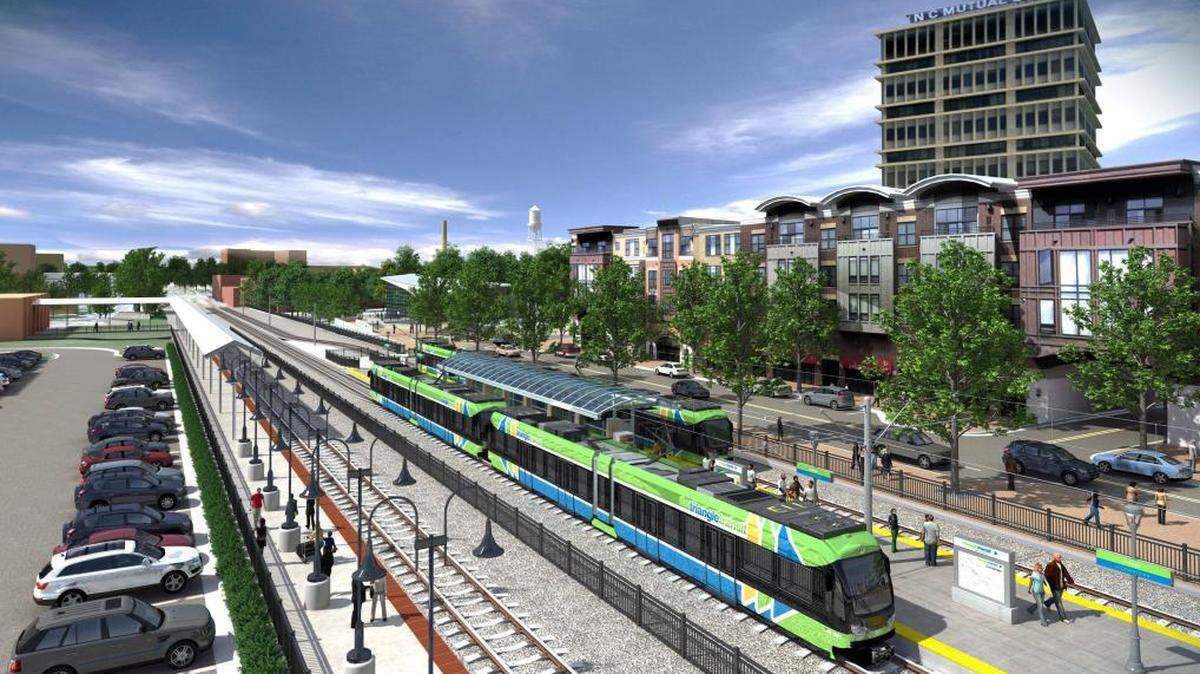
A major medical center must provide ready and reliable access to its resources and services. Indeed, major centers throughout the United States are serviced by rail and subway lines, in some cases directly under the medical center itself. We write to urge Duke University to join with Durham and the Triangle community in support of the Durham-Orange Light Rail transit project. One of us is a professor of pediatrics at Duke Medical School, the other an urban planner and doctoral candidate at MIT.
Faculty, staff, patients and visitors to Duke — as well as the Durham VA Health Care System — will benefit from dramatically improved access. Trips downtown will be shortened to just over seven minutes. The now-30-minute trip between North Carolina Central University and the medical center will be reduced to 16 minutes.
This light rail project is the first step in the development of a transportation system that will afford members of the Triangle community ready access to medical care without needing to drive or pay the costs of parking. That’s an important step forward for equity in our city, where 17 percent of residents live in poverty and 8 percent of households have no access to a vehicle. Light rail will provide an essential alternative to our region’s mounting traffic and help limit urban sprawl and reduce greenhouse gas emissions. This will make Durham an even better place to live and raise families.
Michael Freemark, MD, Duke University Medical Center
Yonah Freemark, MST, MCP, Massachusetts Institute of Technology
Rising costs
We all need to speak out against light rail. Our politicians have not been truthful to us. In 2012, when the sales tax increase vote was held, politicians told us local costs would be only 25 percent of $1.4 billion or $350 million. Now, state funding is cut, and our current cost is 42 percent of $2.5 billion, plus $800 million interest payments on 45 year debt. Since the total cost is now $3.2 billion, it will take 125 years to get the one billion passengers needed to get the just the per passenger construction costs down to $3.
Besides grossly underestimating the project cost and assuming falsely that the government would fund 75 percent of the cost, the project is being botched. Only last month, project leaders learned that downtown stakeholders are up in arms over the plan to close major street crossings. Now we need $81 million more to dig tunnels downtown. Big stakeholders, e.g., Duke, have expressed concern with the routing near Duke Hospital, and residents are upset with a placement of the railroad yard in their neighborhood. Why weren’t these problems foreseen by the planners and addressed long ago? Durham should say no to the project. You’re paying hundreds in taxes each year for light rail. Will light rail benefit you? We need a new referendum on light rail versus other, better uses of our resources.
Rod Gerwe
Durham
In harm’s way
My husband and I are both retired U.S. Army officers. We spent our entire working lives serving our country, not a political party. We raised our son to do the same. He is now a U.S. Foreign Service officer also serving our country, not a political party. He has served in several overseas posts, loyally representing the interests and concerns of the United States. Many of his colleagues are stationed in the neighborhood of recent enemy attacks. None of these Americans are being paid as they go in harm’s way on our behalf. Senators and representatives refusing to vote to reopen the government are getting their salaries. Yet all they care about is their political party, not their country. For shame.
Teri Reid, LTC, United States Army Retired
Oriental
Solutions
The N&O recently published an opinion column by a retired sociology professor who presented a historical perspective of walls. Unfortunately, neither he nor most opinion letters have proposed any solution, nor do they seem to have paid any attention to the people who actually patrol our borders. These patrol agents and their supervisors have said in numerous televised interviews that walls do work well in many areas and decrease the penetration of our border. We should be paying attention to the experts in this matter and not our politicians who seem to want to score political points.
According to a recent Pew report that cited government sources, 416,000 apprehensions occurred at our Southwest border during the first 11 months of 2018. Maybe that information can be utilized to confirm that there is a critical need for border protection. Whether that rises to the level of a crisis or not, it certainly indicates we need to act now. Even the “Pearly Gates” must be attached to a wall, much less the Vatican and the homes of wealthy politicians.
Philip Pearce
Durham