
New DHHS HQ will enhance the development of Raleigh’s Blue Ridge Corridor
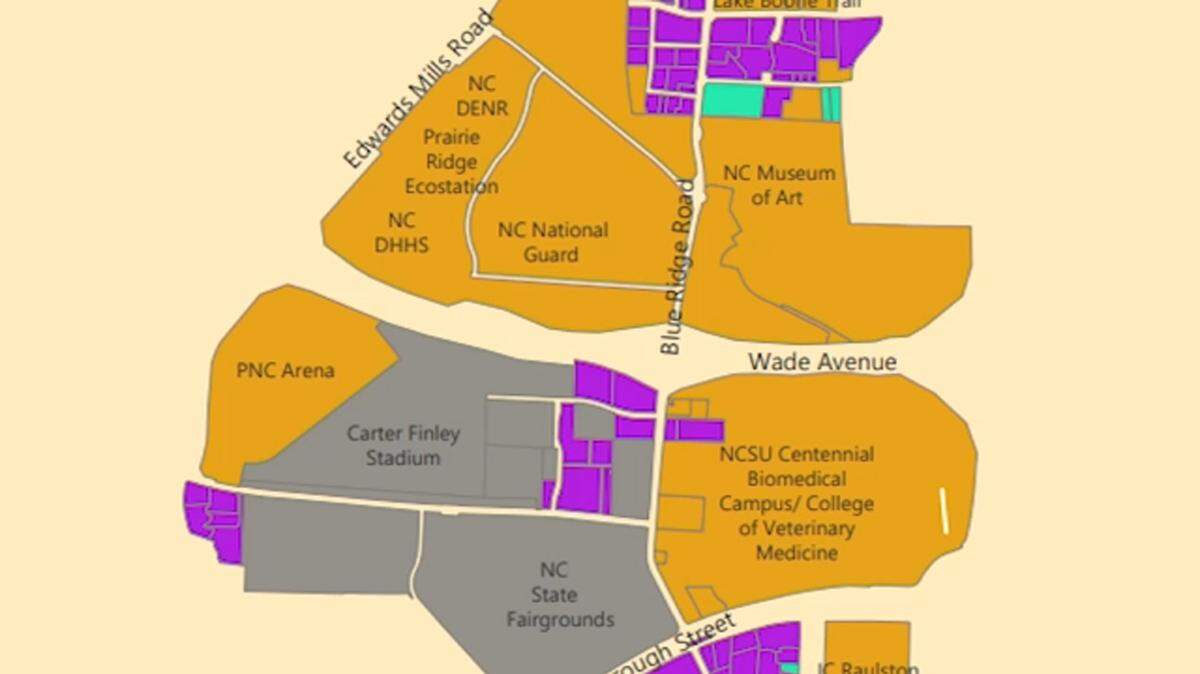
The 2015 agreement by the state of NC to sell the Dorothea Dix property to the City of Raleigh required the state Department of Health and Human Services (DHHS) to vacate most of its offices on that site within 10 years. The transformative nature of Dix Park’s potential impact on sustainable urban development has been widely noted. However, little attention has been paid as to how the new DHHS headquarters in West Raleigh can also be a strong positive in this context.
A century ago the state purchased thousands of acres west of Raleigh previously used as Camp Polk, a short-lived WWI tank training site. Over the next few decades, the NC State Fairgrounds and Polk Prison Farm as well as Umstead State Park were created on these state-owned lands. West Raleigh has since become the home to many of Raleigh’s greatest attractions, including the North Carolina Museum of Art (formed on the old prison site), the PNC Arena and Carter-Finley Stadium as well as the Fairgrounds. With the presence of other major employers and institutions including various state agencies, the NC State University Centennial Biomedical Campus, and UNC Rex Healthcare, this area now hosts well over 6 million visitors annually (during non-pandemic years).
After the PNC Arena opened in 1999, some local business leaders anticipated that within a few years the area bounded by the Wade Avenue Extension, Interstate 40, Hillsborough Street, and Blue Ridge Road would be hard to recognize. Visions of revamped West Raleigh were nothing new but most master plans for the area simply gathered dust. The parts were greater than the whole as the district remained essentially disconnected. At the same time, lack of piecemeal development allowed the area to largely escape the grasp of suburban sprawl.
In 2010, the NC General Assembly chartered the NC Sustainable Communities Task Force to pursue opportunities combining state agency efforts to better integrate state and local investments, including the built environment. One of the focus areas of the Task Force was Raleigh’s Blue Ridge Corridor, with the 2012 District Plan laying a foundation for future sustainable growth. The principles of sustainable development include coordinating housing, transportation, and other infrastructure investments to protect the environment, promote equitable development, and help address the challenges of climate change. Additionally the state’s first comprehensive health impact assessment (funded by the Blue Cross/Blue Shield Foundation of North Carolina) quantified potential return on investment in health outcomes by adding sidewalks and bicycle paths along the Blue Ridge Corridor.
One of the recommendations of the 2012 District Plan was moving DHHS headquarters to the Blue Ridge Corridor. DHHS has proposed consolidating approximately 4,000 Wake County employees (including those on the Dix campus) at the new location. A recent bill signed by Gov. Roy Cooper with broad bipartisan support provided $15 million for site planning. The secretaries of both DHHS and the Department of Administration have recommended an approximately 35-acre site on the west side of Blue Ridge Rd across from the NC Museum of Art.
As a 2012 North Carolina Medical Journal article from DHHS noted, “including health benefits and impacts as a part of the decision-making process ensures that health is considered along with economics, commerce, transportation, safety, environment, education, and other factors.” Incorporating a “Health in All Policies” approach for the NC DHHS site could advance improvements in individual health and address health disparities. The new HQ can positively impact health outcomes by leveraging existing improvements to the Blue Ridge Corridor, including connections to the Ann and Jim Goodnight Museum Park and plans for equitable development around transit. A public-private partnership inclusive of mixed-use and incorporating a wide range of housing options would also set an example for reinvestment in underutilized state properties.
This extraordinary year has seen both a pandemic and a racial reckoning, providing an even stronger rationale for applying “Health in All Policies.” In this context, the DHHS site holds the promise to become a paradigm for health and the built environment.