
NC has already shown why adding a Black woman will strengthen the Supreme Court
It is sadly appropriate that Black History Month opens with Republicans, once more, failing to learn from it.
In this case, the ignorance involves President Joe Biden’s announcement that he will nominate a Black woman to replace retiring U.S. Supreme Court Justice Stephen Breyer. The announcement brought predictable conservative complaints that Biden was putting a “woke” choice ahead of selecting the best candidate regardless of gender or race.
Republicans had no objection to President Ronald Reagan’s pledging to put the first woman on the court, which he did with the nomination of Sandra Day O’Connor.
Of course, cloaked within the complaint about Biden’s pledge is the implication that a Black woman couldn’t also be exceptionally well qualified.
Sen. Roger Wicker, a Mississippi Republican, predicts that not a single Republican senator will support Biden’s pick, a remarkable statement given that the nominee has not yet been determined. What Wicker objects to is the same issue the Supreme Court will soon consider, affirmative action. Wicker presumes a preference by race and gender would produce a biased judge who will “misinterpret the law.”
Biden rightly sees the opposite effect. A justice with the experience of being a Black woman would bring a needed new perspective to seeing how the law serves justice. And that perspective is sorely needed on a court where the Republican majority gutted the Voting Rights Act by claiming that racial bias no longer affects Black voters’ access to voting. The court’s next move likely will be to make it illegal for colleges to consider race when assessing applicants.
North Carolina is especially close to the issues of race and justice raised by Biden’s commitment to naming a Black woman to the high court.
The University of North Carolina is a defendant in the case challenging the legality of considering race in admissions. North Carolina’s Republican-led legislature was among the first to pass sweeping changes in voting laws after the Supreme Court weakened the Voting Rights Act, changes that a federal court said targeted Black voters “with almost surgical precision.”
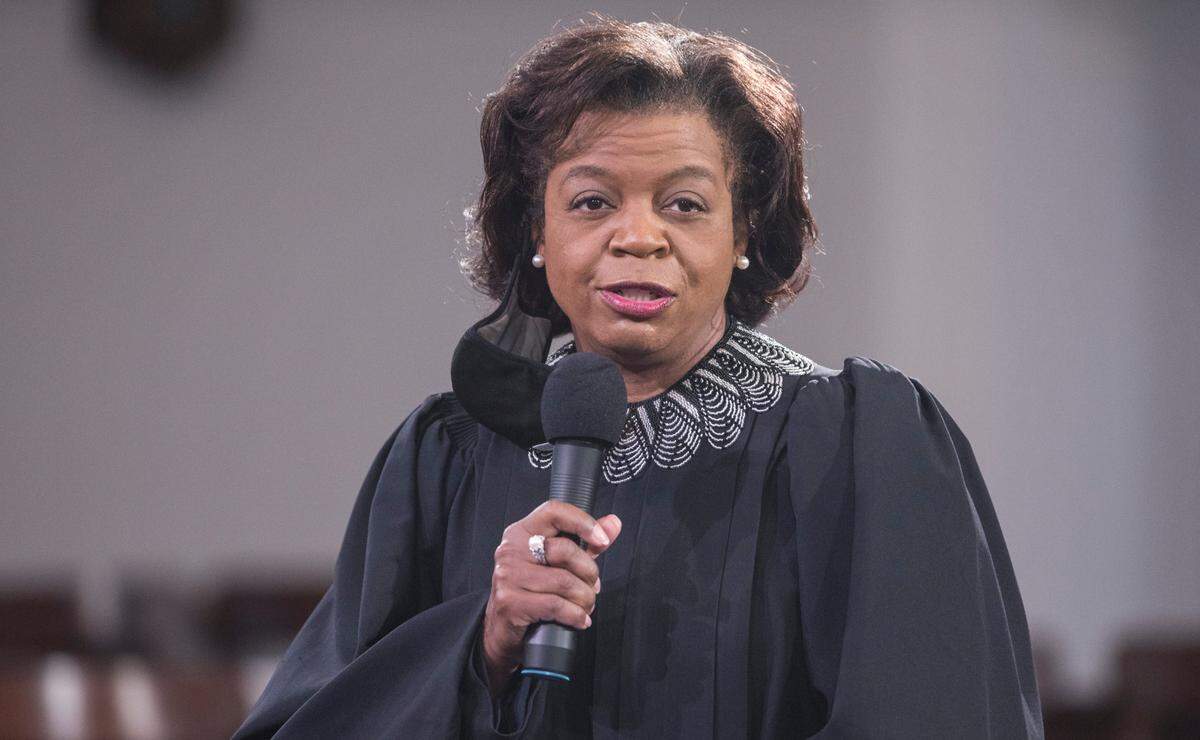
And North Carolina is home to two Black women who are qualified to be on Biden’s list of candidates, state Supreme Court Justice Anita Earls, a Yale Law School graduate who has long supported voting rights, and former state Supreme Court Justice Cheri Beasley, the first Black woman to serve as chief justice of the N.C. Supreme Court and now a Democratic Senate candidate.
In June 2020, Beasley responded boldly to the Black Lives Matter protests that followed the police killing of George Floyd. She said, “These protests are a resounding, national chorus of voices whose lived experiences reinforce the notion that Black people are ostracized, cast out, and dehumanized. Communities are crying out for justice and demanding real, meaningful change.”
Beasley said racial bias extends to the judicial system and the courts must change by expanding the perspectives of those who sit in judgment. “We have to be experts not just in the law, but in equity, equity that recognizes the difficult truths about our shared past,” she said.
The difficulty of making that change has since become apparent. Beasley narrowly lost her bid for another term and within a year of her departure a state appellate court judge used a ruling to deny Beasley’s view of the court system’s flaws. An unlawful search case in which the defendant cited Beasley’s comments ended in acquittal, but Judge Jefferson Griffin used his concurring opinion to reject Beasley’s call for change.
Griffin, a Republican, said there is no bias in how the court system treats Black defendants. “Here, this Court reaches the correct legal outcome regardless of the color of Defendant,” he wrote. “We are fortunate to live in the United States of America where the law is applied the same to all citizens.”
That statement is not about color blindness. It is about blindness to history and to the present.
Fortunately, Biden is committed to naming a justice who, through her experience, can better see the legal system as it is and as it should be.
BEHIND THE STORY
MOREWhat is the Editorial Board?
The Charlotte Observer and Raleigh News & Observer editorial boards combined in 2019 to provide fuller and more diverse North Carolina opinion content to our readers. The editorial board operates independently from the newsrooms in Charlotte and Raleigh and does not influence the work of the reporting and editing staffs. The combined board is led by N.C. Opinion Editor Peter St. Onge, who is joined in Raleigh by deputy Opinion editor Ned Barnett and in Charlotte by deputy Opinion editor Paige Masten. Board members also include Observer editor Rana Cash and News & Observer editor Nicole Stockdale. For questions about the board or our editorials, email pstonge@charlotteobserver.com.
This story was originally published February 1, 2022 at 4:00 AM.