The press should cover Donald Trump more like a Proud Boy than a president
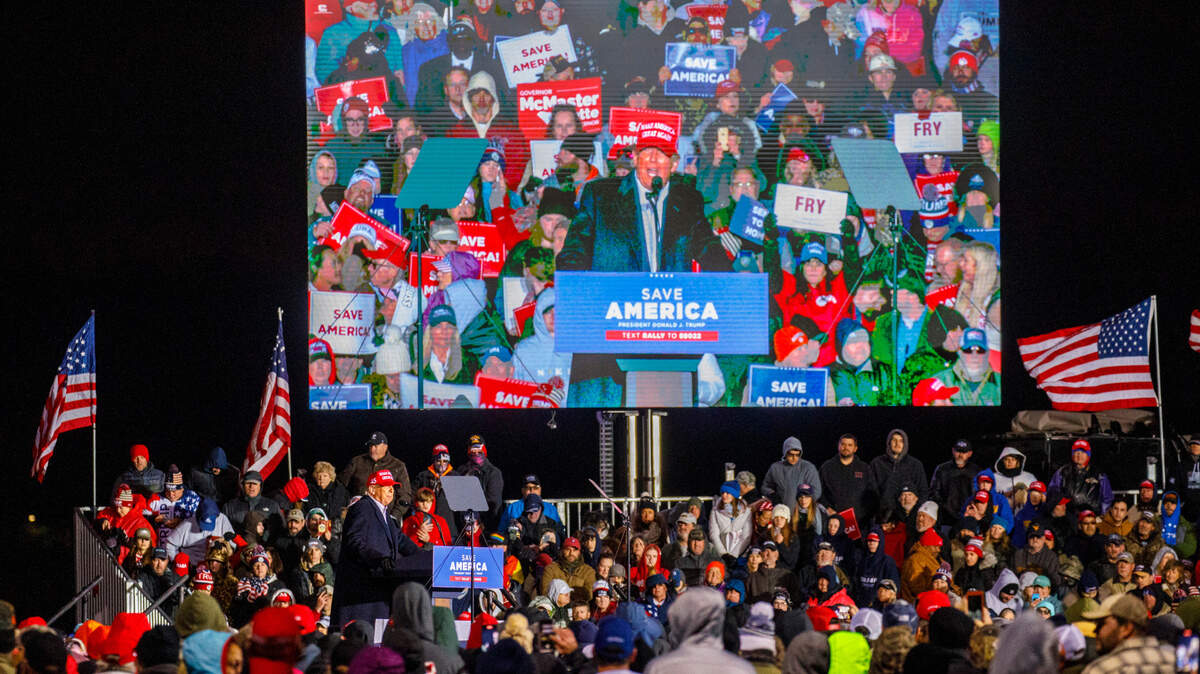
On April 9, former president Donald Trump will visit Selma, NC, for a rally where he’ll campaign for Ted Budd, Bo Hines, and Madison Cawthorn, three of the four North Carolina Republicans he has already endorsed (Virginia Foxx also won his stamp of approval).
Understandably, the preview to his arrival has been part of the local and national news landscape. There will be journalists at his rally to cover what he says and does. But in the last few years, covering the former president has only grown more complicated, even more than it already was.
A Trump visit is newsworthy: he’s a former president, a potential 2024 candidate, and still a major voice in the Republican Party. He’s also someone who tried to overturn a fair election through his supporters. He seems unable to consider the possibility of being wrong about the election and so many things, much less able to admit it.
Before Jan. 6, 2021, the way that journalists covered Trump was more straightforward; he was a presidential candidate, then a president. It doesn’t mean my peers always got it right, but there was a formula by the end of his term. Now? It’s a little more complicated.
We’re in a crucial time where Trump’s actions on January 6 and the years prior could be normalized or forgotten. Treating him as a typical former president instead of a political radical continues this trend.
It may be best for democracy for news outlets to treat him and some of his base as something more akin to extremist groups, like the Proud Boys Trump has been comfortably associating with for years. His visit isn’t like a visit from Barack Obama or George W. Bush, where supporters may be excited but there isn’t the same emotional rawness mixed with misinformation.
There is a formula for reporting on extremist protests as events. You say who’s there, why they’re there, and what happened. You don’t take a side, but there is an understanding that the things being called for, like in Canada’s trucker convoy earlier this year, are not mainstream and aren’t necessarily condoned. The same should happen for Trump events. We shouldn’t treat them like other presidential visits, where for example you share the information on how to get to the event. Acting as if there’s an air of excitement normalizes the disinformation that will come. Reporting on his comments and only debunking the Big Lie is not enough.
Rallies are one of the only ways for Trump to incite his base now. In the days following the insurrection attempt, social media platforms finally had enough. Twitter, Facebook and Instagram kicked Trump off of their platforms after years of disinformation and wrist slaps for a man in a position of power, hellbent on speaking to his base instead of all American people through more formal channels. His supporters know where to find him. He hasn’t been silenced by any means.
We don’t have much history dealing with a disgraced former president, especially one whose supporters don’t think is disgraced at all. When Richard Nixon resigned from office in the wake of Watergate, he was pardoned by President Gerald Ford, wrote a memoir and rarely appeared in the news for about two years before he began traveling internationally and holding small speaking engagements. Nixon, while corrupt, did not hold the power that Trump continues to over the Republican Party’s inner workings and interactions with the right. Trump still has everyone’s ear on the right, from politicians to members of right-wing extremist groups. It’s dangerous for news outlets to continue treating it like just another presidential speaking engagement.
More than a year later, Trump exists in a microcosm that many of us don’t have to interact with directly. We see the occasional statement from his website or hear about the investigation into the insurrection, but we infrequently see his words, in his voice, with random capitalizations and photoshopped images from right-wing pundits. Sometimes, you can forget the last six years.
But then he comes to your town, or a nearby town, for a rally like the ones he’s done so many times before. Suddenly, you’re reminded that his disappearance is not permanent, and his supporters aren’t wavering in their devotion. It isn’t normal. We can’t let it feel that way.
This story was originally published April 7, 2022 at 1:16 PM.