
The toughest task: Making diverse democracies like ours work
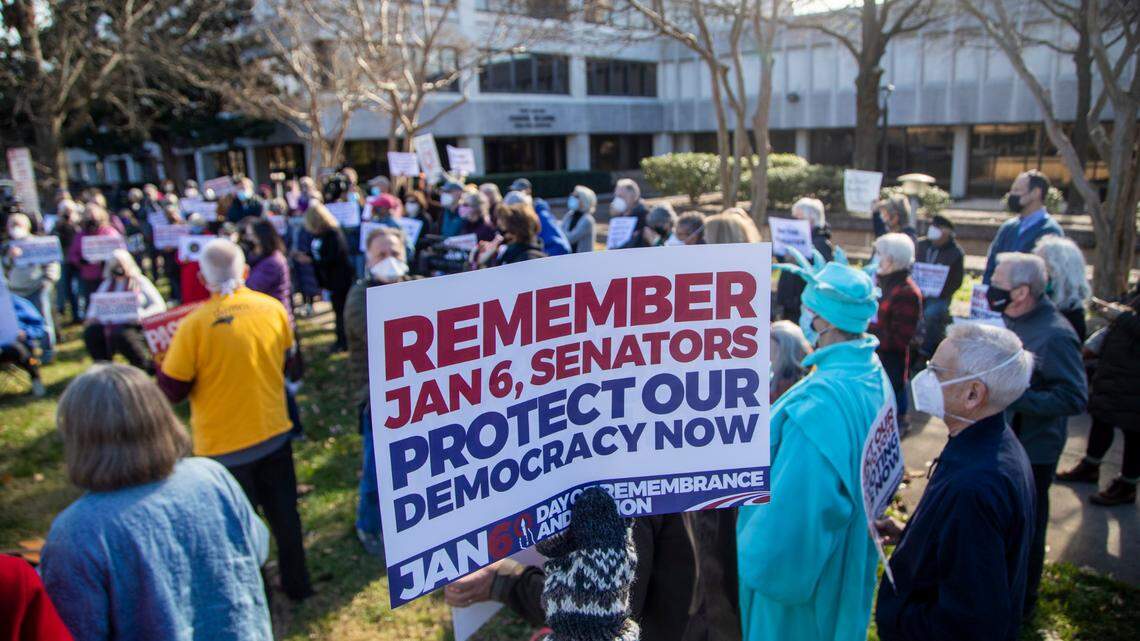
Our fights seem endless. And unyielding. Vaccines, masks, school books, abortion, critical race theory, guns, LGBT rights, religion, police abuse, immigration, climate, taxes, QAnon. Divisions deepen rather than ease. Animosity grows rather than subsides.
And now they’re strung together, like ever-coiling barbed wire, in an increasingly high-stakes political war — gerrymandering, voter suppression, legislative overrides, elector slates, stop the steal, attacks on the capitol. Many grow weary, and demoralized, and scared. The stakes are beyond high. Optimism is beyond low. Trust is nowhere to be found. Leadership is nonexistent.
That’s how it seems to me. At least much of the time.
It’s not an energizing rivalry like Carolina v. Duke might be for some. It’s an exhausting, debilitating and dangerous one. It threatens to do us in.
Yascha Mounk, the German-American political scientist from Johns Hopkins University, sees the horror through a different, more hopeful, lens. In “The Great Experiment: Why Diverse Democracies Fall Apart and How They Can Endure” Mounk writes: “Never in history has a democracy succeeded in being both diverse and equal, treating members of many different ethnic or religious groups fairly, yet that goal is now central to democratic countries around the world.”
When democracies like Germany and the United States were founded, Mounk notes, they were, to a large degree, religiously and ethnically homogenous. The U.S. “has become more diverse, but it doesn’t have a history of treating different groups of citizens equally; one group got the power and influence while other groups were excluded.”
This toughest of tasks has been made the more scorching by stagnant living conditions for middle and working class citizens, grotesque economic inequality, resurgent racism, and social media use that pushes the extremes. And the demographics roll. The Census Bureau predicts the U.S. will be a “majority-minority” country by 2045. “So what we’re trying here is really very hard,” Mounk warns, “and we’ve often failed throughout American history.”
He concludes, though: “We have no choice but to make it work because a brief glance at history will tell you how terrible the alternative is — how violent, how unstable, how unjust the future will be if we fail to make diverse democracies work.”
If this is true, and I think it is, it might help us to realize the essentially unprecedented nature of the work we’re in. And we are, likely, remarkably unprepared, and maybe even remarkably unfit, for the task. But deeply diverse societies often founder; brutalizing the most vulnerable in ways that demolish the humanity of all. A fate no decent one can abide.
And now the United States’, and North Carolina’s defining attestations are put inescapably to the test. Many, apparently, would revolt, insisting on historic privilege rather than long-declared principle; but not all of us, not even most of us. And the mission, it turns out, is of the highest order.
Mounk suggests that in this singular “democratic effort there are bound to be some bumps in the road.” That’s almost too glib for me. It’s stunning to learn that so many of our neighbors are so little attached to the actual American dream.
But Mounk’s diagnosis helps set the mark. And we might ask ourselves, even here in the Tar Heel state, did we think we could be only the heirs of freedom and not its guarantors? That we could claim only liberty’s gift and not its obligation? Haven’t we been warned that democracy is never a final achievement; it is a call to unending struggle, not a perpetually vested birthright. That the arc of moral universe bends toward justice, but only if we ourselves do the bending.
This story was originally published June 10, 2022 at 5:00 AM with the headline "The toughest task: Making diverse democracies like ours work."