
There’s a third B contending in the Beasley-Budd Senate race – billionaires
It used to be that you could measure a candidate’s political strength by how successful they were at getting people to contribute to their campaign.
But Citizens United, super PACs and the rising wealth of the nation’s top 1 percent have changed that. Now a handful of extremely rich people indirectly supporting candidates can offset a multitude of voters who back their candidate with modest contributions.
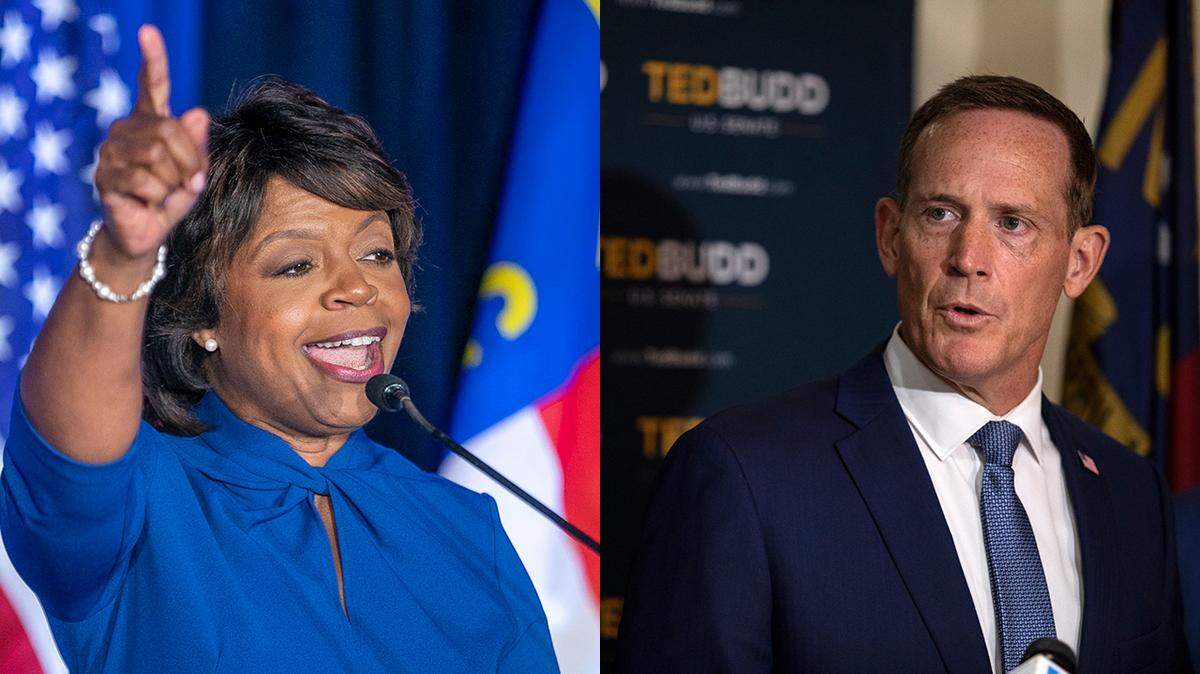
Exhibit A is North Carolina’s U.S. Senate race between Democrat Cheri Beasley and Republican Ted Budd. Beasley has raised nearly three times what Budd has raised, with 90 percent of the contributions to Beasley being $100 or less.
Budd’s fundraising disadvantage has been offset by backing from outside groups. The Senate Leadership Fund, a Republican super PAC, has spent heavily on Budd’s behalf while the Club for Growth Action, a super PAC that favors tax cuts and less business regulation, has spent more than $7 million. Overall, outside spending on ads benefiting Budd or attacking Beasley has swamped outside spending benefiting Beasley or attacking Budd. The gap is $47 million, according to OpenSecrets, a group that tracks money in politics and its effect on elections..
In an October article in Forbes magazine about Budd’s outside money haul, Matt Durot wrote, “In all, 18 billionaires – none from North Carolina – contributed 43% of the money sitting in the Senate Leadership Fund. The group has doled out $29 million, or 16% of its expenditures, to support Budd.”
The advocacy group Americans for Tax Fairness reported last week that “465 billionaires have pumped at least $881 million into the 2022 federal midterm election – 27 times more than billionaires contributed before the disastrous Citizens United Supreme Court decision in 2010.” Meanwhile, the New York Times reported last week that the nation’s top 1 percent of donors, measured by income, has given 38 percent of the total spent in federal races this year.
Asher Hildebrand, a former top aide to Democratic Rep. David Price and now an associate professor at Duke’s Sanford School of Public Policy, said the gulf in outside spending between Budd and Beasley shows that “unaccountable spending by outside groups is increasingly supplanting spending by relatively more accountable candidates and party committees.”
That supplanting is happening quickly. In this midterm election, spending by outside groups has exceeded candidates’ spending in 66 federal races. In 2018, the number was 28.
For Steven Greene, a political science professor at N.C. State University, the growing influence of outside spending is regrettable, but perhaps not reversible. “We want accountability, we want to have transparency, we want to have limits [on contributions],” he said. “But we also want to have free speech and we see spending money to make a political argument as free speech. You might call it an unresolvable tension.”
It needs to be resolved. Allowing a few super rich donors to drown out the voices of ordinary people isn’t democracy, it’s plutocracy. If it continues, there will be more and more campaigns like Budd’s in which a candidate can neglect making broad appeals for contributions and rely instead on a handful of out-of-state billionaires to pay for a barrage of negative ads against his or her opponent.
As Election Day approaches, polls show the Beasley-Budd race is tight and voters are being given a stark choice. But it’s not just a choice between candidates, it’s a choice between two ways of campaigning. One is largely supported by contributors whose donations have limits and whose names are reported. The other is a campaign fueled by huge contributions from wealthy people with national agendas who have little concern for the people their chosen candidate would represent.
For voters who care about democracy, a simple question should decide which Senate candidate is the right choice for North Carolina: If elected, who will they owe?