
Bold ideas could bring the bustle back to Raleigh’s Fayetteville Street
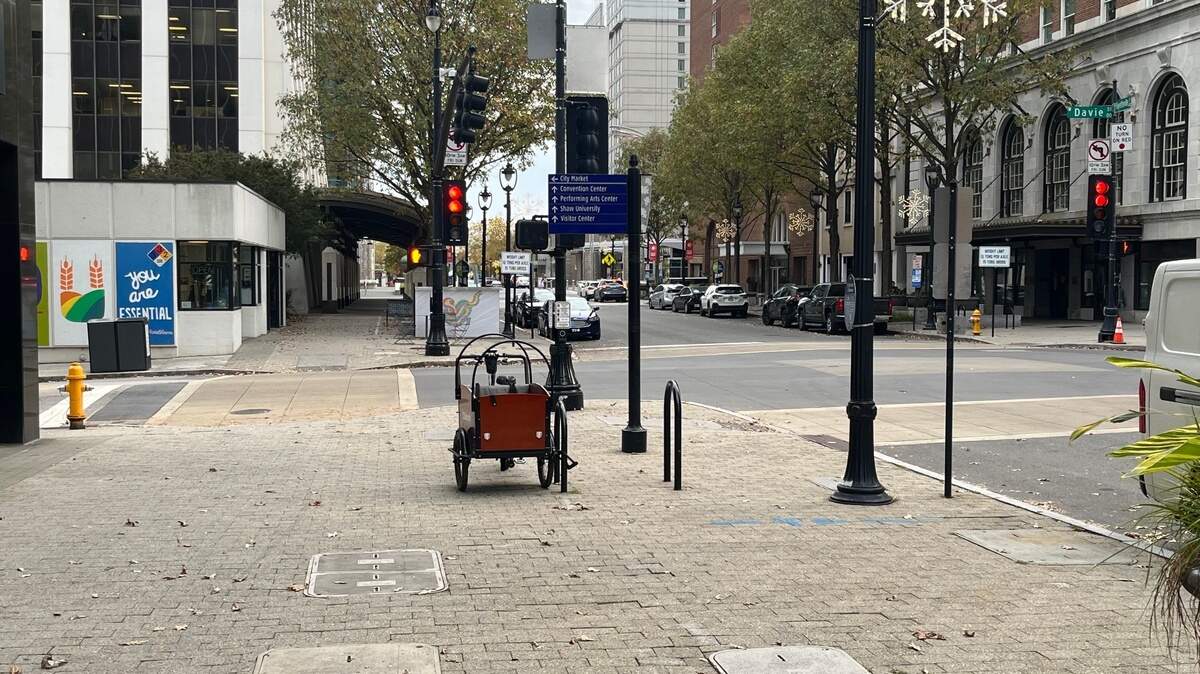
Raleigh’s Fayetteville Street is struggling with long COVID.
The city’s other business and entertainment districts are back to work, even thriving, but Fayetteville Street on a weekday afternoon is a lonesome stretch. A few cars pass and an occasional pedestrian breaks the empty vista.
The owners of Clyde Cooper’s Barbecue, a downtown institution since 1938, darkened the gloom this week by announcing that it will be leaving downtown. The restaurant earns enough from catering to stay open, but the loss of office worker customers and panhandling and crime have made the business untenable downtown.
“It’s not as lively. It’s not as fun,” said co-owner Ashley Jessup, “Downtown used to be the place to be, but it’s not anymore.”
Cooper’s owners may find happiness elsewhere. Jessup said the restaurant has received numerous suggestions that it relocate to North Raleigh, and as far away as Wilson.
It’s also notable that Cooper’s has been challenged by new barbecue restaurants near the Fayetteville Street area. The restaurant’s move may be as much a sign of the city’s broader vitality as it is an indicator of the lack of foot traffic along Cooper’s downtown block.
That glass half full perspective is what sustains Bill King, president and CEO of the Downtown Raleigh Alliance. The business-supported organization is charged with promoting the the Fayetteville Street area as well as the Glenwood Avenue and Warehouse districts.
King is trying to reinvigorate a central business area hollowed by the loss of office workers. First it was the pandemic shutdown. Now it’s a weak return as most businesses go remote or on a hybrid work schedule.
King said a smattering of new businesses are coming to Fayetteville Street or a few blocks in either direction. But it’s not enough. “We’ve seen some things get better,” he told me, “but it’s definitely not where it was or should be.”
The Alliance and the city of Raleigh have applied short-term measures to address less foot traffic and more panhandling and crime in the Fayetteville Street area. More police are present. Security guards are being added. Lighting is being improved.
King hopes the city will pay more attention to the streetscape by replacing the missing grates around trees and getting trash containers off the sidewalks. “These are minor cosmetic things,” he said, but it’s about whether “people feel that this is a place being taken care of or not.”
Such changes will help the revival of Raleigh’s downtown core, but they won’t complete it. For that, King and others are relying on dramatic thinking about what Fayetteville Street and its adjoining blocks should become in an era without abundant downtown office workers.
Mitch Silver, Raleigh’s former planning director who is working in Raleigh, said the solution may be to turn Fayetteville Street into “Eat Street.”
Silver would like to see an abundance of restaurants along the street, with many featuring outdoor dining. “Create a restaurant row,” he said. “In other cities, that seems to work. People want to be where other people are.”
Mitchell concedes that retrofitting office and bank buildings to be restaurants would be expensive, but such work could restore a sense of energy.
King is ready to hear Silver’s ideas and those of others. A consultant is gathering ideas on how to reimagine Fayetteville Street. The report will be presented to the City Council in early 2024.
“What is the next big idea for downtown?” King said. ”We’re looking at that.”
It’s disheartening to walk along Fayetteville Street and see it little changed from the deepest days of COVID. But it’s intriguing that King and others are thinking beyond the moment to envision a vibrant future.
Raleigh’s central downtown, long a hub for office workers, must become something else.
The city should think big. Fayetteville Street’s next incarnation should be built on bold imagination.