
Former GOP governor: The Trumpnado was nothing like my first weeks in office | Opinion
Beginning a first term as governor of a state is not on a scale faced by a president, but big enough for most of us. It involves two months of long days, from election to inauguration, concentrated on assembling a cabinet of superstars plus a capable, trustworthy office staff. There’s a lot of help from the political side, both the campaign and the state party leaders. That’s complex but irreplaceable, as were a dozen victory celebrations.
The first week in office starts with the first day. We didn’t have technology in 1984 to imagine a “virtual” inauguration. Everybody froze outdoors with speeches, entertainments and a parade of school bands plus military units and an artillery salute. Several balls that evening required Dottie and me to learn to waltz.
There was no legislative oversight like the president’s nominees facing hearing and possible disapproval, so all my appointees took oaths of office on the first official day.
There was little time for political posturing that first week, as I was tightly scheduled for moving our legislative program, guided by my brother Joe Martin. I did run into some resistance from the General Assembly, which was dominated by the opposition party (yes, Democrats!), but we soon had enough connections to smooth the way.
The first week of the second Trump administration ran up the score like no other in history. He wasted no time in attacking his primary campaign targets: closing the border and swiftly expelling violent immigrant criminals; addressing conflict in Ukraine and Gaza; canceling President Biden’s war on oil drilling (which Trump blames for inflation); reminding foreign leaders and business executives that he means business with his tariff threats. Here’s hoping he shows mercy and due process for peaceful immigrants.
Somewhat surprisingly, Trump also staked out claims that his campaign barely hinted. The strongest applause line in his mercifully short, 29-minute inaugural address was, “There (will be) only two genders, male and female.”
Four years of Democrats’ abuse of ideals like diversity, equity and inclusion, or DEI, by shaming and blaming straight, white or male Americans as guilty “oppressors” in order to advance other worthies in government, school and business created distrust and division. Trump wasted no time dismantling it.
A barrage of new issues that never registered on the campaign trail stunned us only weeks before Trump’s inauguration. Those who scrutinized every word either didn’t understand what he had in mind for Greenland (what!), Canadian statehood (what!), the Gulf of America (what!) or didn’t tell us. What was that all about? Unparalleled gruff showmanship? Distractions so we, Congress and the courts couldn’t keep up and lose focus? Or positioning his “Art of the Deal” style of negotiating?
Some of it seems designed as a spectacle, perhaps to get us talking about issues we hadn’t examined. Birthright citizenship is ingrained in the Constitution as confirmed by the Supreme Court back in 1898. Do we really think the Founders anticipated air transportation speeding people into the USA just in time for childbirth? Are we willing to amend the Constitution to stop this abuse? Let’s debate it respectfully.
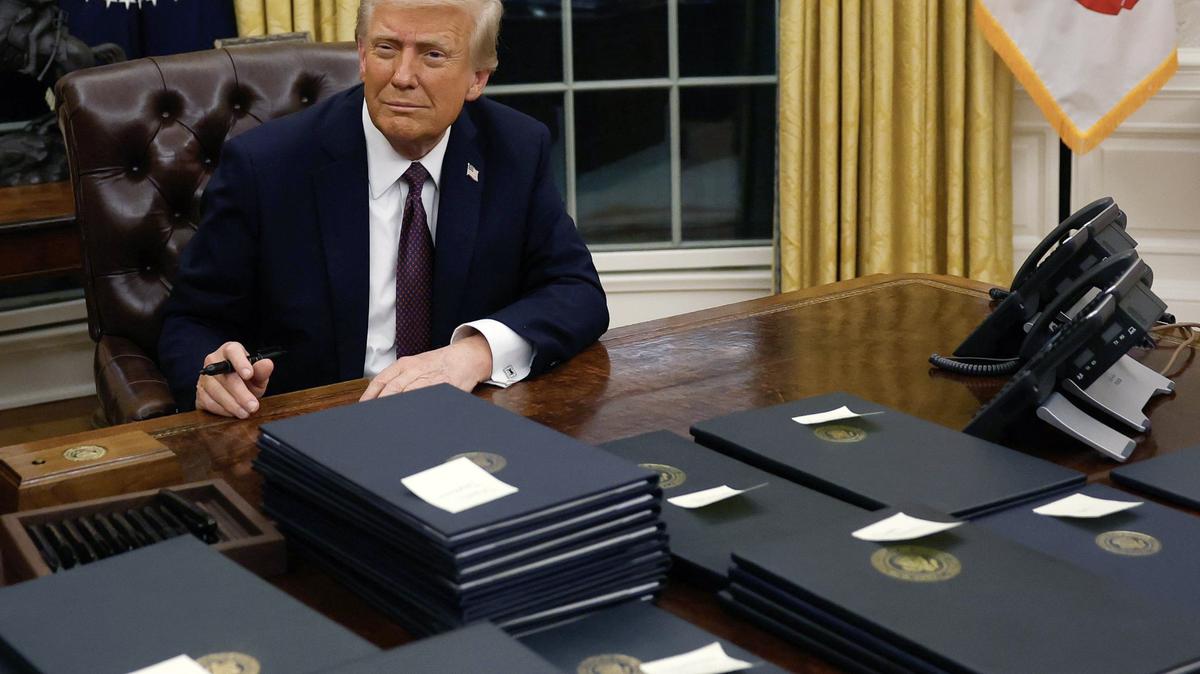
What President Trump has done in one week was highlighted by his torrent of executive orders and directives, some good, some not so much, and the way they connected to his Cabinet appointments. The whirlwind launch of this administration is likely to set the standard for his successors, especially given the polarization separating our two major political parties. If elections swing from far left to far right, back and forth like a pendulum, Trump’s ferocious style may become the pattern for overthrowing all the predecessors’ policies, even if a close margin of victory depended on very few issues. Is this healthy for our democratic republic?
Such divisive partisanship might be healed by creating a third party, devoted to more moderate views and goals, assembled from the grass roots of those who in recent years withdrew from both major parties and registered “non-affiliated.”