
‘Remote learning,’ instead of snow days, is a disservice to NC kids and parents | Opinion
Remote school is not equivalent to in-person school. This was painfully obvious to any parent trying to run an ad-hoc classroom from their kitchen counter during the pandemic, and it has been borne out by reams of data in the years since. North Carolina students lost the equivalent of half a year in reading instruction from 2019 to 2022, and even more than that in math, with the sharpest declines concentrated among the poorest students.
Yet, when snow loomed in the forecast this week, school leaders across North Carolina — including the state’s second-largest district in Charlotte-Mecklenburg and the tiny Chapel Hill-Carrboro City Schools, where my 2nd-grader is enrolled — were quick to announce “remote learning days.”
By sending older students online and younger students to worksheet packets and reading assignments, district leaders avoid having to schedule make-up days. A snow day is lost time, but a “remote learning day” counts toward the state-mandated number of instructional hours, and districts are allowed to use up to five of them in any given academic year.
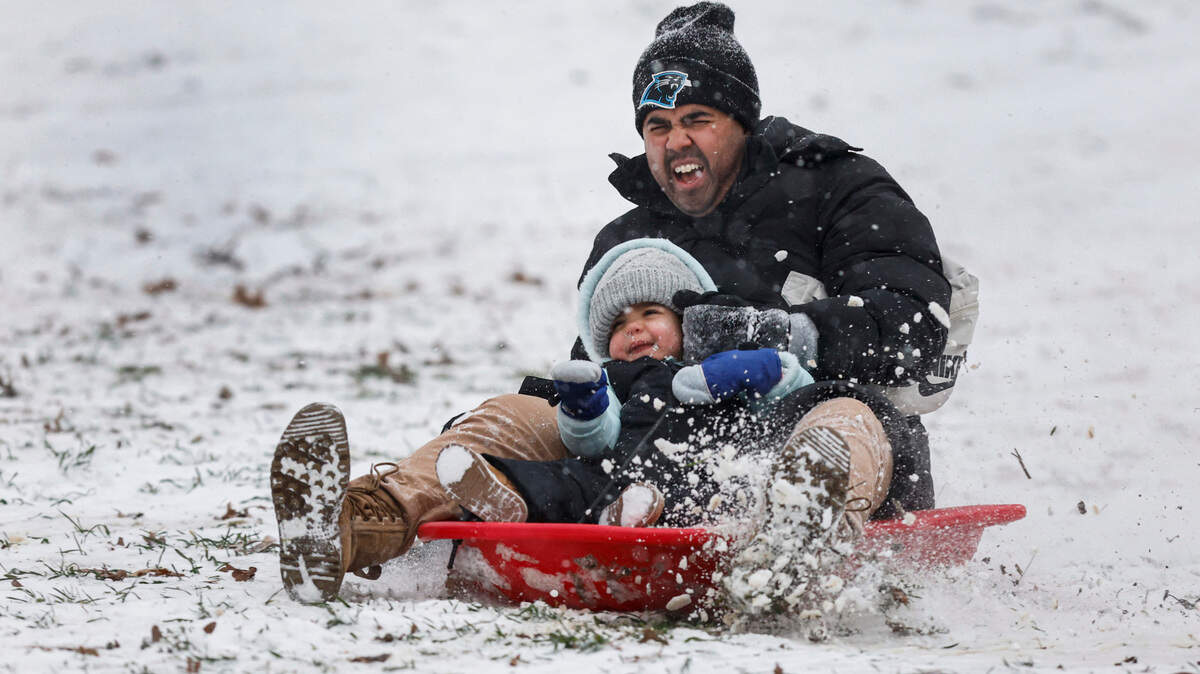
They shouldn’t be. I am typing this from my kitchen counter, where I can look out on a street full of school-age moppets devoting their learning hours to climatology and sledding physics. My little brood has stayed busy making snow cream, constructing blanket forts with the neighbor kids and watching a highly educational Netflix show called Is It Cake?
This is the right and proper use of a snow day, and a society that demands its children sit in front of school-issued iPads while there’s freshly fallen snow on the ground is a society that has lost touch with the purpose of childhood. I appreciate that my daughter’s second-grade teacher sent home a thoughtful collection of assignments, and made clear that she’d be available by text and email if we had questions, but shirking faux-school for a very real snowball fight was the right call.
Declaring a full snow day — and properly making it up later, as Wake County is doing — also avoids the maddening unfairness of asking working parents to supervise academic assignments. My wife and I are lucky that we can work from home when we need to, trading off kid duty between the two of us and among similarly fortunate neighbors.
But there are a great many parents who don’t have that luxury, which is why learning losses during the pandemic were so heavily concentrated among the poorest students. Achievement gaps between well-off and low-income students are at their highest levels in a generation thanks to our prolonged national experiment with remote school. If a core goal of public education is to help promote equal opportunity in a very unequal world, remote learning does the opposite.
Remote learning dents the basic credibility of school for parents and kids alike. Children are perceptive little beings, and when you tell them that a day of Zoom lectures or a packet of homework assignments is a fair substitute for a school day, they begin to suspect we aren’t that serious about the whole enterprise.
Done right, a school day is an immensely rich thing, demanding that you pull yourself together, get out the door on time, talk and work alongside other humans and focus your attention on worthy things for long stretches. If it were just about the content, we could all be YouTube scholars and save a lot of capital expense. School is fundamentally a social technology, a machine for creating habits and relationships. It’s where you learn to be a person in the wider world, to puzzle through the glorious mystery of other people and carve out a public identity for the first time.
You can’t do that in your pajamas, staring at a screen, no matter what the tech hucksters promise. I respect school too much to pretend like it can happen from the sofa, so into the snow we go.