
Is Trump about to trigger a constitutional crisis? A UNC legal scholar’s alarming answer | Opinion
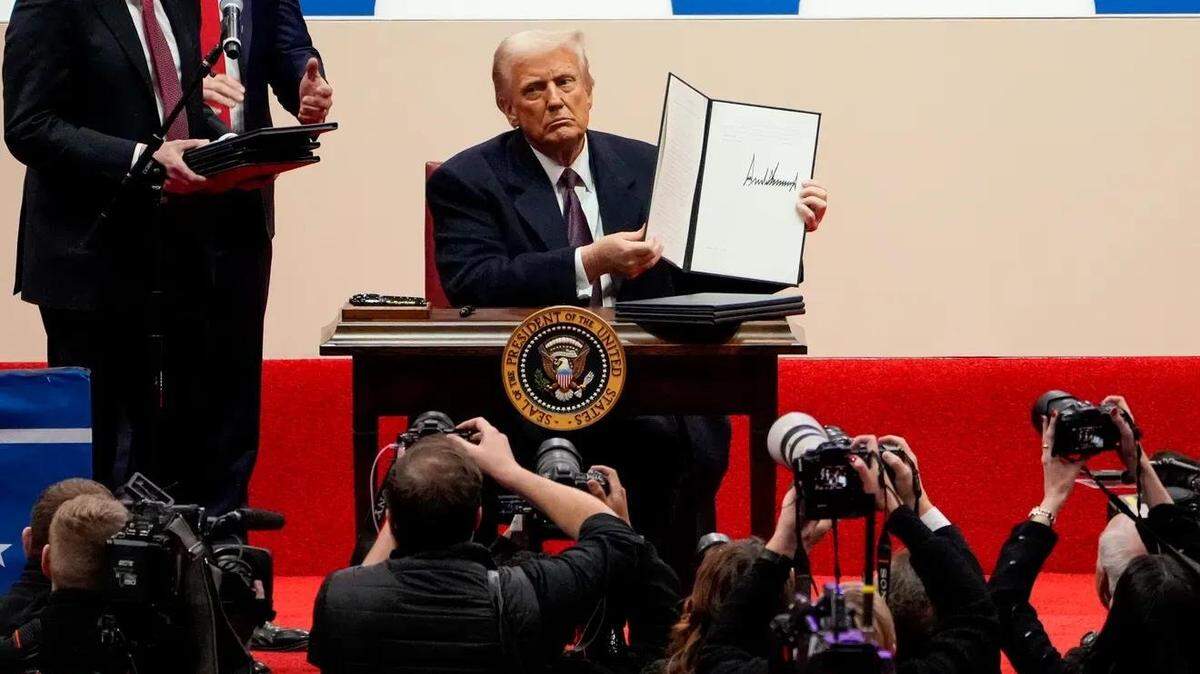
President Donald Trump is on a collision course with the Constitution.
The administration’s laying off of thousands of federal employees has triggered dozens of lawsuits and injunctions. Trump’s move to abolish the Department of Education and to end birthright citizenship have raised fundamental constitutional issues. Over the weekend, the administration appeared to defy a federal judge’s order halting immediate deportations after Trump claimed sweeping powers under an old and rarely used law — the Alien Enemies Act of 1798.
Amid this turmoil, I asked Michael Gerhardt, a UNC-Chapel Hill law professor and one of the nation’s leading scholars on the Constitution and the limits on presidential power, about how close Trump is to breaking the law. Gerhardt has testified in four presidential impeachment proceedings and served as special council to presiding officer Sen. Patrick Leahy in Trump’s second impeachment trial in 2021.
Suddenly the judicial branch is the last line of defense against a president who is willing to test the limits – or test if there are limits – to his power. Gerhardt said the framers intended the judicial branch to play such a role, but the pace and range of issues Trump is raising are straining the ability of courts to hold the line.
“Presidents have tested the limits of their powers throughout American history, but none in so many ways and in such a short span as Trump,” Gerhardt said. “Trump has defied authority in many ways, testing his authority to dismiss people in violation of federal law, asserting the end of birthright citizenship, unilaterally withdrawing from various international agreements and organizations, and refusing to honor congressional expenditures, which had already been legally authorized.”
Trump, after being impeached twice in his first term, has already committed acts that would support removing him from office, Gerhardt said.
“I think Trump has done numerous things which are impeachable,” he said. “These include but are not limited to his disregard of the birthright citizenship clause of the Fourteenth Amendment and his multiple violations of the First Amendment and his threats against the judiciary and institutions of higher education. He has also unilaterally disregarded funding mandates authorized by Congress through the proper channels and thus has usurped its authority.”
Of course, impeachment is almost a moot issue given the willingness of the Republican majorities in the House and the Senate to applaud rather than condemn Trump’s actions, even when they come at the expense of Congress. What’s concerning, Gerhardt said, is whether Trump’s judicial appointments in his first term have also weakened the judicial branch’s willingness to challenge him.
“Trump’s objective has been to stack the judiciary with functionaries who will sign off on anything he has done,” he said.
The compliance of congressional Republicans and the erosion of judicial independence has invited a constitutional crisis. Gerhardt said that occurs when “the Constitution does not clearly provide a solution to a conflict between the branches or between the federal and state governments.”
And how close are we to a constitutional crisis?
“We are already there, I think, with Trump’s declaration that he can save America by defying the law,” Gerhardt said. “That is the pronouncement of a dictator.”
What’s more troubling than the crisis itself, Gerhardt said, is that the nation appears to have lost the means for resolving it in a way that complies with the Constitution.
“Usually, at least one side is beaten down — for example, in the Civil War — or two of the three branches of the federal government join together to oppose the transgressions of the third,” he said. “It could also be resolved through the use of a constitutional mechanism such as impeachment, but impeachment is no longer an effective check against a miscreant president whose supporters in the Senate oppose his impeachment.”
Trump’s apparent defiance on Saturday of a federal judge’s order to halt the deportation of two planeloads of Venezuelan migrants has brought Trump into an open confrontation with the court, Gerhardt said.
“It shows a complete disregard for the rule of law,” he said. “In this country, the law, not any official, is king.”
This story was originally published March 18, 2025 at 12:17 PM.