
Raleigh’s Gipson Play Plaza must recognize troubled history of site | Opinion
The new Gipson Play Plaza, a play area for children and families that recently opened near the entrance to Dix Park in Raleigh, does so much good for local families. Its driving feature is access for all; the designers considered physical accessibility when planning parking areas, paths around and through the playground, playground structures and facilities. The park also welcomes service animals.
Yet as researchers of and advocates for the histories of care for people with stigmatized mental and physical statuses in the United States, we call attention to the significance of the grounds on which the plaza sits. For 156 years, it was part of a larger site of exclusion and confinement for people with intellectual as well as physical disabilities, mental illnesses, substance abuse disorders and other challenges: Dorothea Dix Hospital. Before that, this land was part of a 5,000-acre plantation that enslaved up to 90 Black people.
This place that is now designed for care and inclusion carries a significant legacy that needs to be honored and remembered. In a time when much of United States history is being rewritten and erased, it is especially important that we attend to the stories of the people whose lives have always been among our most vulnerable. Just a half mile from the plaza rest the remains of hundreds, perhaps thousands, of individuals who lived the final years of their lives on these grounds. For many of those individuals, the hospital became the home they needed, while for others, it was a place of anguish and pain. The history of Dix Hospital — like its sisters in Goldsboro, Morganton and across the U.S. — is a complex one, marked by continual underfunding and overcrowding.
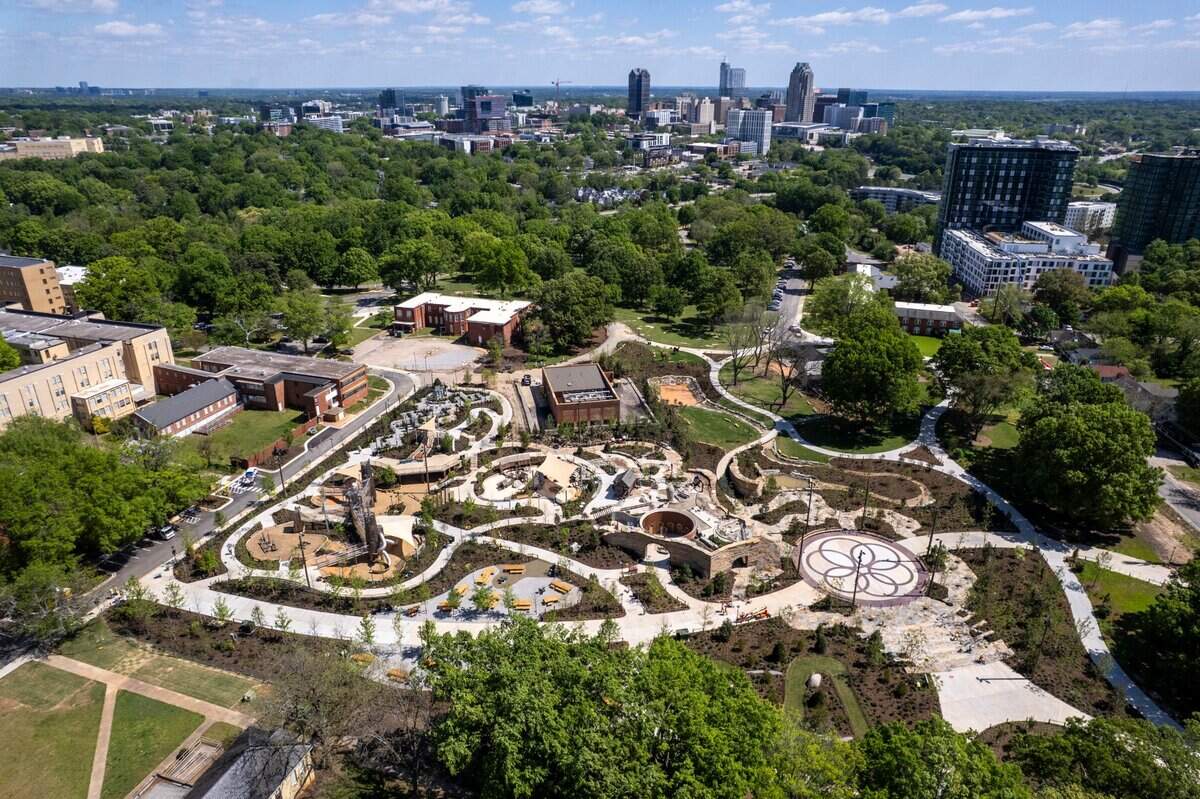
Nineteenth- and 20th-century hospital buildings, including the “House of Many Porches,” that carry this complex history of care and confinement still stand watch over the Gipson Play Plaza. This site is not alone: it is part of a network of such projects around the U.S. that are repurposing their decommissioned psychiatric hospitals: culturally, and sometimes physically, erasing these histories. Columbia, SC’s, BullStreet District has appropriated the buildings of the South Carolina State Hospital as “a new destination for innovators, entrepreneurs and companies to create and thrive.” The Richardson Hotel in Buffalo, NY, is billed first and foremost as a National Historic Landmark featuring the landscape designs of Frederick Law Olmsted. The websites for these ventures include simplified, cursory histories; the physical environs show little effort to provide historical contextualization and permanent memorialization.
Even as such spaces can offer important benefits to local communities, a lack of care toward their histories limits our understanding of how the past impacts us today. We are fortunate that Dix Park’s website, and the site itself, does attend to history in various forms, and we simply want to encourage a more thoughtful process of continuing to incorporate that history into the narrative of each new and exciting development in the park.
To present the story of the Gipson Play Plaza with no mention of the turbulent history is a significant oversight, however unintentional it might be. Erasing history when it is difficult or inconvenient means we cannot learn from it; the past is never irrelevant. As Dix Park continues to transform a site with a troubling history into a space of recreation and inclusion, we do a disservice to ourselves and to the people who lived there, to its present-day manifestations and to citizens who want to know the truth if we do not continually attend to the past.
This story was originally published June 17, 2025 at 5:00 AM.