
Judge says North Carolina has moved past racial bias in its electoral politics. Black leaders disagree | Opinion
AI-generated summary reviewed by our newsroom.
- Judge Dever ruled racial bias no longer affects North Carolina elections.
- Black leaders and civil groups dispute the ruling and cite persistent gerrymandering.
- Case targets Districts 1 and 2; contorted maps split Black counties and empower GOP.
As redistricting cases go, it seemed a minor one, except the final ruling produced this major news: Racial bias no longer affects North Carolina elections.
At least that’s the startling conclusion delivered by U.S. District Judge James Dever.
The case, Pierce v. North Carolina State Board of Elections, involved a complaint that state Senate Districts 1 and 2 in the northeastern part of the state were illegally drawn to deprive Black voters of a political voice.
Dever, an appointee of former President George W. Bush, ruled in favor of keeping the districts unchanged because he said, well, North Carolina has changed.
“It is not 1965 or 1982 in North Carolina. It is 2025,” the judge wrote. “Due in part to societal progress on race and due in part to the [Voting Rights Act], North Carolina is a very different state politically and socially than it was in 1965 or 1982. Black voters in northeast North Carolina and throughout North Carolina have elected candidates of their choice (both white and black) with remarkable frequency and success for decades.”
Dever noted that many Black officeholders, including two who testified at the trial, House Minority Leader Robert Reives (D-Chatham) and state Sen. Dan Blue (D-Wake), represent districts that are majority white. The judge also observed that the percentage of Black lawmakers in the General Assembly matches the percentage of Black people in North Carolina’s population – 22%.
Dever wrote that, “[T]he success of minority-preferred candidates in crossover districts supports a finding that legally significant racially polarized voting does not exist in North Carolina, including in northeast North Carolina.”
But statewide numbers don’t reflect what is actually happening in individual districts. Majority white urban districts may regularly elect Black candidates, but the old patterns of racial polarization persist in some rural or suburban districts.
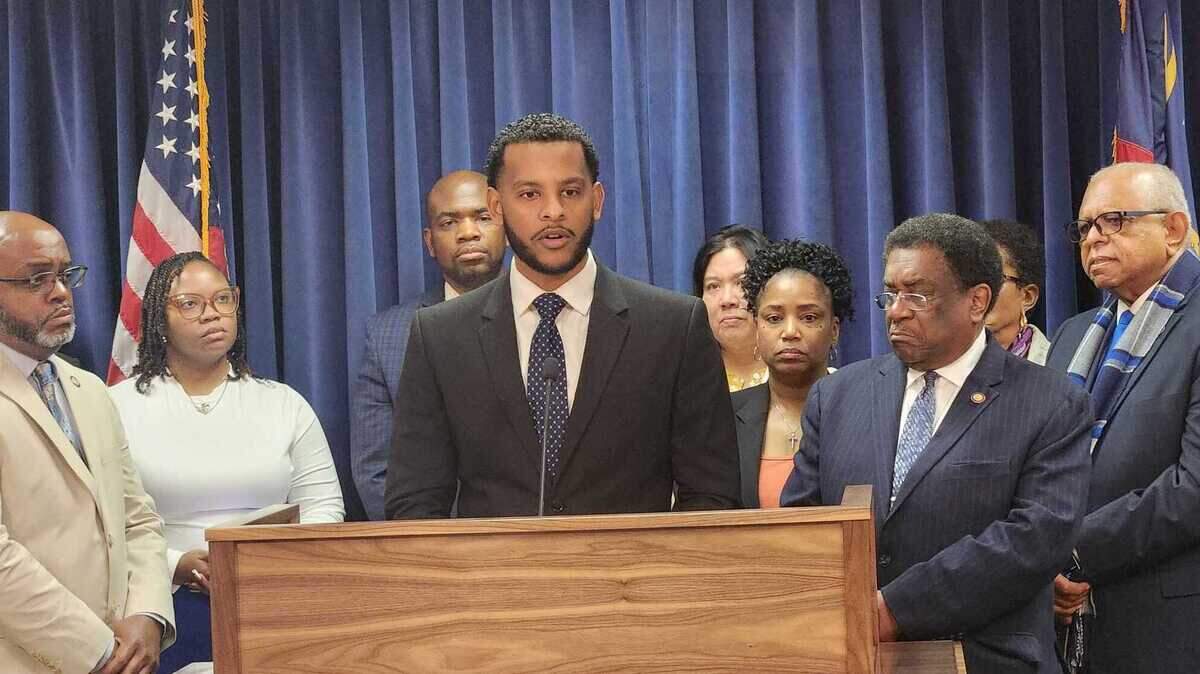
Reives said in a statement that “the judge got it wrong.” While voting strictly along racial lines is not an issue in his district, it is a reality elsewhere, he said.
“Racially polarized voting still exists in parts of eastern North Carolina,” he said. “That’s been confirmed by studies that show Black voters in those parts struggle to elect candidates of their choosing and it’s what I’ve found to be true in working with candidates in that area.”
Black elected officials have made great advances in North Carolina, said Blue, a longtime leader in the General Assembly, but there can still be a suppression of Black voting power. “You’re measuring the wrong thing if you just measure the numbers,” he said. “You have to measure how effective we have been in making sure all voices are heard.”
All voices are clearly not being heard in North Carolina. All 38 Black members of the 170-member General Assembly are Democrats and in the minority. Of the 101 Republican lawmakers, almost all are white except for a Hispanic, an Asian-American and. an American Indian. Republicans determine what legislation passes. Black legislative candidates have been elected, but they remain effectively powerless.
That disenfranchisement – largely the result of gerrymandering – is clear in the challenge to state Senate Districts 1 and 2. The districts split heavily Black counties in the northeast region known as the “Black Belt” and combined them with heavily white counties. Both districts were won by white, Republican senators.
In District 2, the contorted shape drawn by Republican state lawmakers is extreme. The district stretches from Beaufort on the coast to Warrenton near the Virginia border – a distance of some 170 miles. Significantly, the GOP senator elected in this convoluted district provides the number needed — 30 — to override a veto in the upper chamber.
Bob Phillips, the executive director Common Cause North Carolina, has been involved in legal challenges to racial discrimination in election laws and the partisan drawing of election districts. His group is part of a federal case in which Common Cause, the NAACP and individual Black voters allege that some of the state’s legislative and congressional districts are illegally gerrymandered along racial lines.
Phillips said progress by Black candidates in parts of the state doesn’t mean bias against Black voters is absent across the state.
“It’s not apples to apples,” he said. “What happens in one part of the state doesn’t mean it happens everywhere else. We are a diverse state and it reflects differently in voting patterns.”
A ruling in the NAACP case is expected this year and Dever’s ruling will be appealed. But until then, North Carolina has been declared free of efforts to suppress the political power of Black voters.
But two white Republican state senators representing the “Black Belt” and a dearth of Black lawmakers in the legislative majority says that isn’t so.
Associate opinion editor Ned Barnett can be reached 919-404-7583, or nbarnett@newsobserver.com