
As the ocean claims Outer Banks houses, it’s time to retreat from our beaches | Opinion
AI-generated summary reviewed by our newsroom.
- Fifteen Outer Banks homes collapsed since mid-September, prompting retreat.
- Beach nourishment costs millions and only delays erosion, not permanent protection.
- Experts urge buyouts, insurance reform and legal limits on hard coastal structures.
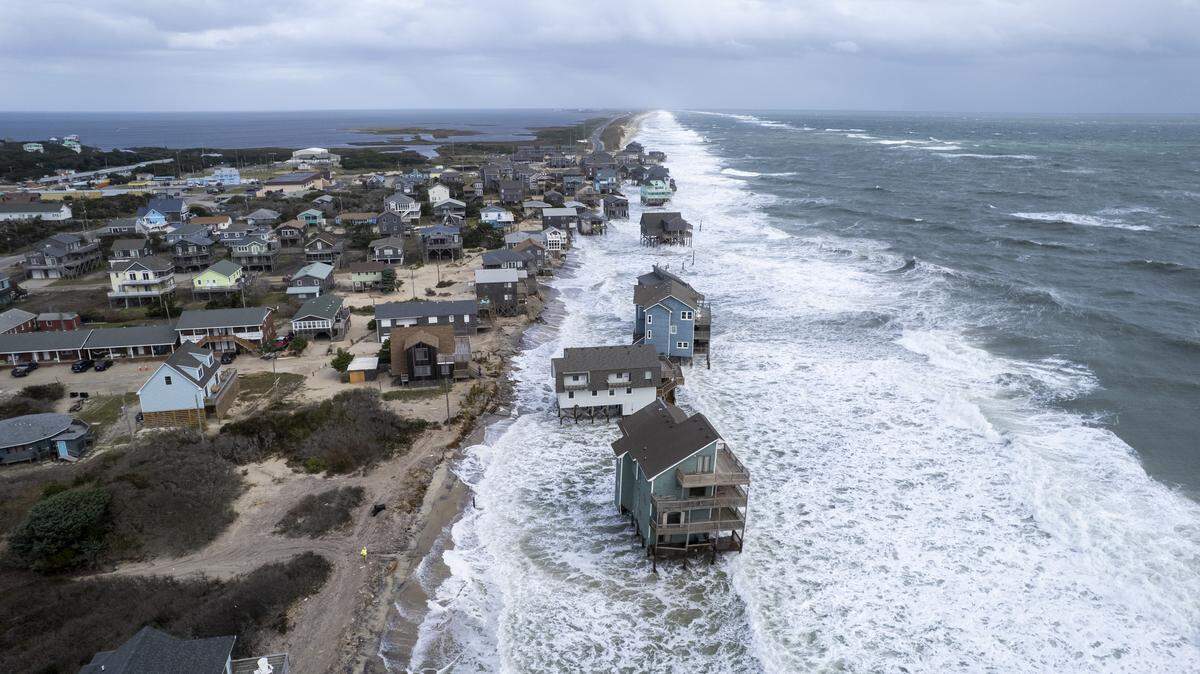
As Outer Banks houses on stilts waver and collapse into the ocean – 15 have fallen since mid-September – it looks like climate change has reached a literal tipping point.
But scientists say the spectacle is less about warming oceans and rising sea levels and more about how humans are responding to the forces of nature.
Two prominent coastal geologists, the late Orrin Pilkey of Duke, and Stan Riggs, now a retired East Carolina University professor, argued in books and interviews that the ocean cannot not be held back. They urged development to retreat from the beach.
But Outer Banks communities such as Buxton, which saw four homes collapse in a single day late October, have instead opted to pay for multimillion dollar beach nourishment projects, even as the new sand is swept away after only a few years.
I asked A. Brad Murray, a Duke professor who studies coastal change, what Pilkey would think of the parade of homes toppling into the ocean. Murray declined to speculate on what his former colleague and friend would say, but he said events are certainly proving Pilkey correct.
“The fundamental thing, as Orrin was really effective in pointing out, is that when you build a community and expect it to stay in one place but you do that on a landscape that tends to not stay in one place, it leads to challenges,” Murray said. Beach nourishment is one way to keep the shoreline in place, Murray said, but “it takes a whole lot of resources.”
Efforts to stop erosion ultimately make the Outer Banks more vulnerable, Murray said. The barrier islands exist, he said, because when the ocean washes over them, sand is deposited, adding height and width to the islands. When that overwash is blocked by man-made dunes or other barriers to protect beachfront homes and Highway 12 – the islands lose height and width.
“In the longer term,” he said, “the more effective we are at preventing coastal hazards, the faster the barrier landscape disappears.”
Reide Corbett, dean of East Carolina University Integrated Coastal Programs and executive director of the Coastal Studies Institute, said pumping sand to expand beaches gives beachfront homeowners “a false sense of security.” Some of the homes that have fallen into the ocean, he said, were purchased within the last five years.
Corbett said beaches at Buxton, Rodanthe and other points on the Outer Banks are eroding at an average of 10 to 15 feet per year. Putting sand back on the beaches buys time, he said, but it doesn’t stop the ocean’s southern flowing current from scraping that sand away.
“People didn’t want to listen to Riggs and Pilkey and here we are,” he said. “The science hasn’t changed, the erosion rates haven’t changed, but we’ve been sort of ignoring that and using the mitigation of nourishment to just put it on the back burner.”
Dare County spent $18.1 million in 2022 to nourish its beach and will spend more in 2026. Corbett said that money might be better spent buying out or moving oceanfront homes.
The losing fight against the ocean is creating pressure to reconsider a 2003 state law barring groins, jetties and seawall along the barrier islands. The hard structures can accelerate erosion down the beach.
“There are people who want to rip that law down and that is scary to me. There’s plenty of science behind the reason that law was finally passed,” Corbett said. “A concern I have as a scientist is that emotion will get the most of us and we’ll start making bad policies because of high emotion.”
Meanwhile, there is a need for a change in federal flood insurance that doesn’t pay for an uninhabitable home on the water’s edge until it falls in and sends dangerous debris into the water. U.S. Rep. Greg Murphy, R-3rd, has co-sponsored a bill that would allow the insurance to pay for the removal or demolishment of houses before they collapse into the water.
That could be the beginning of moving back not from nature, but with it.
Associate opinion editor Ned Barnett can be reached at 919-404-7583, or nbarnett@newsobserver.com
This story was originally published November 3, 2025 at 5:00 AM.