
Heated hearing shows why NC public schools are losing students — and allies | Opinion
Wednesday’s NC House oversight hearing with Chapel Hill-Carrboro City Schools leaders was anything but gentle.
Lawmakers hauled in the superintendent and board chairman George Griffin after a video surfaced of Griffin bragging about defying the Parents’ Bill of Rights. That’s the state law that requires schools to notify parents before changing a child’s name or pronouns and sets limits on gender-identity lessons in the early grades.
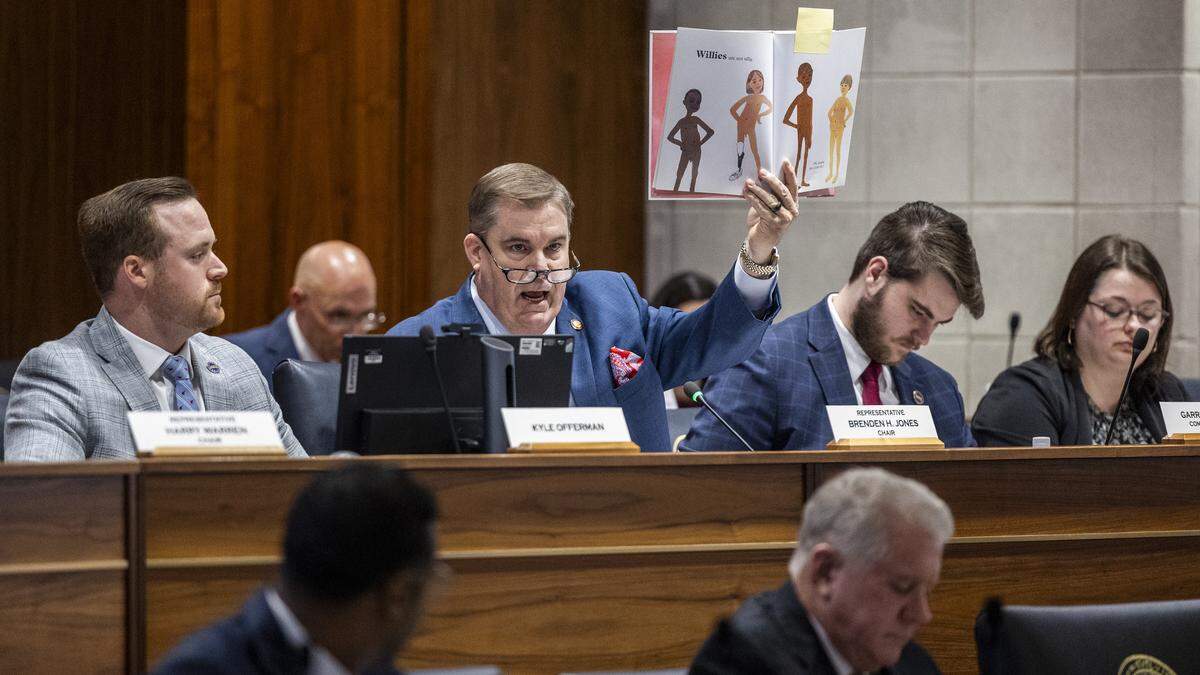
At one point, Rep. Brenden Jones held up a children’s book called “Santa’s Husband.” It’s about exactly what you think it’s about, and had reportedly been read to Chapel Hill second-graders. Jones demanded of Superintendent Rodney Trice: “Is this approved? Is this what you’re telling the children to read? Is this OK in your guidance?”
Trice stumbled through an answer.
“You’re the superintendent. You’re not aware of what’s going on in your school system?” Jones shot back. “It’s trash,” he said, and flung the book to the floor. “That’s what good that is.”
The book slam is what everyone will remember. But underneath the shouting and sound bites, the Chapel Hill–Carrboro hearing was about something more basic and more corrosive: North Carolina is running a trust deficit with its public schools. And it’s getting worse.
Republicans and public schools
Over the past five years, 102 of North Carolina’s 115 school districts have lost students, and in many places the slide has continued even after COVID.
Chapel Hill-Carrboro’s enrollment is down 13% from its pre-COVID peak. Charlotte-Mecklenburg Schools is at its lowest total in 15 years. Even Wake County slipped in the new 2025–26 numbers.
Big-city superintendents have started to latch on to “declining birth rates” as the reason, and in some rural communities, that’s part of the story. But in fast-growing places like Wake, Mecklenburg and Orange, families aren’t disappearing. They’re choosing something else.
Democrats will look at those numbers and say the culprit is Republican hostility to public schools. That’s not quite right either. Yes, the General Assembly has focused on expanding school choice, but that hasn’t meant ignoring public schools. Republicans spent much of the last decade pushing teacher pay steadily higher.
It is fair to say, though, that not everyone in the Republican caucus believes the public school system can be saved in its current form.
Some still want to invest, raise pay and strengthen neighborhood schools. Others look at districts like Chapel Hill-Carrboro openly defying state law and talking down to parents, and conclude that the system isn’t interested in being fixed.
‘It does not make my job easy’
During the hearing, Rep. Mike Schietzelt tried to put words to what lawmakers are feeling.
“We have to do something to help our public schools, and if you look at the House budget, we’re trying,” the Wake County Republican said. “It makes it really difficult for us to do our job when the leaders of these school districts can’t come in here and even give us a straightforward answer to straightforward questions.”
After the hearing, I called Schietzelt to hear more. We’ve talked before about education, especially his push to raise starting teacher pay to $50,000, and I wanted to know how a spectacle like this lands with someone still trying to sell his caucus on public schools.
On the phone, he called it a “chicken-and-the-egg problem.” He told me he spends a lot of time talking to constituents about the need to raise teacher pay. But then they see second-graders reading Santa’s Husband in class. And they say: Why on earth would we give that system more money?
“When the administrators are sitting here pulling this garbage,” he said, “it does not make our job easy.”
Schietzelt’s message to Chapel Hill-Carrboro is simple: Help me help you. Right now, they’re doing the opposite.
A real problem: trust
Parents don’t trust that school leaders will respect basic boundaries or tell the truth until they’re forced. Lawmakers don’t trust that districts will use new resources wisely or stay within the lines they’ve been given. Teachers don’t trust that the legislature has their backs. And each group uses the others’ worst behavior to justify its own.
The more that cycle spins, the more families head for the exits. And the more the people left in the system feel under siege.
Republicans can’t make the long case for public education reform — higher starting pay, better pipelines, more rigorous schools — if the only time the public sees them engage with school districts is to light them up on culture-war fights. Districts, for their part, can’t expect trust or money while they’re rewriting laws and brushing off parents. At some point, voters conclude nobody’s fixing the house; they’re just fighting over the matches.
Our public schools are losing students, losing teachers and losing the benefit of the doubt. If that continues, the big debates — over teacher pay, school choice and what belongs in a second-grade classroom — will be beside the point.
There won’t be much of a common system left to argue over.
Contributing columnist Andrew Dunn is the publisher of the Longleaf Politics newsletter, which offers thoughtful analysis of North Carolina politics and policy from a conservative perspective. He can be reached at andrew@longleafpol.com.
This story was originally published December 11, 2025 at 5:00 AM.