
The surprising ‘Friend of the Court’ in Trump’s birthright citizenship case | Opinion
I realize that what I’m about to say doesn’t sound quite so significant to a normal person. As I write it, I understand that it sounds like a newsflash from East Nerdsville. But I’ve been a law professor for over four decades, And, in our neighborhood, this doesn’t really happen.
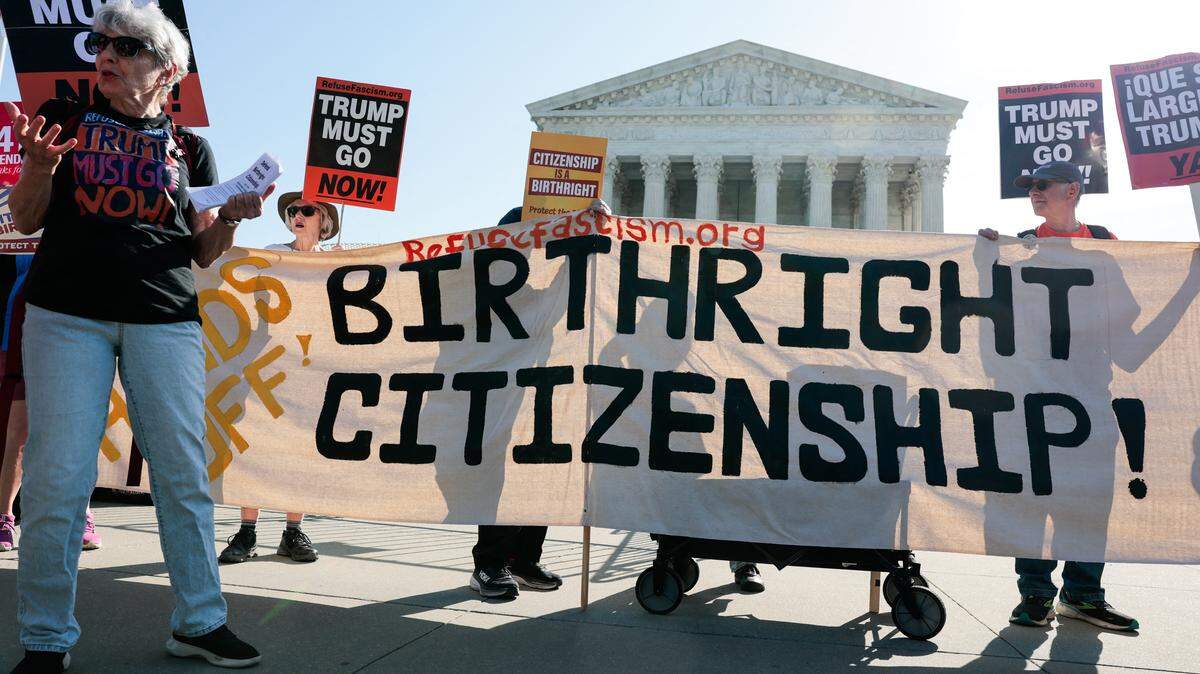
My great colleague, Eric Muller, has submitted an amicus brief in the birthright citizenship case (Trump v. Barbara) that is proving to be of immense consequence. And it is creating something of a national stir. Rachel Maddow did a long segment on it. (That’s right, on an amicus brief.) The Atlantic discussed it extensively. And then, the jackpot, Muller’s effort worked its way, repeatedly, into last week’s Supreme Court oral arguments themselves. High cotton. For folks like us, this is the equivalent of U. Conn. freshman Braylon Mills’ closing three-pointer against Duke. (Sorry, tasteless.)
Justice Ketanji Brown Jackson, for example, interrupted the Trump administration’s Solicitor General John Sauer to ask:
“What do we do with Professor Muller’s amicus brief and the historical record and the fact that even at times in this country where we understood that parents were declared enemies of the United States — I’m talking about World War II and the Japanese internment — babies born in that circumstance were given birthright citizenship? So the concept of the allegiance of the parents wasn’t driving [the decision]?”
Later, counsel for the ACLU would remind that “Professor Muller’s amicus brief tells us that even when people who were deemed “enemy aliens had babies in these detention camps everyone agreed that those babies were U.S. citizens.”
Muller’s ears were assuredly on fire. When I asked him, he reported he felt “gobsmacked”.
Eric Muller, along with being a tremendous teacher, is an internationally recognized expert on the removal and imprisonment of people of Japanese ancestry in the United States from 1942-1946. He’s published four books on the subject. His brief focused on “the history of citizenship conferred on the children of enemy aliens, (and) other people of Japanese ancestry who had renounced or never held U.S. citizenship.” It was important, in his view, that the high court be “properly informed” of our past “and the ethical considerations stemming from that history.” Even if, I might add, our present executive branch seeks to ignore, or distort, the narrative.
This is, assuredly, some of the best work that can be done by a law professor. As I understand it, even the president of the nation was in the audience. Here’s hoping it doesn’t mean the University of North Carolina ends up on some list.
Muller has some experience with retaliation. In 2021, he was removed as chair of the governing board of the UNC Press in an unprecedented move by the UNC Board of Governors. President Peter Hans offered no objection. One (unnamed) member of the BOG explained to NC Policy Watch: “Muller has had a target on his back for a couple of years.” He had taken a position opposing the illegal sweetheart payout to the Sons of Confederate Veterans over Silent Sam. “Professors are supposed to be teaching their classes and not making statements to the press about what we do” – the BOG member made clear. That’s the Board of Governors charged with protecting freedom of expression on the UNC campus.
But I’m guessing Muller sleeps well.
Contributing columnist Gene Nichol is a professor of law at the University of North Carolina-Chapel Hill.