
Toll lanes turn your commute into a casino, and in NC, it’s working | Opinion
The first time I drove in the I-77 toll lanes, I immediately understood why people pay to use them.
It was a Friday afternoon, and I was driving north from Charlotte toward Mount Airy with my kids for a camping trip. Traffic was backed up, as you might imagine, so I jumped into the paid lanes when things got messy and jumped back out when cars started moving again.
Every switch felt like a small wager. Pay five bucks, hop in the fast lane for a mile and see how much time you win. It worked like a charm, shaving about 30 minutes off my trip.
I’m still waiting on the bill, so maybe I’ll feel differently when it shows up. But in the moment, I have to admit it was exhilarating. I won.
Eight years in, the I-77 Express Lanes north of Charlotte have become more than a controversial road project. They are an experiment in price, scarcity and driver psychology, and the latest financial data show the project is entering a new phase.
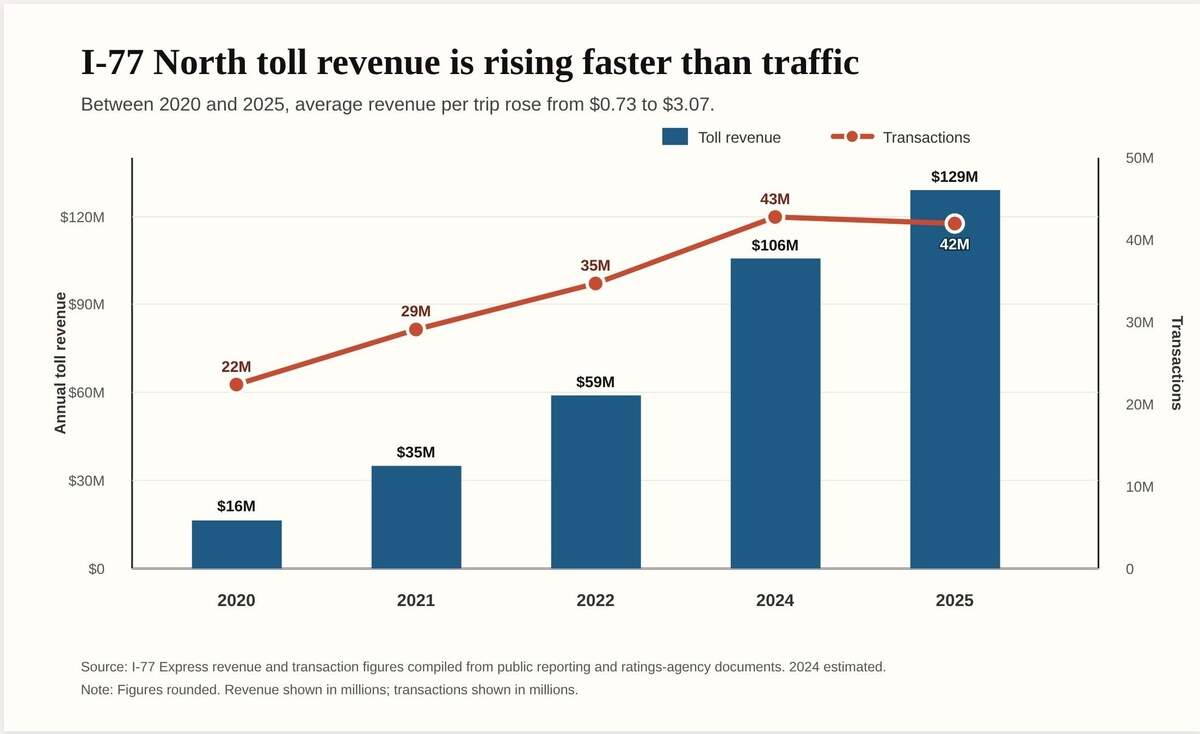
Revenue and use moved in opposite directions last year, revealing the business logic underneath the driving experience.
The same pricing strategy that made me feel like I had beaten traffic is also what makes the road a strong business. It does not need everyone to pay. It just needs enough drivers willing to pay more for the premium experience.
The price is the point
New bond-rating reports released this week suggest that is exactly what is happening. Coming out of the COVID-19 pandemic, use of the toll lanes grew steadily, and revenue rose along with it.
But in 2025, I-77 Express hit an inflection point. Transactions fell 2%, but toll revenue still rose 22%, according to an April 24 report from Morningstar DBRS. For the first time, fewer transactions produced more money.
Was the roulette-like feeling of my drive just an incidental byproduct? Or is it the point?
I called Rob Boisvert, a spokesman for I-77 Mobility Partners, to ask. His answer, in essence, was that the feeling comes from how managed lanes are designed to work.
Lake Norman folks already know this, but toll lanes use price to protect speed. As congestion builds, tolls rise until enough drivers decide to stay in the regular lanes, which keeps the express lane moving.
The goal is not to pack the lane with as many cars as possible. It is to keep the price high enough, and traffic light enough, that the experience feels premium. You are not just moving faster. You are flying past everyone else.
That is exhilarating if you’re in the toll lane. It’s maddening if you’re not.
I-77 Mobility Partners argues that the lanes work for everyone. Boisvert said data show average weekday peak-period speeds in the free lanes have increased 30% to 40% since before construction began in 2015, even as corridor traffic has risen substantially. Nearly 7 million distinct vehicles have used the express lanes since they opened, Boisvert said, and about 375,000 different drivers use them each month.
At the same time, the reliability the toll lane offers has real value. A parent late for pickup, a contractor heading to the next job or a traveler racing to the airport might gladly pay for certainty. At least you have the chance to get to your destination on time. With nothing but free lanes, you could be stuck in gridlock with no way out.
So yes, I think the I-77 North toll lanes are a net-positive. They give drivers an option on a corridor that badly needs one. But that does not mean the tradeoff is painless, especially for people who face the choice every day.
A road built for the betting age
Now is the right time to reckon with what toll lanes do to driver behavior. North Carolina now has two managed-lane corridors, both in Charlotte: I-77 north of the city and I-485 around the southern end of the loop.
More are being considered or advanced across the state, including the currently controversial I-77 South project. The N.C. Department of Transportation has also weighed the concept for pieces of I-40, U.S. 1, I-540, U.S. 15-501 and the Cape Fear River crossing in Wilmington.
Don’t get me wrong, I understand the frustration a lot of people still feel. The toll lane is selling the feeling of being one of the lucky few who found the shortcut.
For occasional drivers like me, that can feel almost fun. I don’t need the lane every day. I can treat the toll as a splurge, a rescue, a little tactical victory over a bad traffic day.
For daily commuters, of course, the experience is different. If you drive I-77 every morning and evening, you’re facing a recurring choice between losing time or paying whatever the algorithm says relief is worth that day.
Still, the bidding system is what keeps the lane moving. That is why toll lanes fit so neatly into this moment. North Carolina legalized mobile sports betting in 2024, and I don’t think most of us realized how quickly it would become normal. Sports betting turned a game into a stream of little wagers. Toll lanes do something similar to the commute.
Pay now. Save time. Beat traffic. Try again tomorrow.
Maybe people should skip the sportsbook and drive I-77 at rush hour instead. They can chase the same high. It might even be cheaper.
That’s a joke, but only barely.
Toll lanes may be necessary. They may even work. But they do more than move traffic.
They turn the commute into a series of wagers.
And on I-77, the house is learning exactly what drivers will pay.
Contributing columnist Andrew Dunn is the publisher of the Longleaf Politics newsletter, which offers thoughtful analysis of North Carolina politics and policy from a conservative perspective. He can be reached at andrew@longleafpol.com.
This story was originally published April 29, 2026 at 8:15 AM with the headline "Toll lanes turn your commute into a casino, and in NC, it’s working | Opinion."