
I’m a millionaire and Tar Heel. I want to pay more in taxes for schools | Opinion
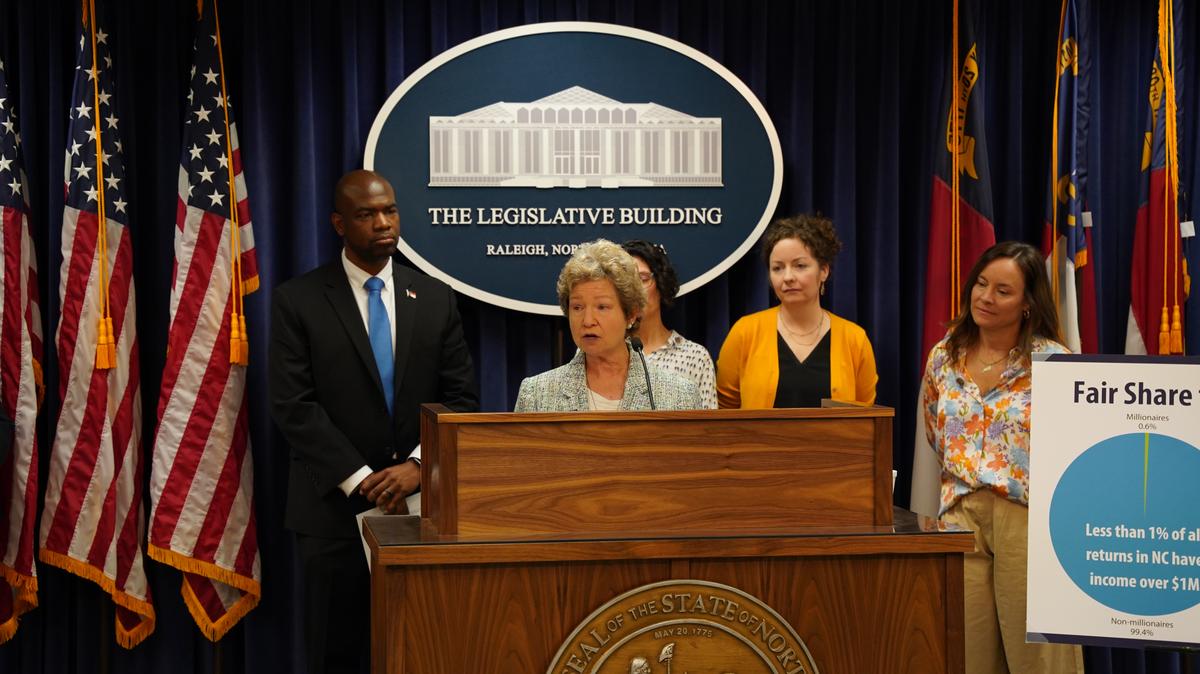
We have so much to be thankful for in The Tar Heel State. From college basketball rivalries, to a Down East Pig Pickin’ or High Country Fish Fry, from the splendor of the Outer Banks to the views from the Blue Ridge on down to the Smokies — we really have it all. At the same time, we still have some areas for growth. Two of those areas are how we fund our schools and our failure to tax the richest amongst us. That’s why as a person of wealth, I am thrilled to see Rep. Allen Buansi introduce the Fair Share for Public Schools Act, which would make our tax code fairer and give our schools the critical infusion of funds they need to get off life support.
I feel passionate about fixing our backwards tax code, which gives undue advantages to high earners like me. I also raised four children in Wake County public schools and feel heartsick that our schools are starving for funding at every level. The Fair Share for Public Schools Act would help fix both of these problems by establishing a 7% income surtax on income over $1 million and directing the revenues raised to the State Public School Fund.
We have a regressive tax system in North Carolina that unfairly shifts the tax burden away from millionaires like me and onto lower- and middle-income people. As things stand today, the bottom 20% of earners pay 10.5% of their income in state and local taxes, while the top 1% pays 6.0%. But what makes even less sense to me is the fact that, thanks to eight years’ worth of tax cuts from Congress and the North Carolina General Assembly, the top 1% will pay about $5 billion less in taxes this year than they otherwise would have. Why should we continue to cut public services we all need, when they could easily be paid for with a sensible tax plan?
The way we treat our public schools in North Carolina though is arguably even more backwards than our tax code. According to a report out last month, we rank an embarrassing 46th among all 50 states in teacher pay, and our teachers make $16,500 less than the national average. We are also the only state in the nation where the average teacher salary is expected to decrease this year. If that weren’t enough, North Carolina also ranks 46th in per-student funding, with a gap over $5,000 below the national average.
I am the proud product of public schools, and so are my children. One window I have into how poorly our public schools are doing was through my daughter’s experience as a long-term substitute teacher in North Carolina’s public schools. She loved teaching, but the shockingly low pay — coupled with other stressors like classroom overcrowding, sparsity of counselor support, buying student supplies from her own pocket, and long hours — made this an unsustainable career choice for her. How can our state’s teachers be expected to educate, guide, and mold the next generation of Tar Heels if they’re being paid so little?
When we pay our teachers poorly and give our schools pennies in funding for other essential resources, we are setting up our students for failure not only in the short term but in the long term as future workers. That will ultimately hurt North Carolina businesses in the long run. Our state is currently ranked 1st for business but dead last for workers. If we don’t properly fund our schools and prepare the next generation to enter the workforce, we’ll inevitably start to slip in the rankings for businesses and have no chance of climbing in the rankings for workers.
Fixing our state’s broken tax code, however, is a worthwhile goal in and of itself, no matter how revenues are spent. My husband, John, and I made our money through a combination of investments and inheritances. I often encounter the argument that investors need lower taxes as incentives to invest and create jobs. That could not be further from the truth. Even if tax rates were to rise on our income, I would not sell off our investments or stop making new ones. There is no justifiable reason in any world, real or imagined, why a millionaire like me should pay a lower tax rate than a worker making $17 an hour working at one of the Christmas tree farms in my town.
I raised my kids in North Carolina and retired in North Carolina because we outshine the nation with our variety of foodways, recreation, music, sports, natural beauty, and pure hospitality. Patriotic millionaires like me would be honored and proud to pay more in taxes should this bill pass — if it means we can move one step closer to a fairer economy and brighter future for our youth.
Monica Lavery is a member of Patriotic Millionaires. She is a retired clinical social worker who worked in the public and private mental health sectors for thirty years. She lives in West Jefferson, North Carolina.