
It’s not enough to just amend the Daniels plaque. Use it to transform the controversy.
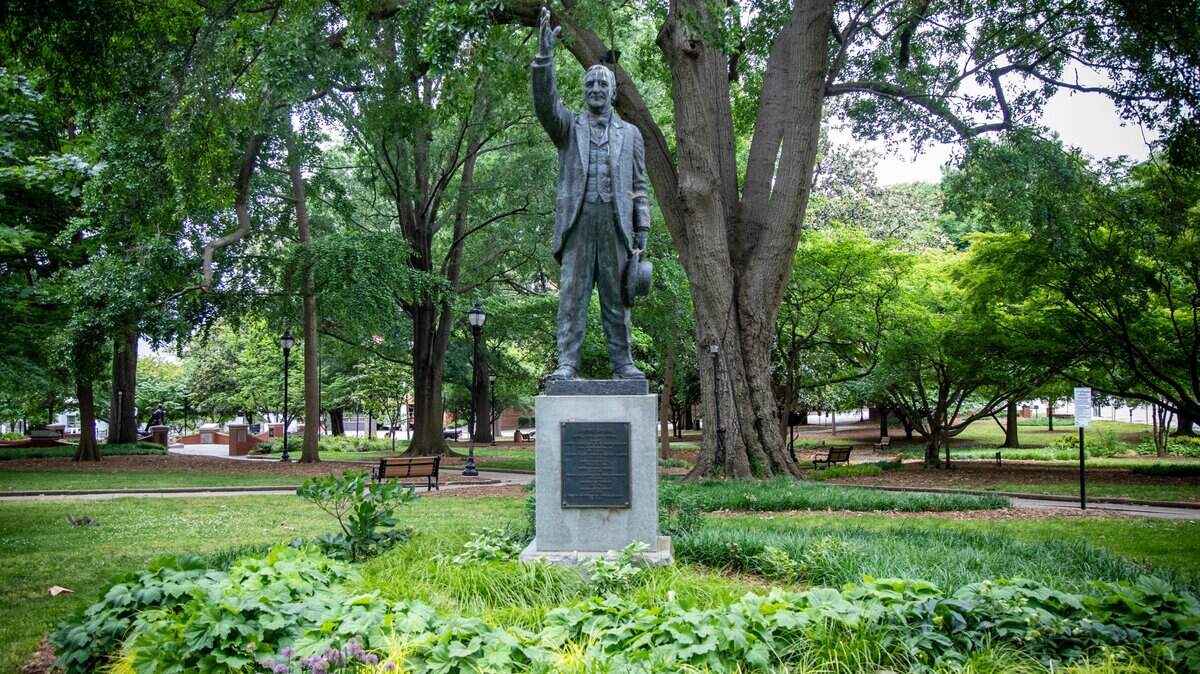
Daniels’ plaque
Regarding “Ex-rep wants Josephus Daniels statue updated on massacre,” (May 8):
The expanded reality of the sought-after addendum to the Josephus Daniels plaque in Nash Square is not enough.
This is the time to push back the shadows of the past and assemble a fresh narrative from personal stories of our responses to the monument. The city history museum can provide public opportunities to ask ourselves: “What do we see in the monument today? How were people a century ago looking at it? How would we memorialize it for people 50 years from now?”
Monuments are what we make them. Ours can transform controversy and uplift conscience, where everyone’s story together becomes greater than the sum of their conflicting parts, not just counter narratives, forever opposing each other.
Douglas A. Johnston, Raleigh
Don’t tolerate it
The incident between the wrench-toting protester and the family in downtown Raleigh (May 10) fills me with anger, sadness and fear for our community and society. Be the targets black, white, or purple, we must make it clear this kind of behavior will not be tolerated.
Catherine Colvard, Raleigh
Federal help
In this pandemic, state, county and local governments revenues are collapsing while expenses for emergency assistance rise. Congress must immediately pass $2 trillion in federal funding to rescue state and local government budgets. The first trillion would be for immediate needs; the second would be reserves designed to prevent inadequacies that crippled the CARES Act.
Rather than laying off workers, state and local governments — especially health departments — should be hiring thousands of new employees for testing, contact tracing, and disinfecting public buildings.
Banks entrusted with the Payroll Protection Program failed miserably by shunning small businesses. Local governments have historic knowledge of local businesses and charities and are better equipped to determine local needs. They already coordinate with and help fund charities, such as local food banks and homeless shelters.
Anthony Wikrent, Mebane
Massive testing
After COVID-19 was detected in the president’s and vice president’s staff, the White House turned to massive levels of testing and contact tracing to track down and isolate infected individuals with the goal of allowing them to continue to do their jobs in safety.
If it’s good enough for the White House, it’s good enough for the rest of us. Massive levels of testing and a dedicated corp of contact tracers will give people confidence in their safety and start to restore economic activity. Absent those assurances, too many people will decide to stay home even as restrictions are relaxed.
Matt Greenwolfe, Durham
Contact tracing
Dr. Mandy Cohen of NC DHHS says we need more COVID-19 testing, and she’s clearly right — a lot more. But what happens after someone tests positive? Are we capable of aggressively and diligently tracing contacts for all positive tests? Are we ensuring all contacts are tested? Are we requiring all positive cases to self-quarantine? If we’re not doing all these things, then more testing will be to no avail. We need to hear where we stand on contact tracing and enforcement of quarantines.
Bob Hogan, Chapel Hill
Vote by mail
States are the laboratories of democracy. And with their vote-by-mail systems, red Utah, purple Colorado, and blue Oregon have run experiments that have yielded spectacular results. We can do the same in North Carolina.
Vote-by-mail is safe. Social distancing is implicit. By contrast, at least 50 people contracted Covid-19 when they went to crowded polling stations in Wisconsin.
Vote-by-mail is secure. According to the Brennan Center for Justice, fraud in vote-by-mail systems is extremely rare, less than 0.0009%. Paper ballots are also less vulnerable to hacking than antiquated electronic voting machines.
Researchers have found that vote-by-mail increases participation equally for Republicans and Democrats, about 8% apiece.
Anne Gordon, Chapel Hill
RDU quarry
Regarding “RDU quarry opponents want a public hearing on mining permit,” (May 6):
Umstead State Park is one of the most visited parks in North Carolina. Having a quarry operation blasting rock adjacent to it will greatly diminish the attractiveness of visiting this park. As a long-time resident of Raleigh, I’ve seen how the Raleigh, Cary, and Morrisville area has developed over 45 years. Green spaces have been lost, leaving Umstead park as one of the few forested areas where we can go to escape city life. It is a treasure to save for future generations, not ruin.
Jim Merchant, Raleigh
BEHIND THE STORY
MOREHow do I get a letter published?
The Raleigh News & Observer publishes letters to the editor on Tuesday, Wednesday, Friday and Sunday most weeks. Letters must be 200 words or less, and they will be edited for brevity, clarity, civility, grammar and accuracy. Please submit to forum@newsobserver.com
What are you seeking when you choose letters?
We’re seeking a variety of viewpoints from a diverse group of writers.
What must I include?
You must include your first and last name, address, email, and phone number. We never print anonymous letters. If you’d like for us to consider publishing your photo, please include one.
How often can I have a letter published?
Every 30 days. But you can write as often as you’d like!
This story was originally published May 11, 2020 at 12:44 PM.