
Wake up, NATO. Trump doesn’t believe in allies.
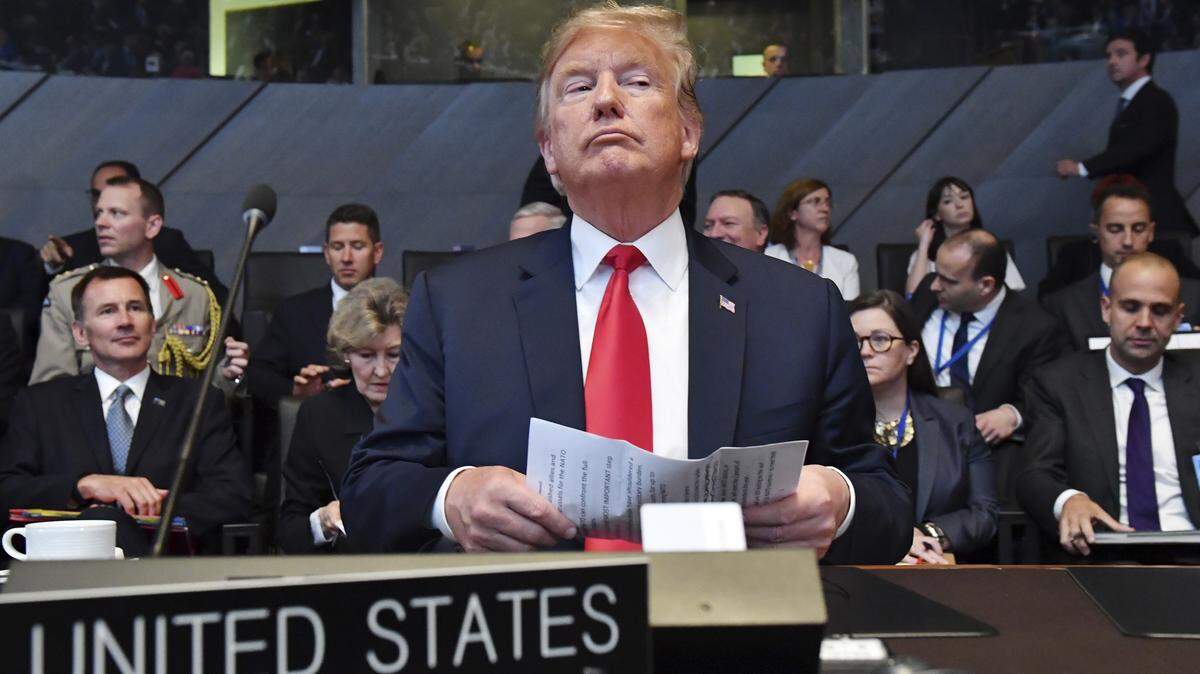
Not so long ago, Europeans believed that despite Donald Trump’s harsh words, Washington would never endanger its Cold War alliances. “Do not read his tweets, follow his actions,” senior American officials told their European colleagues when the conversation turned to the future of the trans-Atlantic relations.
How wrong we were to believe them. It was the tweets that really mattered in the end.
Within hours of the religiously anticipated NATO summit in Brussels, President Trump was castigating Germany, historically one of America’s closest allies, claiming, ridiculously, that it is “captive” to Russia and calling NATO countries “delinquent.”
Clearly, Trump is ignoring European Council President Donald Tusk’s appeal: “Dear America, appreciate your allies. After all, you don’t have that many.”
For Trump, America’s alliances symbolize everything that is misguided about his country’s foreign policy. In a 1990 interview with Playboy magazine, he said that the United States is “defending wealthy nations for nothing — nations that would be wiped off the earth in about 15 minutes if it weren’t for us.” They “laugh at our stupidity.” His views don’t seem to have changed since then.
Europeans are now finally being forced to realize that Trump’s world is one shorn of allies.
Here’s why the European leaders are so surprised: It’s not difficult to imagine a mainstream political leader campaigning with promises to build a wall on the border, move the American embassy in Israel to Jerusalem and punish the Chinese government for its economic policies. Mainstream politicians might easily pledge all of these, but upon assuming power they would never act on them.
Like today’s other populist leaders, Trump knows that his standing with voters hinges on making good on his most radical promises. All the populist leader has to do is be different from the mainstream — to do what mainstream politicians would never do.
What makes Europeans particularly vulnerable in the Trump era is that they still view themselves as America’s allies. But in Trump’s world, there no longer is any concept of alliances. It is not that he is displeased with European military spending or with Europe’s position on Iran. Rather, it is that in a world where America is a disruptor and not a force for stability, allies are now a burden. They have expectations and claims that constrain America’s policies, whether that is a preferential trade agreement or a commitment to joint military exercises. Worse, they insist on predictability and reciprocity, which are completely out of sync with Trump’s view of the world.
Peering through Trump’s twisted prism, one finds not friends and enemies, but fans and enemies. Fans are those who are loyal to you no matter what; they never expect reciprocity. Enemies are also valuable because they help you solve problems; you can assert your power by breaking them or befriending them. The Trump administration’s approach to the North Korean enemy is a perfect example of this. Its relationship with Russia — Trump is meeting with Vladimir Putin next week — could be the next example.
Europeans are doomed if they think the issue now is how to salvage their alliance with the United States. The time for that has passed. The challenge now for the leaders of Europe is learn to live in a world where America has no allies.
For a start, they can show that they take seriously the need to provide for their own security, investing in autonomous European defense capacity rather than relying so much on the United States. The Europeans must also discover that while their unity is important, it can help to be a little unpredictable themselves. They also can give up their posture of learned helplessness when it comes to Russia.
The logic of the post-Cold War world has been that the United States exercises its global influence by preserving and expanding its alliances. This logic no longer holds. The gravest risk the European Union faces is to be the guardian of a status quo that has ceased to exist.