
Triangle sports fans understand rivalries and why some say a Yankees loss is baseball at its best
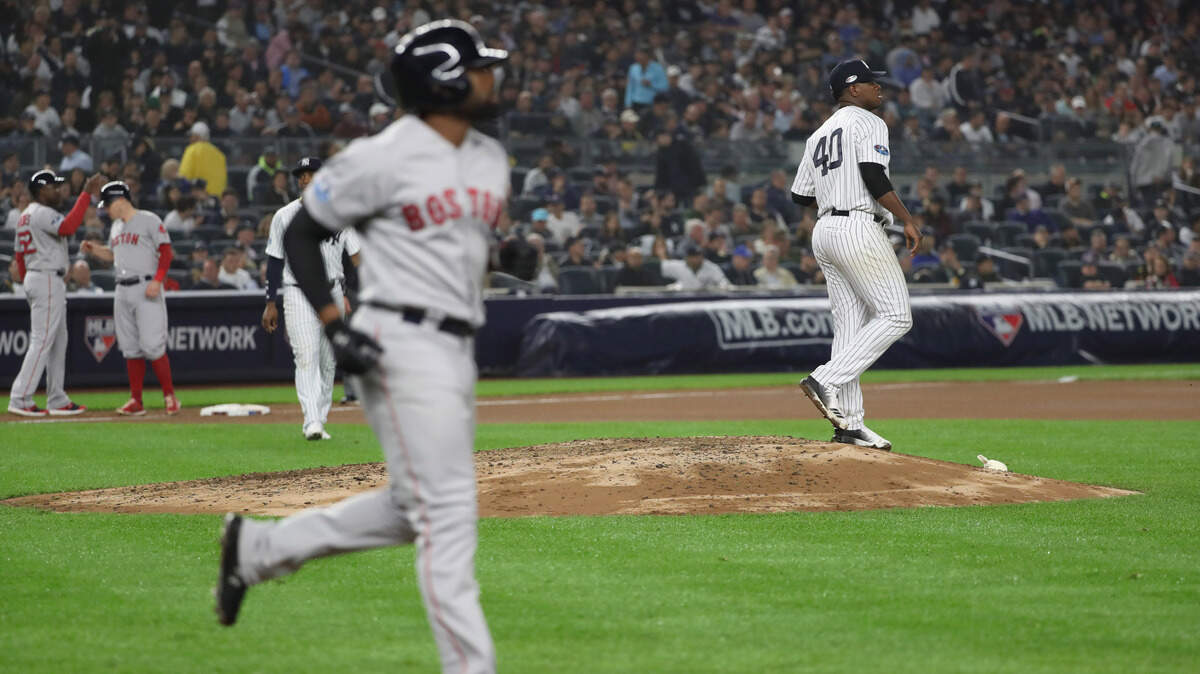
I can watch postseason baseball again.
No, it’s not that I got my TV fixed, or my glasses. What I got was even better, or just as good -- the same outcome I was raised to desire and have continued to covet every baseball season. I got to see the New York Yankees lose, eliminated before they reached and, as likely as not, won the World Series, as they’ve done 27 times before.
When you’re raised by a Bronx native who hated the Bronx Bombers, who perversely rooted for the star-crossed Brooklyn Dodgers, pulling against the haughty Yanks was as natural as eating hot dogs at a ballgame. Fans raised around here, trained from birth to venerate or excoriate a certain college team’s colors, players, coaches and traditions surely understand the phenomenon.
I first attended a major league game at intimate Ebbets Field, capacity 31,902. The Dodgers’ starting lineup boasted five eventual Hall of Famers (including Jackie Robinson) and an all-star at virtually every position, including pitcher. Yet Brooklyn didn’t win its sole World Series until 1955, beating the mighty Yankees after being thwarted five times by the pinstriped plutocrats.
Yankee Stadium seated 67,000, graphically illustrating the difference in franchise resources compared to Brooklyn. With a lineup of players nicknamed Mickey and Whitey, Moose and Yogi, the Yankees sounded more like members of an elite country club or the Mickey Mouse Club than a bunch of pro athletes. That they were among the last big-league clubs to integrate only reinforced that impression of exclusivity.
The Yankees currently rank as the second-most valuable pro franchise in the U.S. after the Dallas Cowboys, according to Forbes. The Yanks had baseball’s top payroll 15 times in the last 20 years, spent more than $2 billion from 2008 though 2017, and trailed only the L.A. Dodgers in salary payments from 2014-17.
This year New York, still regarded as baseball royalty in many corners, scraped by with only the seventh-biggest payroll to start the season, and had only the game’s 13th-highest paid player in Giancarlo Stanton. Must be tough. The Yanks still have enough money to acquire players as needed, as they’ve done repeatedly over the years. For the longest time they plundered one franchise in particular, the Kansas City Athletics, from whom they acquired Roger Maris, the single-season home run leader in the majors from 1961 until 1998.
Homers, the slam dunks of baseball, are an historic Yankee staple, bombast in action. This attention-getting proficiency apparently confused New York’s latest slugging phenom, Aaron Judge, who mistook playing for New York with license to flaunt his assumed superiority. Judge rubbed in his team’s sole victory in the American League Division Series against Boston by blasting the Frank Sinatra tune “New York, New York,” a staple at Yankee Stadium, outside the Red Sox’s locker room.
Sweet, then, to hear Boston’s celebratory clubhouse belted out a mocking version of the same song as team members bathed in Champagne after closing out the series. “Baseball players, we hold grudges for a long time,” analyst and retired major leaguer Harold Reynolds said on “MLB Tonight”.
So do fans. After the Dodgers and New York Giants left for the West Coast in 1958, there were a few desolate seasons in which my family, yearning for live big-time ball, grudgingly went to games at Yankee Stadium. We were among the few who came to root for the visitors. Then the Mets, a National League expansion team added in 1962, came to New York, and we were saved.
Once I moved to North Carolina I escaped close proximity to the Yankees. As a journalist, that freed me from the necessity of fighting my heartfelt prejudice. (I didn’t want to give it up, either.) Of course, since I attended a Triangle university, people – including athletic officials -- expected me to pull for my alma mater’s teams. When I told them I did not, that I’m a professional neutral, that I might root for an individual but not a school, they were confounded. Some actually asked my wife for confirmation, neutrality so foreign a concept it’s not easily believed.
But I don’t want to remotely resemble the N.C. State grad who used to heckle officials from press row when things weren’t going the Wolfpack’s way. Or emulate Dick Young, a long-dead dean of New York sportswriters, who came to spring training to cover the Mets for the N.Y. Daily News wearing a Mets jacket, his allegiance literally worn on his sleeve.
The problem is, fans can’t see clearly. Their view is filtered by a veil of their own creation. The distortion is part of the fun of being a fan, part of what makes victory feel so good and defeat so painful. When there was a close call at first base to sink the Yankees in the American League Division Series, I wanted the runner to be called out. My desire colored my perception; replay merely confirmed it.
This effect is often observed in ACC basketball and football arenas, where fans somewhat familiar with the rules, seated many yards from the action, insist loudly they see a violation that eluded game officials positioned far closer and trained to spy infractions.
If you’re intent on nursing preferences, then football and baseball, in which the action arises in discrete chunks, are easiest to watch on TV. I follow a Yankees game by switching channels when they’re at bat and might prosper, and tune back in when their opponent is at the plate. Filtering experience to suit predilections is key to fanhood. Happily, with the Yankees eliminated from postseason play I don’t need to bother.