Rod Brind’Amour recalls a snowy scene, a career-changing day with the Canes
Many remember the great Raleigh snowstorm of January 2000, when almost two feet of snow fell in a week’s time, paralyzing the city.
Rod Brind’Amour does. He flew into the middle of the storm, landing in what seemed to be a surreal scene, appearing stunned, dazed and confused by all that was happening to him.
On Jan. 23, 2000, Brind’Amour was traded to the Carolina Hurricanes by the Philadelphia Flyers. It ended the Canes’ messy situation and contentious contract talks with center Keith Primeau, while bringing in a veteran player who would help alter the future of the Carolina franchise and one day make it a Stanley Cup champion.
“It was a tough time for me when I first got here, I can tell you that,” Brind’Amour said. “It’s strange how things work out. I never would have guessed we’d be saying that, you know 20 years ago, that this would be how it all worked out. I feel pretty blessed, pretty fortunate that it’s worked out the way it has.”
Twenty years later, Brind’Amour is the Canes’ second-year head coach. After the Canes’ 4-1 win Tuesday over the Winnipeg Jets he again has his team well-positioned for a push to qualify for the Stanley Cup playoffs.
But flash back to January 2000. On the morning of Sunday, Jan. 23, he was with the Flyers in Pittsburgh, going through a morning skate, being kidded by then-teammate Keith Jones about a possible trade. He was the perfect fit for the Flyers, a gritty, high-effort, low-maintenance type who didn’t take any shifts off. Flyers fans loved him.
At 2 p.m. that day, Brind’Amour got a phone call — from Paul Maurice, then the coach of the Hurricanes. The trade had been made and his new coach, not Flyers general manager Bob Clarke, was giving him the news.
He quickly hopped a flight and arrived at RDU to find two new teammates, Ron Francis and Gary Roberts, waiting for him. And a snowstorm. All Brind’Amour had with him was the suit he was wearing.
“I didn’t have anything and then I got caught in the snowstorm for 10 days and couldn’t get anywhere,” he said. “I left my rental car on the highway. I couldn’t move. It was an interesting time.”
Brind’Amour had worn No. 17 with the Flyers but that number was taken on the Canes — by forward Jeff Daniels, now one of Brind’Amour’s assistant coaches. Brind’Amour was assigned No. 27 for the rest of his first season.
And No. 27 wasn’t very good in his first game for the Canes the next night, in what was then called the Entertainment and Sports Arena. The Canes topped the Montreal Canadiens 3-2 in overtime but Brind’Amour had three penalties including a high-sticking call that resulted in a power-play score for the Habs.
“It was probably the worst game of my life,” Brind’Amour said after the game. “At least we won.”
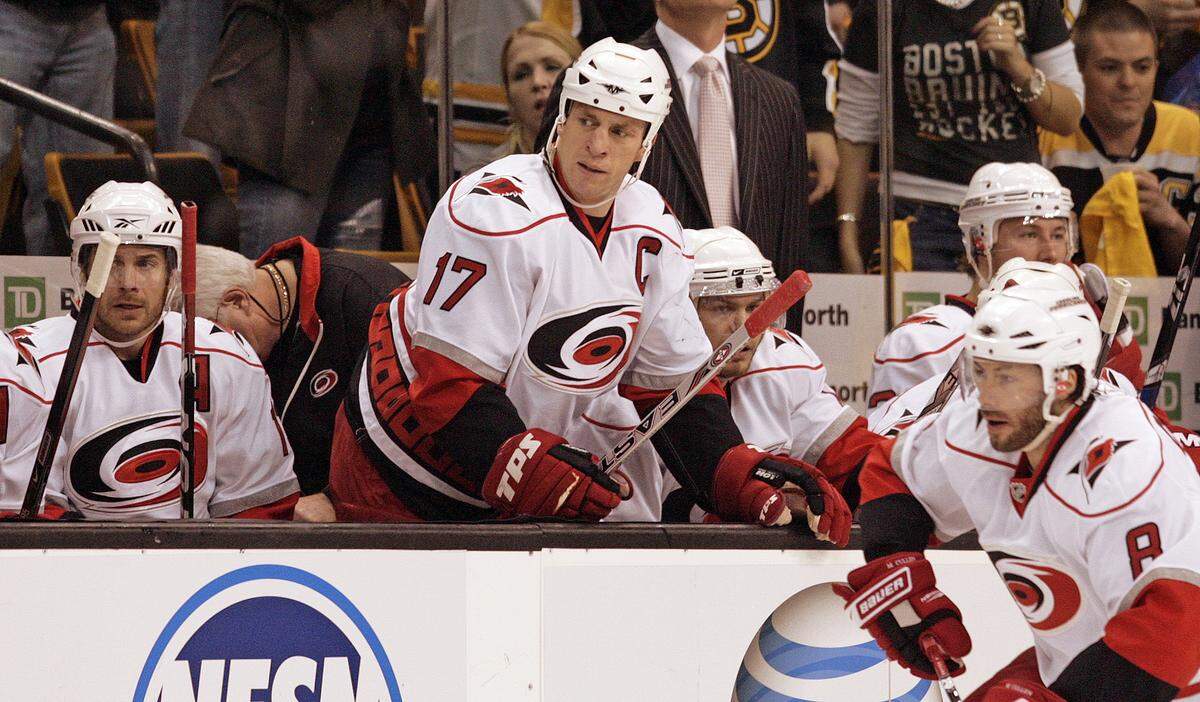
Brind’Amour also said he was nervous, which was understandable. At a press conference earlier that day, he appeared dazed, his eyes widening as he answered questions.
“I remember him being, I wouldn’t say confused but almost lost,” John Forslund, the Canes’ longtime television play-by-play man, said. “Not lost as a player, but lost in where he was. At that time there was such a stark difference from where the Hurricanes were as a franchise and where Philadelphia was. More attention, bigger city, everything. And then dropped into this circumstance.
“I just remember him being kind of a confused athlete asking ‘What’s happened to me, how am I going to do this?’ And then immediately doing his job.”
Which is what Brind’Amour said at the time: “My job is to show up and play.”
Maurice, the day after the trade, noted that the same things usually were said in describing Brind’Amour.
“A great character guy. A perfectionist when it comes to physical conditioning,” Maurice said in 2000. “He’s a very intense man. A man with a tremendous amount of pride to his game.”
In 2002, Brind’Amour and the Canes were playing in the Stanley Cup final, losing to a Detroit Red Wings team packed with future Hockey Hall of Famers. In 2006, he was the Canes captain, raising the Cup in victory. After retiring as a player in 2010, his jersey number, No. 17, was retired by the Hurricanes.
On Tuesday night, Brind’Amour was behind the Canes bench and Maurice behind the Winnipeg bench as the Jets’ coach.
“There’s three or four guys that I thought had the biggest impact (on the Canes franchise),” Maurice said before the game. “Kevin Dineen, Gary Roberts, Ron Francis and then Rod Brind’Amour, in that chronological order. They were the right kind of character guys that they could turn a franchise around. And they did.”
As a coach, Brind’Amour said it’s easier to relate to a player who has been traded to the Canes, who had no say in the matter, that was forced to make a transition he didn’t expect and is much harder than he expected.
Brind’Amour had been with the Flyers for eight-plus seasons when he was traded. Then 29, he had suffered a hairline fracture in his left foot in preseason in 1999-2000 and had played just 12 games by late January. Then, he was gone.
“It’s always tough ... when you get traded from a place that you feel is a part of you,” he said. “It’s an adjustment. It takes some time just to feel normal.”
Brind’Amour said he did quickly learn the meaning of “Southern hospitality.” Caught in a line that stretched outside a Harris Teeter during the snowstorm, he said a lady told him to go ahead and go inside the store, that he had no overcoat.
“That’s what stood out, how nice everybody was, accommodating,” Brind’Amour said. “A little different than I was used to, let’s put it that way.”
And now his home of 20 years. As Forslund put it, “Rod has completely embraced North Carolina.”
The Trade
On Jan. 23, 2000, the Carolina Hurricanes traded center Keith Primeau and a fifth-round pick in the 2000 NHL Draft to the Philadelphia Flyers for center Rod Brind’Amour, goaltender Jean-Marc Pelletier and a second-round pick in the 2000 draft.
This story was originally published January 23, 2020 at 1:00 PM.