23 and me: The UNC basketball player with Michael Jordan’s number before MJ owned it
By now Ged Doughton knows the joke well enough that he can see it coming, before his friends begin the set-up. They’ll be out somewhere, Doughton and his buddies, they’ll meet someone new and the conversation will turn to basketball.
And Doughton’s friends will point to him and say: “Well you know this guy’s number — he played basketball at Carolina and his jersey’s retired.” And Doughton will think: “God, here we go again,” he said with a laugh Monday, during a phone interview from his home in Charlotte.
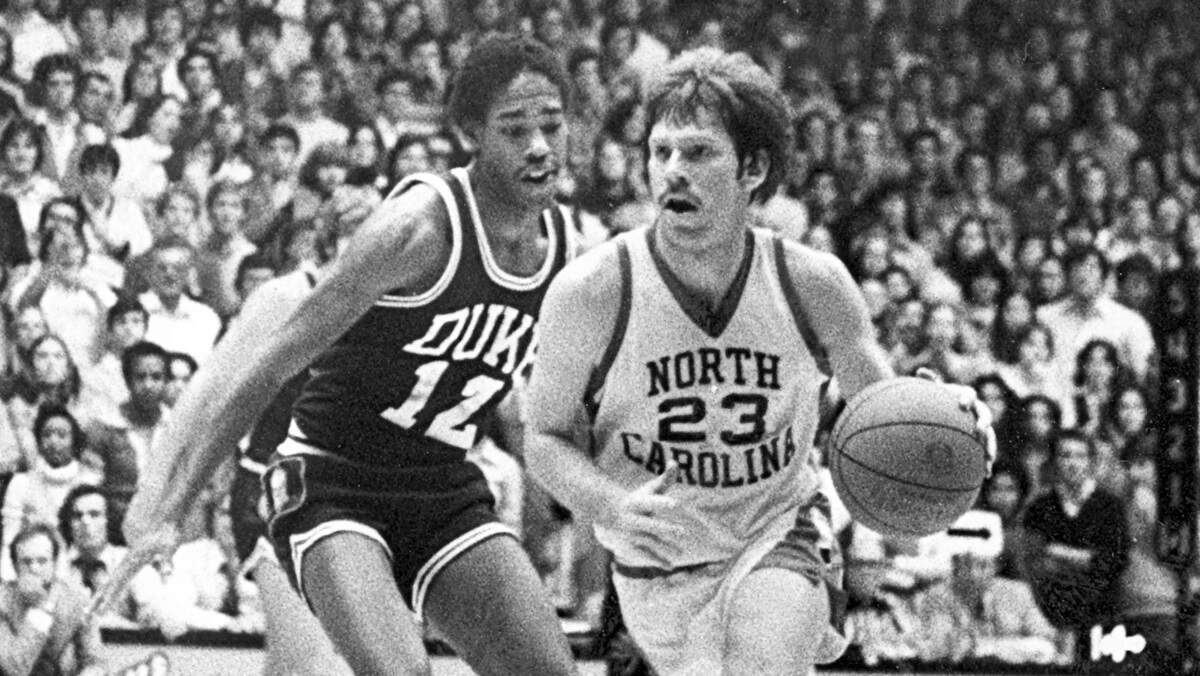
It has been 41 years since Doughton played basketball for Dean Smith at North Carolina, and he can laugh easily about the fact that he is not among the Tar Heels’ most memorable players. In his four seasons, he averaged 2.1 points. Outside of a brief stretch his senior season, he never started. His greatest moment, he said, might’ve come on a play he didn’t make.
And yet he achieved a childhood dream of playing basketball for Smith and the Tar Heels, and it’s true, what his friends like to tell people: Doughton’s number is indeed retired.
The iconic number
It hangs up there in the Smith Center at UNC, a symbol of basketball sanctity. It is perhaps the most iconic number in all of American sports — and certainly the most famous in basketball, the one kids have aspired to wear for decades, and the one a generation of NBA players wear with purposeful intent. Turns out, it wasn’t even Doughton’s first choice when he arrived at UNC in 1975, a freshman point guard from Winston-Salem.
Doughton had grown up idolizing Larry Miller, and Miller wore No. 44 when he became one of the best players early in Smith’s tenure at UNC. In high school, Doughton wore No. 22, his thought being: “Well, I’ll try to be half as good as Larry Miller.” When Smith asked Doughton what number he wanted at UNC, Doughton requested 22.
Smith told him it was already taken by Dudley Bradley, the most heralded incoming freshman.
To which Doughton said he replied: “OK. Uhhh — how about 23?”
And that’s how Doughton became the answer to a trivia question, years before realizing his chance connection to the man many believe to be the best basketball player in the history of the sport. Doughton, who back then wore a flop-top ‘70s haircut and a mustache his mother urged him to shave, was the last UNC basketball player to wear No. 23 before Michael Jordan.
Like millions of others on Sunday night, Doughton watched the first two episodes of “The Last Dance,” the anticipated ESPN documentary about Jordan and his final season with the Chicago Bulls. In these times of lockdowns and social distancing amid the coronavirus pandemic, the prospect of the documentary had loomed like a tantalizing mirage in a desert.
Then, finally, it was here after a sped-up production schedule. In a country still adjusting to life without sports, there was at last something to sit down and watch, and that something just happened to be the start of a 10-part series about, arguably, the most captivating athlete in American history.
Doughton watched like everyone else, and the old clips of Jordan in his college days, wearing that No. 23 — Doughton’s number — did bring back some memories. At one point, Doughton said, he turned to his wife, Cathy, and asked her where the jerseys were that she’d had framed. His jerseys. The North Carolina tops with the No. 23 sewn on them. Dean Smith always let the seniors keep their jerseys, and Doughton said his sat in a drawer for more than two decades.
Then his wife took the Carolina blue road jersey to a shop and had it framed, with the front side showing — just the number.
“When she went to pick it up,” Doughton said, “the lady said, ‘Hey — this thing’s been sitting here for a week or so and everybody comes in here going, Can I buy that?’”
Doughton appreciated the thought behind his wife’s gesture but part of him wondered what people might think if they came over to the house and saw that Carolina blue No. 23 hanging up in the bonus room. He told his wife: “It looks like we took Michael Jordan’s jersey and framed it.”
She had a solution, and took his home jersey back to the same shop and this time had it framed so that the back of it showed, with Doughton’s name above the number.
For a while he had them both on display. Then after a while he took them down, he said with a laugh, “because I’m almost a little embarrassed ... (like), ‘Why did you frame Michael Jordan’s jersey and put your name on the back of it?”
Gathering dust in the attic
Doughton’s two No. 23s, the ones he wore, are sitting out of sight, up in the attic. They’re “just kind of sitting there,” he said, old memories gathering dust. It doesn’t quite feel like his number anymore.
The “23 thing has been funny” now for a long time, Doughton said, “really since Michael, you know, became Michael.” And, best anyone can pinpoint, that happened that March night in 1982 in New Orleans. Doughton was there, too, along with Cathy. Smith had helped out with the tickets. From his seat in the Superdome, Doughton watched Jordan rise for a jump shot from the left side in the final seconds. He celebrated, like all UNC fans, when the shot went in.
The Tar Heels beat Georgetown. Smith won his first national championship. And Doughton had a feeling, as well as anyone could then, that in time his old number might grow to be something more than a couple of sequential numerals. He was right, just as sure as the early reports he’d heard about Jordan were right, not long after Jordan had arrived in Chapel Hill.
That summer of 1981, Doughton received a call from one of his former teammates. He thinks it was Jeff Wolf, who’d graduated in 1980 but still hung around campus, like a lot of former players then and now, for pick-up games. Doughton said Wolf told him:
“Hey, you’re not going to believe what we’re seeing down here. This guy, Mike Jordan. At pickup games, nobody wants to guard him.”
Doughton said he expressed some measure of skepticism, which was long gone by the time Jordan made the shot in New Orleans.
The best and the worst?
Doughton is 63 now and works for UNC-Charlotte in fundraising as a senior director of major gifts. From time to time, he does some public speaking, and his connection to Jordan always makes for good fodder. Doughton keeps one of his jokes on standby, a self-deprecating line he has repeated so often the comedic timing comes naturally.
“We’re the bookends of Carolina basketball,” he said. “He was the best, I was the worst.”
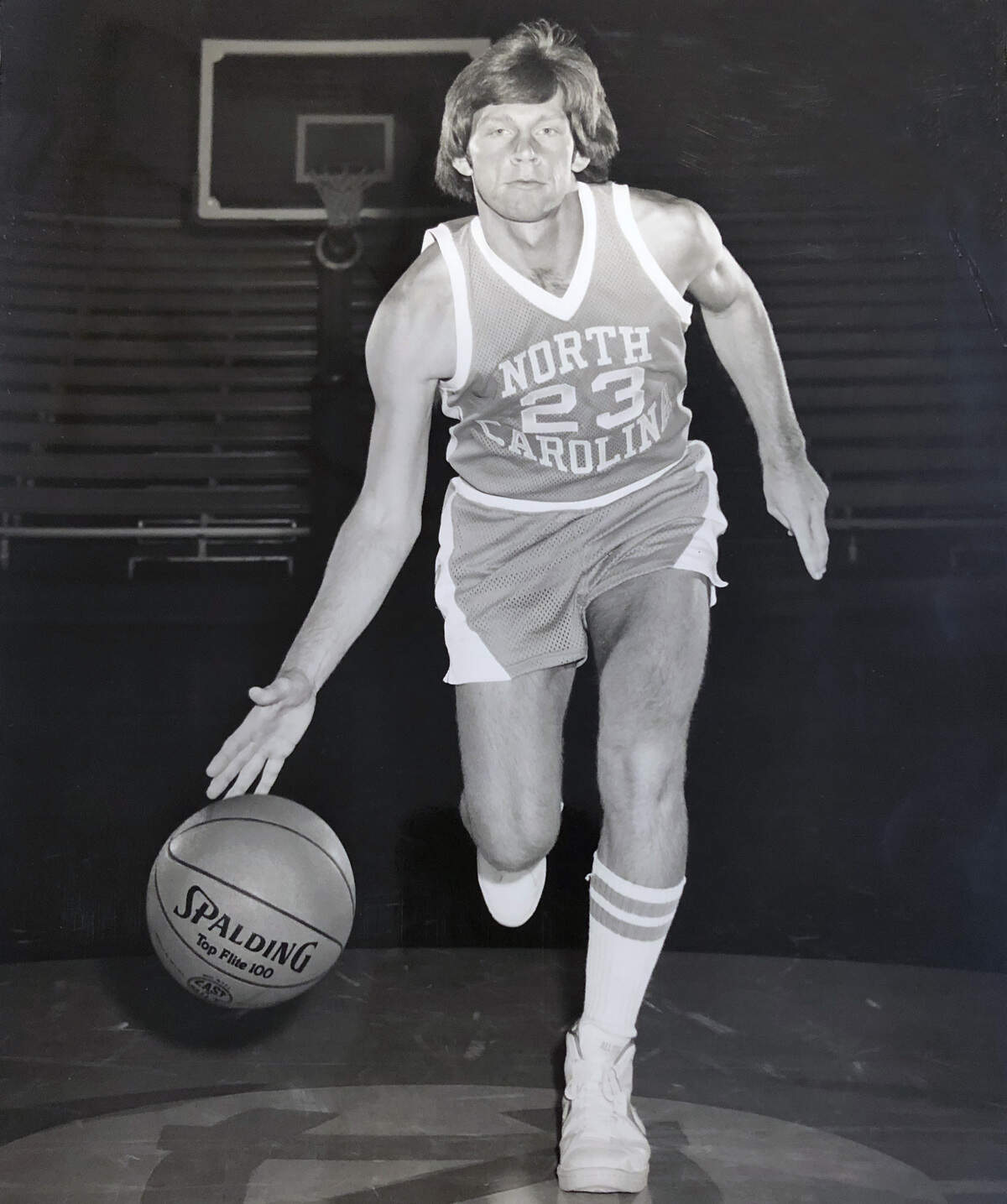
The second part isn’t exactly true. For three seasons, Doughton toiled in practice and waited for a chance. He’d arrived at UNC a non-scholarship player, before earning one. As his senior season approached he thought he might have a chance at succeeding Phil Ford at point guard, but he lost out on the starting position.
Still, in his final year, the 1978-79 season, Doughton was among the first players off the bench. He said he was Smith’s sixth man. During a late January game against Duke, UNC’s starter at point guard, Dave Colescott, suffered an eye injury that forced him to miss a couple of weeks.
Doughton entered the starting lineup. He helped lead the Tar Heels to victories against Duke and against Arkansas and Sidney Moncrief, in Greensboro. Doughton was the starting point guard, too, during a victory at N.C. State in a game best remembered for Dudley Bradley’s game-winning steal-and-dunk just before time expired.
In his four years at UNC, that play remains Doughton’s favorite moment.
“If people don’t see the film of it,” he said, “they don’t even really realize I was a part of it.”
But there he is, in a grainy video on YouTube. He told the story again on Monday. The Tar Heels led 40-19 at halftime. The Wolfpack came all the way back and led by one in the final seconds.
“We’re at Reynolds Coliseum,” Doughton said. “It’s the loudest I’ve ever heard a place.”
After State took the lead, Dean Smith did not call a timeout (something UNC fans of today would recognize in Roy Williams, then a first-year assistant on Smith’s staff). Bradley missed a jump shot and, for a moment, it looked like the Wolfpack would prevail. Doughton attempted to foul Clyde Austin, the Wolfpack’s formidable guard, but “he blew by me so fast, I never laid a hand on him,” Doughton said. Seconds later, Bradley cut Austin off near the sideline.
Doughton sprinted toward the play and, just before he arrived, Austin bobbled the ball away. Dudley grabbed it and went the other way for a dunk. The Tar Heels won by a point. In the video, Doughton can be seen, in a sea of happy UNC players, bobbing off the court, jumping, hands in the air as he disappears out of the frame with his teammates. It can be difficult to make Doughton out in the crowd but, “Well,” he said, “I’m 23.”
Two weeks as a starter
The Tar Heels lost against Marquette in the national championship game his sophomore season. His senior season, UNC lost its first NCAA tournament game in Raleigh, against Penn, on what became known as Black Sunday. Doughton always had those two weeks as a starter, though, and that victory at N.C. State.
The first decade or so after he graduated from UNC, Doughton said, the question he received most often from people with a casual understanding of his history was whether he knew Dean Smith. The next 10 years after that, the question he most often received became: “Do you know Michael?”
Once, in the early 1990s, he took his two daughters to a preseason basketball scrimmage at UNC. Doughton made time to stop by the basketball offices and visit with Smith, and Smith welcomed him. On a wall inside Smith’s office, he had a large composite photograph with smaller pictures of every UNC player he’d coached. He invited Doughton’s daughters, the oldest of whom was about 10, to search for their father on the wall.
“She looks at the picture and she goes, ‘Where’s Michael Jordan?’” Doughton said. “And then the other daughter said, ‘Yeah, where’s Michael Jordan?’ And coach Smith goes, ‘Well, oh, no, no — hey girls, your dad was a great player.’
“I said, ‘Coach, show ‘em Michael’s picture and we’re out of there.’”
Even to his own girls, Doughton said while he laughed, he wasn’t the most interesting player to wear No. 23. At UNC, the number has but a brief history. Not as brief as No. 52, which was only worn by James Worthy before it was retired. But brief, nonetheless. Before Jordan, seven players wore No. 23 at North Carolina. Among them were Bud Maddie and Skippy Winstead and Buddy Clarke. Before Doughton, it was Jimmy Guill’s number.
23 became more than a number
And now, forever, it will be Jordan’s, the way that No. 7, in baseball, belongs to Mickey Mantle, and that No. 99 belongs to Wayne Gretzky in hockey, and the way that No. 16 might belong to Joe Montana in football. And yet 23 is different, too, because it came to symbolize not only one man but his entire ethos. Wearing No. 23 — choosing to wear it, especially in basketball — came to say something about the player who selected it. Doughton began noticing that in the late 1980s and early 1990s, when he’d help coach youth teams in Charlotte.
Legions of kids were wearing his old number.
“You quickly learned, all you had to do was watch warm-ups — whoever was wearing 23 was either the best player on the team, or he was the coach’s son,” Doughton said. “He was one or the other. Most often, 23 was the best player,” and he could tell stories about kids arguing over who would get to wear it, so that the coaches would have to hold a drawing.
Over the years, at various events where old UNC basketball players gathered, Doughton crossed paths with Jordan on occasion, though they never really talked until four years ago. One of Doughton’s friends in Charlotte is Fred Whitfield, the president of the Charlotte Hornets. Whitfield and Doughton went to lunch one day, and Whitfield invited Doughton back to the office to spend some time with Jordan, the Hornets’ majority owner.
“He’s not going to remember me,” Doughton told Whitfield.
When they arrived, Jordan walked in after a while and Whitfield said: “Hey Michael, you recognize this guy, don’t you?”
Doughton said he told Jordan he’d give him one hint.
“I’m the last guy to wear your jersey at Carolina, before you.”
“And I’m telling you, this is true, Gospel,” Doughton said. “He looks right at me, with just these steel eyes. He says, ‘I know who you are. Don’t give me any more clues. I’ll come up with it.’”
The three of them went inside Jordan’s office and talked for a while. During the conversation, Doughton noticed Jordan looking him over, his eyes narrowing, thinking, trying to place him. Finally, Jordan pointed at Doughton and spoke, his voice quiet: “I want to say you’re Ged Doughton,” he said, and Doughton laughed and said, “That’s right.”
What happened next made Doughton jump a bit in his seat.
“He clapped his hands, jumped out of his chair, and says, ‘Dammit, I told you I’d get it. I told you,’” Doughton said, raising his voice. To him the scene illustrated Jordan’s competitiveness, the pleasure he took in something as small as remembering someone’s name without assistance.
Jordan’s competitiveness, his intensity, is sure to be one of the themes of the documentary. Before the first episode aired on Sunday, Doughton posted a picture of himself from his UNC days on Twitter, a somewhat blurry shot of him with the ball, wearing his white North Carolina No. 23.
After he posted it, he said, someone contacted him about buying his old jersey.
“I said yeah, but it’s got my name on the back of it,” Doughton said. “He was like, that don’t bother me. And I was like, well, maybe I should find out what somebody would pay for a Jordan jersey with Doughton on the back. I don’t know.”
He was only kidding. His old jerseys are somewhere in his attic, but Doughton figured he’d hang onto them. He has four grandchildren now, and one day, he said, “they may think this is a pretty cool thing” that he was the last North Carolina player to wear No. 23 before it became something more than a number.
This story was originally published April 21, 2020 at 5:55 AM.