Inside the Greensboro Coliseum, the ACC tournament gave North Carolina what it needed
When everything began to change, I was in the upper deck of the Greensboro Coliseum, Section 237, half watching a college basketball game and half seeking an escape from the latest headline. It didn’t work. I sat there scrolling away, anyway.
It was a year ago on Wednesday. March 11, 2020. The first full day of games at the ACC tournament.
We all have our “where were you when” moment from the start of the pandemic. The moment when things started to feel real and perhaps frightening. When it began to feel like something strange and different was happening. The moment we knew that life was going to change.
For me, that moment was that Wednesday night a year ago, a little past 9 p.m. I’d come to Greensboro to write stories about the tournament. I’d left a couple of days later, earlier than expected, and drove home on a quiet highway. I-40 felt deserted and eerie. We all began to hunker down.
**
Three-hundred and sixty-five days later, I returned to the Coliseum on Wednesday night and spent some time in section 237. Once again it’d been the first full day of the ACC tournament, an event no one was ever quite sure would even happen this season.
I was not a credentialed media member this time, but a spectator. I bought a ticket, took my seat and reflected upon the symmetry: A year ago this place, and event, came to represent the starting point of something life-changing. Now perhaps an end is in sight, not that things will be the same any time soon.
I remembered a photo I took with my phone a year earlier. It was impossible to know that it’d be among the last normal pictures of my 2020. It was from Section 237, a corner of the Coliseum, looking down at the court where North Carolina was playing Syracuse. The time was 9:22 p.m.
It shows a crowded Greensboro Coliseum, swaths of light blue covering most of the lower bowl. On the edges of the court, you can see the cheerleaders, the bands, the reporters sitting shoulder-to-shoulder at the media tables. If you look closely you can see the Syracuse mascot, a college kid dressed up like an orange, presumably oblivious to the events outside the costume.
You can see several thousand people who didn’t know how much their lives were about to change.
Moments before that photo came the news that Tom Hanks and his wife, Rita Wilson, had tested positive for the virus. Moments after, an NBA game stopped in progress at the revelation of a player’s positive test; soon the league suspended its season.
Not long after that, the ACC announced the tournament would go on without fans in attendance. The next day it was off completely, the natural conclusion to dominoes that had been steadily falling by then for more than 24 hours, the pace increasing throughout that long Wednesday.
When the Ivy League canceled its spring sports season that day, announcing the decision in the mid-afternoon, it seemed alarmist for a moment. Everybody else followed, soon enough, but not before hours of announcements — from the NCAA, from different leagues — that games would go on without fans. That was part of what sent me to the upper deck, too: I wanted to preserve the memory of a crowd on a day when crowds were ordered away.
Already there was a weird vibe throughout the coliseum. We knew normalcy was ending.
**
This most recent Wednesday hardly represented a return to it and yet being back in the coliseum, one year later, provided relief and small moments that somehow felt more significant. I couldn’t remember the last time I stood in line at a concession stand. Or the last time I’d climbed stadium steps as a fan, without a laptop waiting for me in a media room.
Sports, and especially college sports, have often felt too out of place to enjoy throughout the pandemic. As N.C. Central basketball coach Levelle Moton told me recently about the plight of his team this season, “our pain has become their entertainment.” College athletes, especially football and basketball players, have made sacrifices in the name of maintaining a billion-dollar industry. Yet Moton also wondered about the alternative: Would it be better not to play?
At their best, college athletics can be a unifier — not only for those participating but for those who find it challenging to live without following them. Undoubtedly, that described a lot of the people who’d come to the Greensboro Coliseum on Wednesday. The night session included Duke and North Carolina in consecutive games, and so different shades of blue were scattered about.
During the second half of Duke’s victory against Louisville — the Blue Devils’ final victory of the season, it turned out, after a positive virus test knocked them out of the tournament on Thursday — a small contingent of Duke fans began making some noise. Nearby, a UNC fan interrupted by yelling, “Go Heels.” Perhaps nature was healing, after all.
Usually, though, it was quiet. The distance between spectators — people sitting in pairs, with empty rows or long stretches of empty seats on either side — disrupted the energy that usually spreads through an arena. The maximum crowd size was 15% of the coliseum’s capacity, or around 3,000 people. By the end of Wednesday night, there might have been half that.
While UNC ran away from Notre Dame, winning by 42 points, I had several rows to myself. There were only 10 others sitting in Section 237.
**
I pulled out my phone and made the same picture I did a year ago, from around the same spot. This time the vast emptiness stood out. There was no band, no cheerleaders, no mascots on the edge of the court. The court itself had become like its own island in the middle of the floor.
The seats on the benches were spread out. The few media members there to cover the games had plenty of room. Even from the far reaches of the arena, the viewing experience felt intimate. Pandemic sports haven’t translated well to television; the atmosphere fans provide has been missed.
In person, though, the lack of crowd energy somehow isn’t as noticeable. It allows the chance to hear things that otherwise would be drowned out: shoe squeaks and shouts. The game itself sounds louder, as if you’re watching it in a small high school gym.
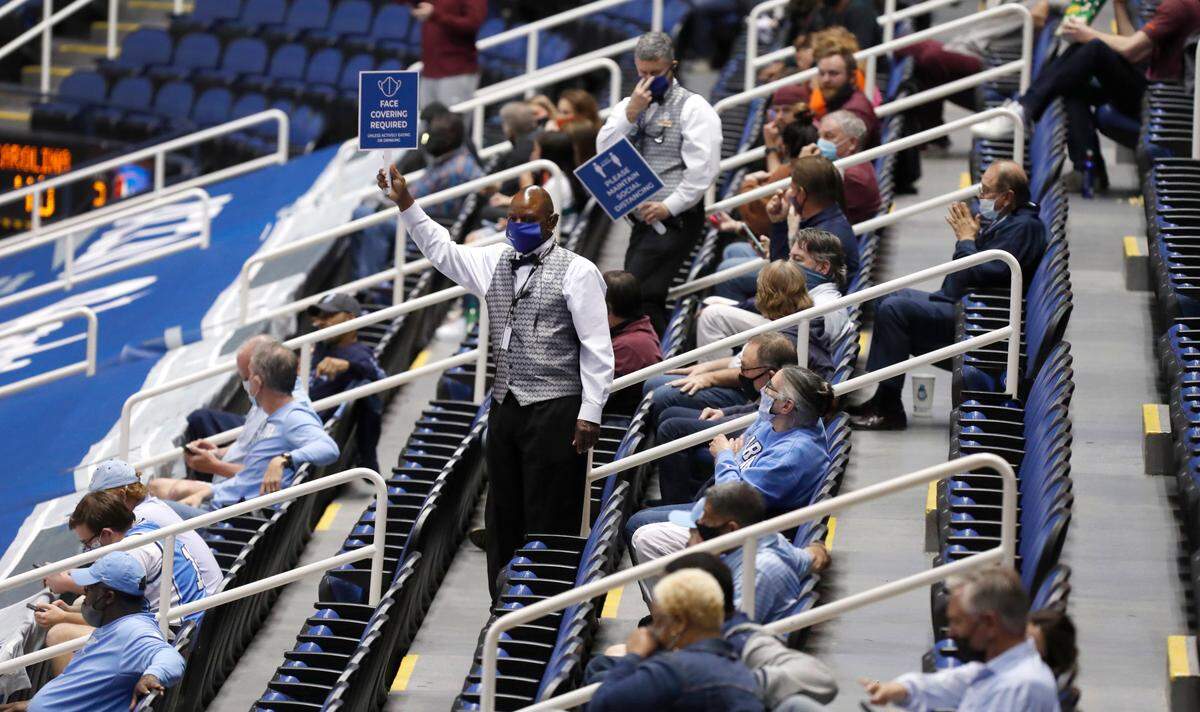
The return of the ACC tournaments to Greensboro — the women’s tournament was last week — ended a long year without events at the Greensboro Coliseum. One concession worker said he’d spent a lot of it cutting grass to pay his bills. Now after a long layoff, they had an event to work again. Ushers returned to a new responsibility: enforcing mask rules.
They carried signs up and down the aisles that said: “FACE COVERING REQUIRED.”
It brought to mind how much had changed since my last time in the coliseum. A year ago, I’d never heard of Zoom. I’d never worn a facemask, at least not the kind I don’t leave home without. I’d used hand sanitizer, but not religiously. I thought of the stories I’d covered the past year, many of them heartbreaking; and the people I’d met, many who shared stories of some of their worst days.
I thought about how quickly the energy disappeared in Greensboro, the streets emptying. Usually, the town embraces the tournament in a way that can’t be replicated anywhere else. Few cities share a connection with an event the way Greensboro does with the ACC tournament.
Driving around on Wednesday, that was still gone. There weren’t even any scalpers hawking tickets. The parking lot at Stamey’s, the barbeque restaurant across the street that’s been there forever, was mostly empty. Natty Greene’s, a local brewery, had opened a location across the street from the coliseum before the ACC tournament last year.
There was still a sign hanging outside that said it was “now open.” Next to it was an even larger sign, an advertisement that the building was up for auction. It’d been out of business for a while.
And yet there were small signs of hope, too. Not everybody who has made their way toward the coliseum this week has come for basketball. Some have arrived for a shot. A COVID-19 vaccination site is adjacent to the arena, close enough that when people arrive they’re greeted by signs directing them to basketball parking or vaccine parking.
A year ago, the coliseum emptied on a Wednesday night, people walking out and into an uncertain world. Now some had returned seeking something of a cure, or at least a few hours unlike any they’d been able to experience in a long time.
This story was originally published March 11, 2021 at 9:06 PM.