Tyler Zombro built a bond with batter who hit him in recovery from ‘horrific’ baseball injury
Tyler Zombro awoke in the hospital, surrounded by family. He didn’t know why he was there. He couldn’t remember. One moment he’d been on the pitchers mound at Durham Bulls Athletic Park, a promotion away from the Major Leagues, and in the next, he was on the move from the ICU to a regular hospital bed.
Everything in between remained a blur. In some ways, it still is.
Zombro, 27, likes it that way. He has never watched what happened to him. The replay is out there, easy enough to find, but he has no intention of ever seeing it, not “after I saw how negatively the video affected so many people around me,” he said earlier this week, almost a year after witnesses feared the worst when a line drive knocked him unconscious. There remains a gap in his mind, the moment before the pitch and waking up sometime after, his family around him while he came to.
He was confused. He remembers that much. He remembers wondering, “Like, what the heck happened?” and slowly his loved ones began explaining, and soon enough he became familiar with the technical terms: details of the skull fracture he’d suffered and the epidural hematoma, which is what happens when blood amasses between the skull and the brain.
He did not know then if baseball would be in his future. He did not know if he’d be able to walk normally or what disabilities, if any, he’d have to learn to live with. Two weeks after what Zombro calls “the accident” or “the incident,” he posted a thread on Twitter with details of his recovery.
In a video he shared, he could barely walk. In a photo he shared, half of his head had been shaved and a long, C-shaped incision made in his scalp to allow his brain to swell. In another photo he shared, that incision had been closed and, in a way, the side of his head resembled a baseball — a long row of tight stitches one of the earliest signs that the time for healing had begun. In the last photo he shared, a woozy-looking Zombro is looking into the camera, the top of his head half-hair and half-bandage, and he’s holding his hands together in the shape of a Bull, an homage to his team.
“I’m one lucky guy and can’t wait to get back out there (whenever that is)!” he wrote, though nobody could be sure that he really would be back out there.
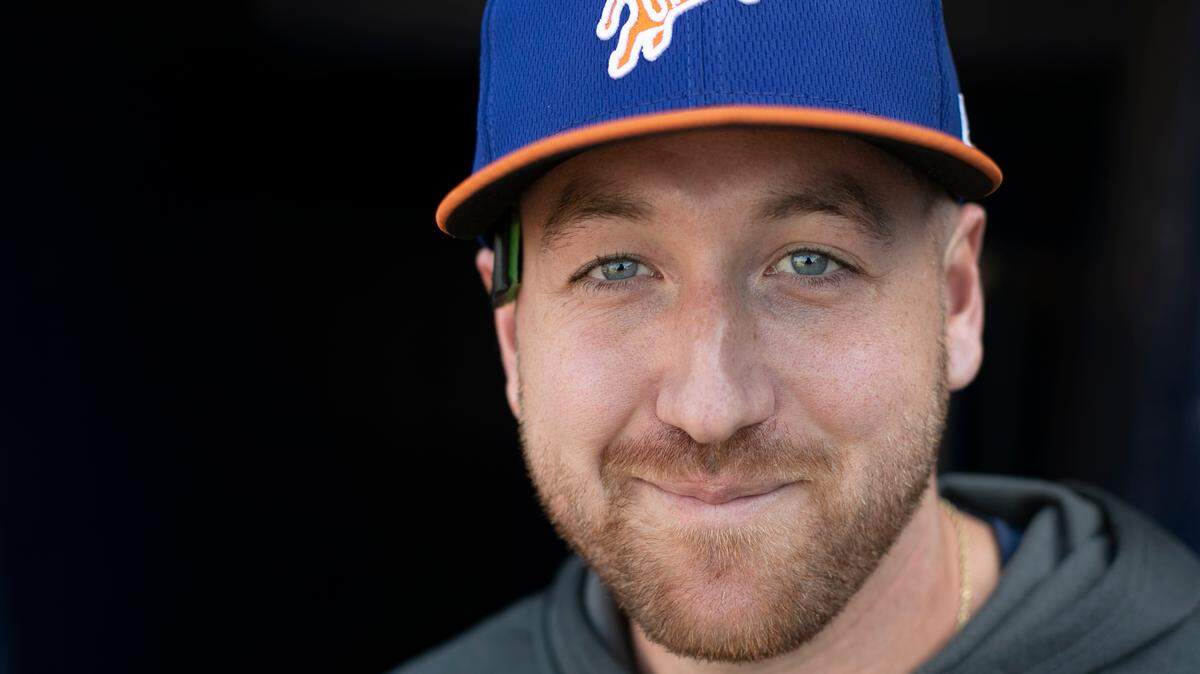
Now it was almost 10 months later, the final week of April. A perfect Wednesday afternoon in Durham, where the Bulls had begun a six-day homestand. Players arrived at Durham Bulls Athletic Park for a stretching session that began a 3 p.m. and batting practice followed. Then Zombro emerged from the dugout and stepped in front of the cameras and began telling his story, one that has captivated the baseball world since he suffered a heinous injury last June 3, one so scary that the game was suspended while paramedics rushed Zombro to the hospital.
There was no sign of it now. No visible scar and no hitch in his step and already the comeback was officially complete, what with Zombro appearing earlier this week, in Norfolk, Virginia, in his first real game since everything happened. He found comfort in being back, for he’d experienced some of the best moments of his life atop a pitchers mound but also the most devastating.
“It’s kind of a blessing that I don’t remember the accident,” he said, and he’d come to understand that he couldn’t fear what he couldn’t recall.
Aftermath of Zombro’s injury
Brett Cumberland remembers. He remembers the hit and he remembers the aftermath.
He remembers crouching when he reached first base because the emotion of the moment, the scene in front of him, no longer allowed him to stand. He remembers the sick feeling he carried into the night, “a terrible night,” he said, while he feared the consequences of what was then the most recent swing among the thousands of times he’d swung a baseball bat throughout his life.
Had that swing ended one man’s playing career? Had it done something much worse?
Cumberland and Zombro had never met. They’d grown up on opposite sides of the country; Cumberland in California, where he played in college at Cal, and Zombro in Virginia, where he played in college at James Madison. They’d been born less than a year apart and came to chase the same dream, both winding their way through the minor leagues, through stops in Bowling Green, Kentucky, and Montgomery, Alabama (for Zombro) and Jackson, Mississippi, and Bowie, Maryland (for Cumberland) before they wound up in the International League, in Triple-A ball and one level beneath the Majors, at the same time.
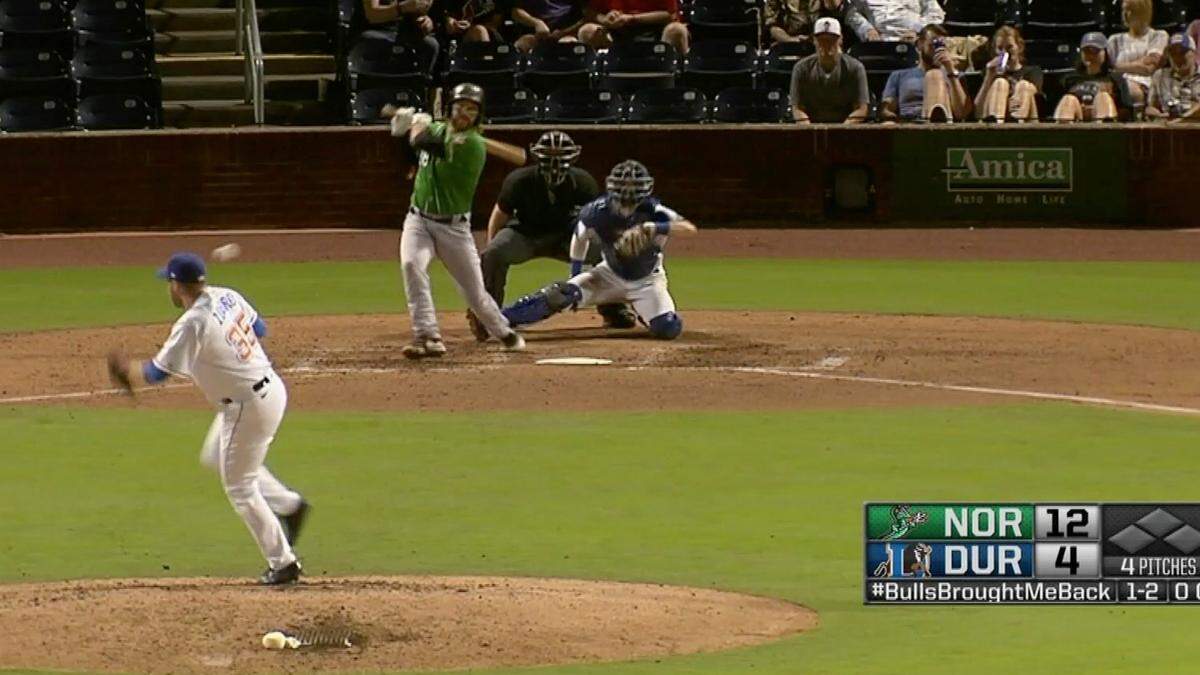
A long and random string of events had led them to the Durham Bulls and Norfolk Tides at the same time, and it was happenstance that brought them together June 3, 2021, when late in an otherwise forgettable game they stood about 60 feet apart from one another inside Durham Bulls Athletic Park. Cumberland, a catcher in his fifth minor-league season, came to bat in the top of the 8th. The Tides led 12-4. Zombro, a right-handed reliever in his fourth minor-league season, had just entered the game. Cumberland was the first batter he faced. The count was one ball and two strikes. Zombro went into his windup from the stretch and delivered a sinker. Cumberland swung.
The ball left his bat at 104 miles per hour and there was no time to react.
“It was definitely the most horrific thing I’ve seen on a baseball field,” Brady Williams, the Durham Bulls manager, said earlier this week. And yet amid Zombro’s terrible fate was one kinder, for “if something like that was going to happen, he was in the right city,” Williams said, and it didn’t take long to rush Zombro to the hospital.
That happened moments after the line drive struck the right side of his head. Zombro collapsed to the dirt and began convulsing. His teammates in the field covered their mouths with their gloves while they kneeled. Cumberland crouched and then knelt near first base. Paramedics rushed onto the field with a stretcher. The game stopped.
“I just immediately started praying for him,” Cumberland said, and he is a man of faith. He prayed throughout that long night. He waited for news. Part of him feared the worst because it was impossible not to for anyone who saw and could remember what happened.
Tyler Zombro’s return to the mound
There was a poetic symmetry in Zombro’s first game back, given his return came against the Norfolk Tides. He and Cumberland met for the second time, not during a game but before one. For months, they’d been keeping in touch, Cumberland receiving updates in the earliest days from Zombro’s mom, who became happy to share news of her son’s progress.
“Divine intervention,” Cumberland said earlier this week, by phone, of Zombro’s recovery.
It was a recovery that left some observers stunned by how quickly it progressed and even Zombro said his medical team “got me back to full functionality much quicker than I anticipated.” There’d been “grueling days” in the beginning, days when Zombro labored to walk or even to speak; ones where a successful speech therapy session represented a momentous victory.
At first, he made a goal of incremental improvement: “Just get 1 percent better each day,” he said.
Despite the transient nature of Minor League Baseball, players and coaches coming and going, the Bulls became something of a second family; a support system. It wasn’t a one-way exchange, Williams said, because Zombro’s recovery “became kind of like a motivating factor for everybody.”
“It really motivated all of us to be better every day, to work hard, because he was not able to do that,” Williams continued. “Our motto was just ‘Keep going.’ That’s what we all said to him.”
Soon enough, Zombro began imagining the possibilities. His strength slowly returned. He began walking without assistance. He progressed out of speech therapy. His cognitive function returned to normal. Hair grew back over the half of his head that’d been shaved, covering the scar of an injury and moment that conjured all kinds of haunting adjectives: Horrific and gruesome and ghastly. Now the scar is hidden, as invisible to Zombro as the memory itself.
When the Bulls traveled to Norfolk last week, Zombro expressed his desire to meet with Cumberland. When it happened, the two men embraced, the way that Zombro’s parents embraced Cumberland in the days after their son’s injury. That’d been an emotional moment, Cumberland said of the time he’d met Zombro’s parents for the first time, and so was this, last week, coming face to face with the player on the other end of the most traumatic hit of Cumberland’s career.
Cumberland told Zombro that he was elated by his recovery, that he couldn’t wait to see him pitch. Zombro told Cumberland that he didn’t want him thinking about what happened, haunting him.
“My concern will always be that he gets into the (batters) box and he’s thinking about that incident, not doing well with it,” Zombro said. “And I don’t want that to alter his career at all. So to hear him say, ‘I’m excited for you to get back on the mound, excited to see your pitch’ — that meant a lot to me, and shows me that he’s moving on from it.”
“And I told him,” Cumberland said, “I said it kind of shows your character and what kind of guy you are. And he was asking me how I was doing, you know?
“And I thought that was truly amazing.”
Zombro made his season debut last Sunday. The crowd in Norfolk gave him a standing ovation. The team offered a tribute on the scoreboard. Cumberland stood against the railing of the dugout and watched, just like he told Zombro he would.
“I’m so thankful that he’s alive,” Cumberland said later, “and that he’s pitching and doing what he loves. ... I just feel like I have a deep love for Tyler and his family. And I’m a huge fan his now.”
They’d become friends, each one admiring the other’s strength; each one praising the other’s ability to respond to a moment that connected them.
Zombro couldn’t remember it. Cumberland would never forget.
It had shaped them both, the brief flash of time that began with Zombro’s pitch and ended with Cumberland’s line drive. Now, on Sunday, Zombro stood on the mound again. He said he wasn’t afraid. He wore a protective insert in his hat, a kind of lining made of kevlar, and it had taken him a while to become used to the weight — 12 ounces — but it had become “just second nature to me.”
Zombro allowed a lead-off double. Some early jitters, perhaps, before he retired the next three consecutive batters. And there was his manager, Williams, waiting with a hug and “it was awesome,” Williams said, to share that moment with Zombro after a return that once seemed so improbable.
It wasn’t too long ago when Zombro’s goal was to walk again like he walked before, and to talk normally, and then to regain his strength and to throw, and then to face a batter again. Now the goal is what it was before everything happened, and that goal is the same as Cumberland’s goal and the same for every player enduring the not-all-too-glamorous grind of the minors.
“Obviously, to get to the big leagues,” Zombro said, articulating that hope. “You know, that’s all of our dreams here.”
What he’d been through had changed him, though, the way it would change anyone. It had changed Cumberland, too, whose faith had only grown stronger, but for Zombro, the experience offered perspective and made him slow down; it made him appreciate smaller moments with his wife and the journey in pursuit of something greater.
“Everybody wants to be a big leaguer,” Zombro said, “but you can’t wish the minor-league time away either,” and now he understood more than most about how quickly something could be lost. He’d come to appreciate the small gap in his mind, the inability to remember what happened to him, but the absence of memory had itself become something of a reminder.
There was a pitch. Then a fade to black. Then an awakening, and a new beginning.
This story was originally published April 29, 2022 at 6:00 AM.