
Farewell to Rickey Henderson, lightning-fast hero of my youth
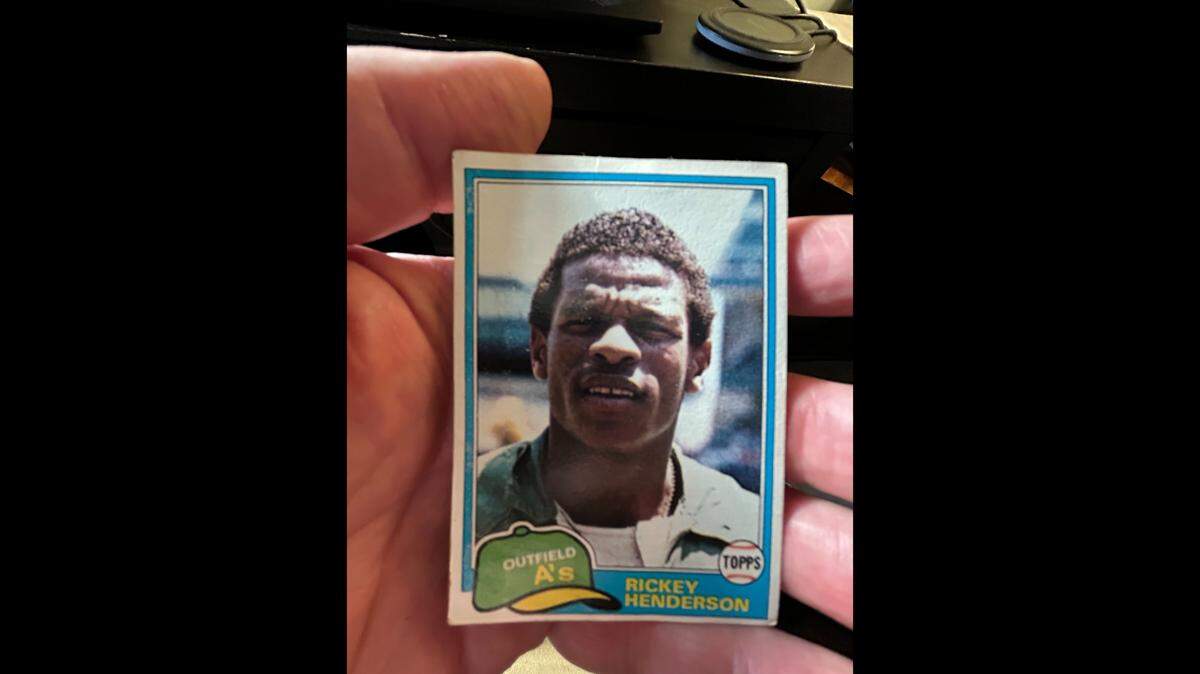
When I was an 11-year-old kid with skinned knees, tube socks and a Huffy bike, the Oakland A’s occupied about 90% of my thoughts: who was pitching that day, who was batting .300, and above all else, what daily spectacle dropped down from the heavens courtesy of Rickey Henderson.
In San Jose, California, where I spent my childhood, we were unaccustomed to winners of any kind, having suffered through the Giants of the 1970s, who were so chronically terrible their shortstop Johnnie LeMaster printed the word “Boo” on the back of his jersey because that’s what people yelled when he came to bat.
The A’s had long since sold off their colorful stars: Catfish Hunter and his handlebar mustache, Rollie Fingers and his twirly mustache, Reggie Jackson and his mustache of infinite swagger.
But then in 1981, the A’s suddenly fielded a team that not only played to win, but did so in sneaky, unorthodox and almost underhanded ways — a style that Rickey Henderson defined.
It wasn’t just that he smacked home runs, which he did. It was the way he crouched down at the plate like a cat waiting to pounce, thoroughly annoying the unlucky pitchers who faced him, driving them to tears. You couldn’t help but walk him.
And once you walked him, he stole second like he was collecting rent. He took third base like it was rightfully his. Then he crossed home plate on a ground ball, and you realized the A’s had managed to score a run without getting a hit.
There was never a more electrifying player to watch: He slid head-first and came up dirty and smiling. He hit leadoff home runs 81 times. He famously talked to himself out loud, often in the third person. He played deep into his 40s, seemingly immortal.
And now that he is gone, somehow dead at 65, I mourn him most for the intense brand of fandom he inspired, a sense of excitement I can no longer summon about much of anything — an obsession available only to a kid in a grass-stained A’s cap.
Let me give an example:
In 1982, Henderson stole 130 bases in a season, a record that will likely stand for eternity. But as a sixth-grader, I followed it so closely that I could have told you the running total on any day of that summer. I witnessed him stealing two of them: 92 and 93, if I remember correctly.
I used to pick up aluminum cans on the side of the road and recycle them for spending money, and I would bet myself that if I could collect 130 by the time I got home, Henderson would break the record.
I didn’t think about Star Wars as much as I thought about Rickey Henderson, and in 1982, we didn’t even know yet if Han Solo was ever going to get out of his carbonite prison.
Rickey Henderson signed an autograph for me twice. My friends and my dad and I would wait outside the clubhouse after a game, and he would emerge with his sunglasses and his shirt half-buttoned, exposing his gold chain with a diamond-studded no. 35 on it.
I can see his looping signature now, an unbroken line of letters with a giant H in the middle. I stored both of those autographed baseballs in my box of Legos, where they disappeared.
As the tributes pour out today, so many writers fixate on his Yogi Berra-esque quotes, delivered famously in first-person: “Rickey don’t like it when Rickey can’t find Rickey’s limo.” I’ve read a biography that suggests this quality of his has been exaggerated.
More will focus on his feuds with the equally legendary Yankees owner George Steinbrenner, which doesn’t much interest me, because everybody feuded with that man.
I’ll always see Rickey Henderson through the awestruck eyes of a kid who still thinks sports matter. I miss that kid, and I’ll miss Rickey.