As college football season draws to an end, what can NC schools be in changing landscape?
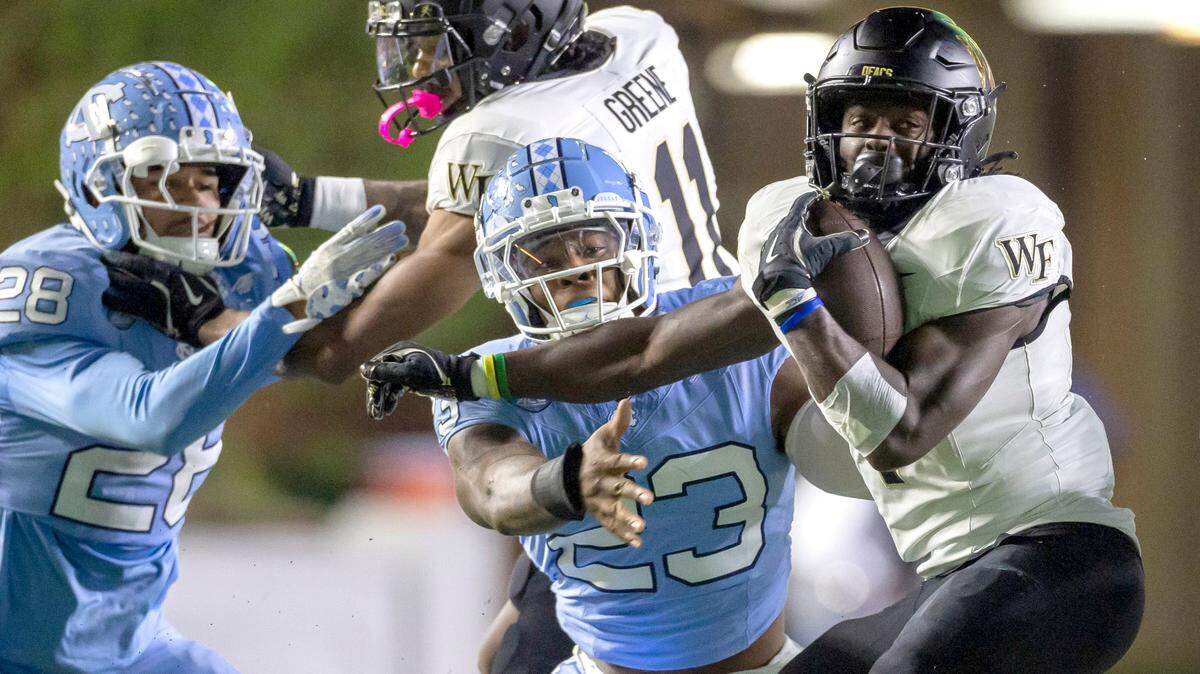
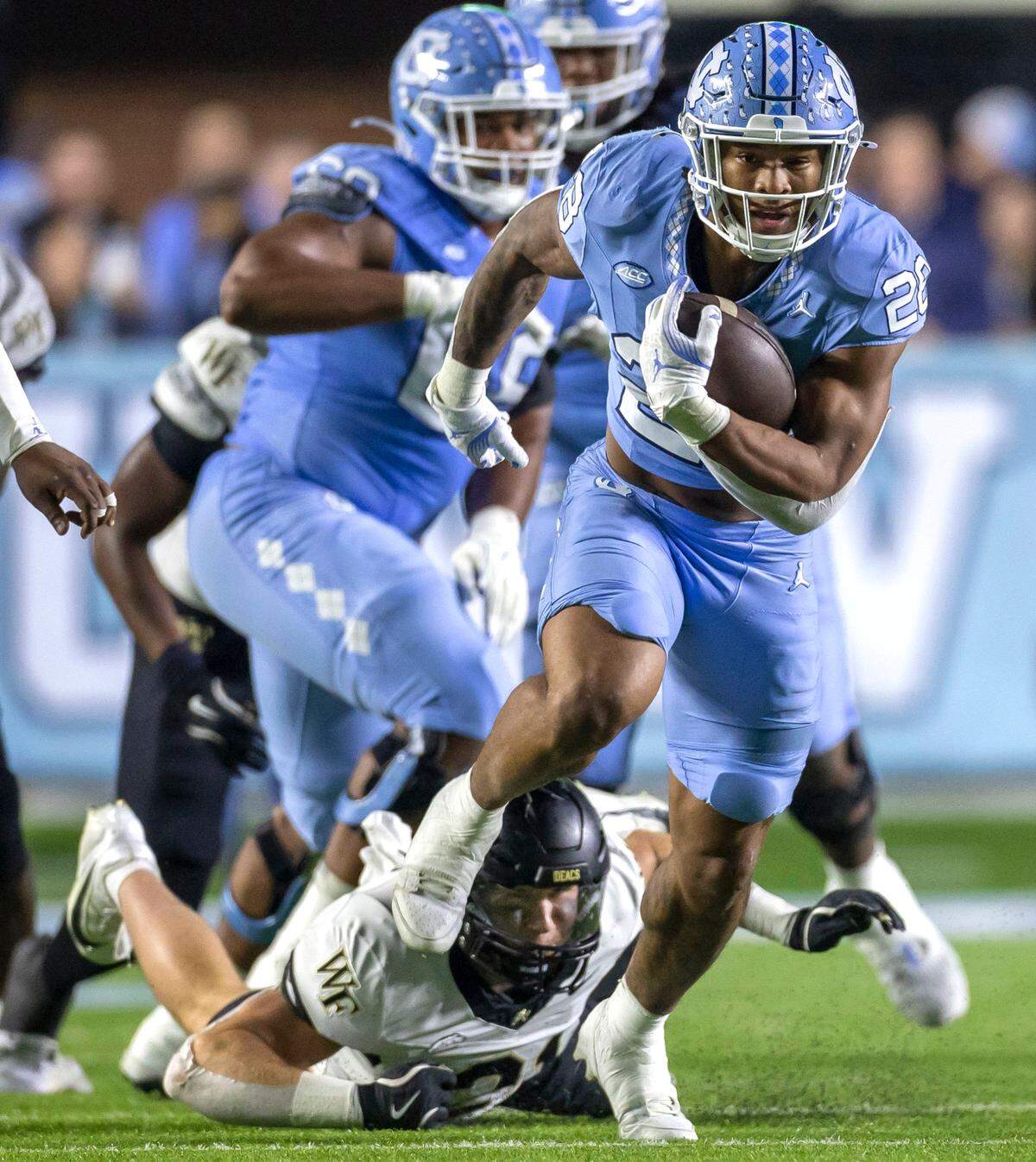
On the field, the difference between North Carolina and Wake Forest on Saturday night at Kenan Stadium wound up being only a touchdown. The Tar Heels persevered for a 31-24 victory, thanks in no small part to Omarion Hampton’s 244 yards rushing, and afterward coach Mack Brown praised his team for “staying confident, staying tough” and finishing in the fourth quarter.
“This was a great fight,” Brown said.
He wasn’t wrong. This was the kind of game, especially at this point in the season, that UNC has trouble winning in recent years: close and competitive, and requiring some mettle. The Demon Deacons have not had a particularly good season, and yet they showed up and tested a more potent and talented in-state rival on the road. That’s no small feat, in itself.
And yet as evenly matched as these two teams appeared on the field and scoreboard Saturday night, it was difficult to put aside their reality outside of those things: UNC, with its brand power and status as a flagship public school in a state without an SEC or Big Ten presence, will remain a coveted target should those leagues decide to expand. Wake Forest? Not so much.
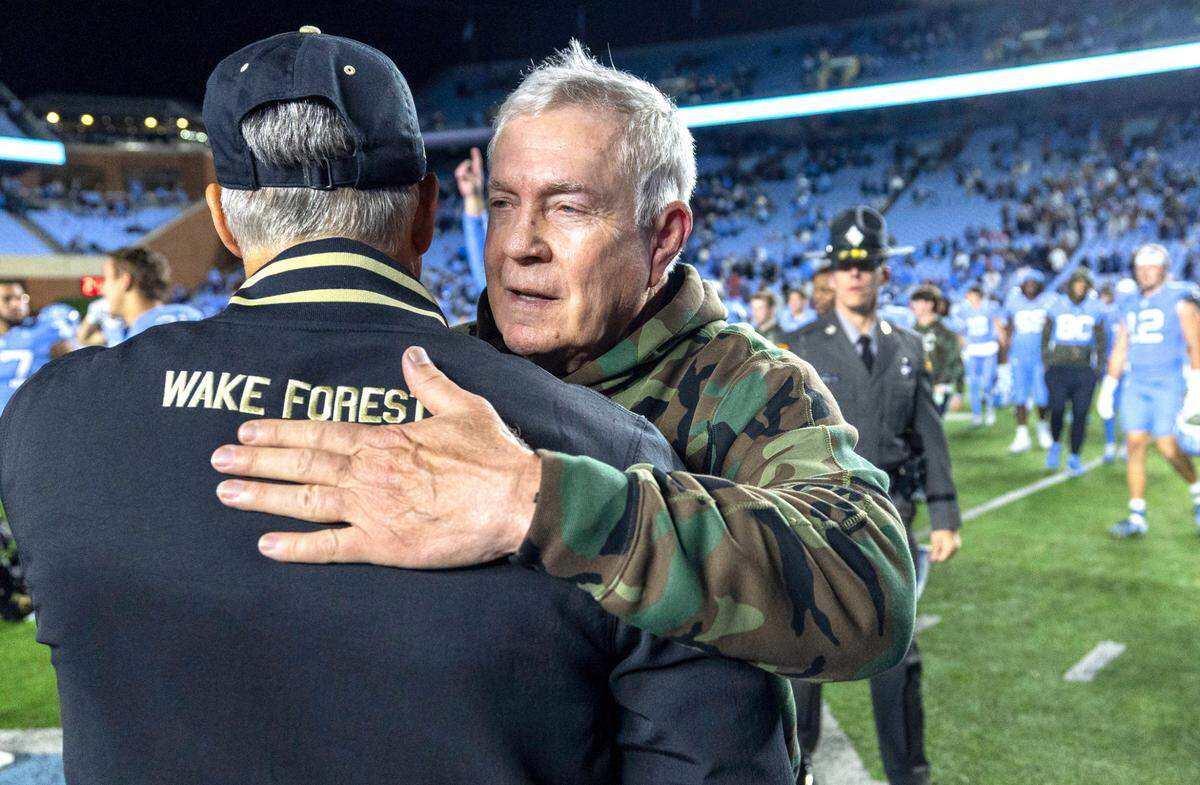
That’s not fair, or right, of course. On the field, Wake has proven itself as a reliably competitive program. The Demon Deacons are three years removed from an 11-win season and even in this, a second consecutive relative down year, they have a road win at N.C. State and were a break or two away from perhaps walking out of Kenan Stadium with a victory, too.
But so much of college football these days depends on variables well beyond the field. Schools’ futures in the sport, and maybe in college athletics, as a whole, appear to be more tied to their Q Score and so-called brand recognition. Television ratings matter a lot more than they ever should. And then there’s NIL and fundraising and money-spending, and the reality that less prestigious programs — even in power conferences! — are becoming feeders for the bigger and wealthier.
Some of that explains Wake Forest’s downturn the past couple of seasons. At Wake, Dave Clawson, now in his 11th season as head coach, built his program on ideals that now suddenly feel antiquated and quaint. (And they shouldn’t feel that way, for the record, but they do.)
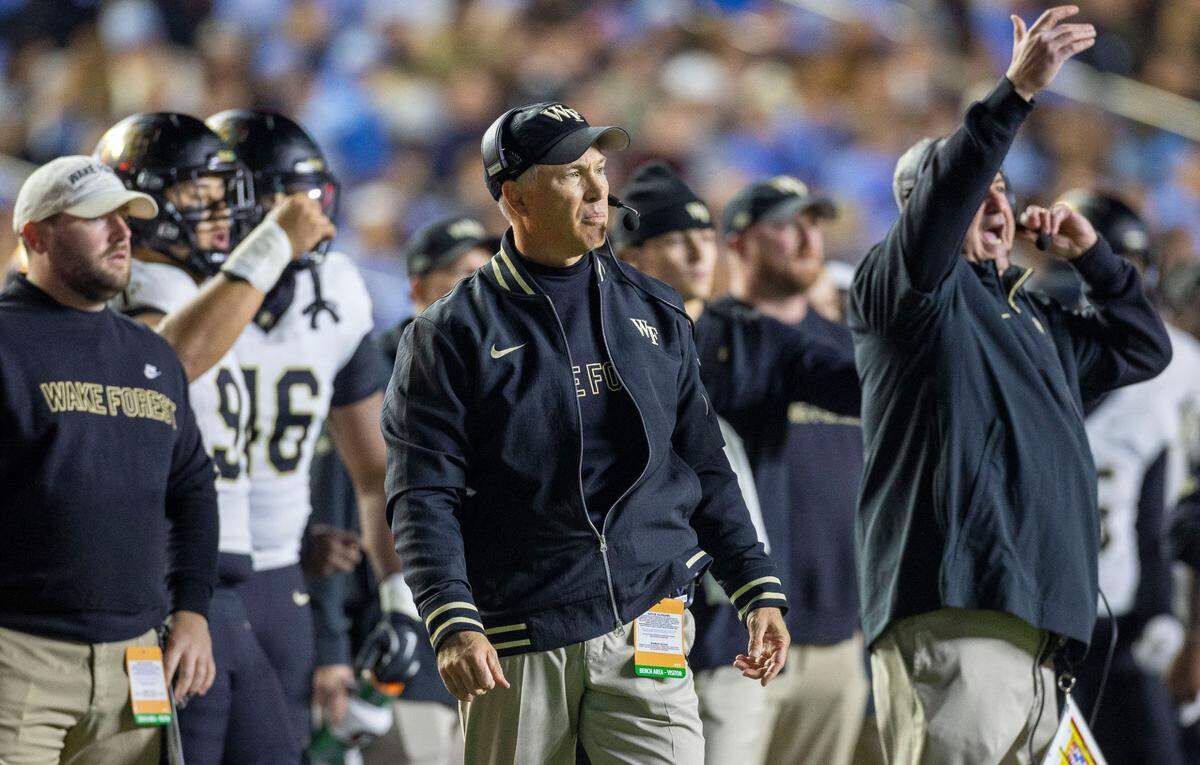
For years, Clawson and his staff found talented high school players other programs had missed. They found prospects, too, who fit into Wake’s broader campus culture, and who had a legitimate desire to attend school there. Then they developed those players, often keeping them as back-ups or end-of-bench reserves for two or three seasons before they were ready to contribute.
The result was seven consecutive years of bowl eligibility, three seasons in which Wake entered the top 20 of the Associated Press top 25 poll and that memorable 2021 season — which suddenly feels like ancient history. And feels that way in large part because of how much everything has changed. On the field, Wake cannot run its program the way it did — not without NIL and the transfer portal and constant roster rebuilds.
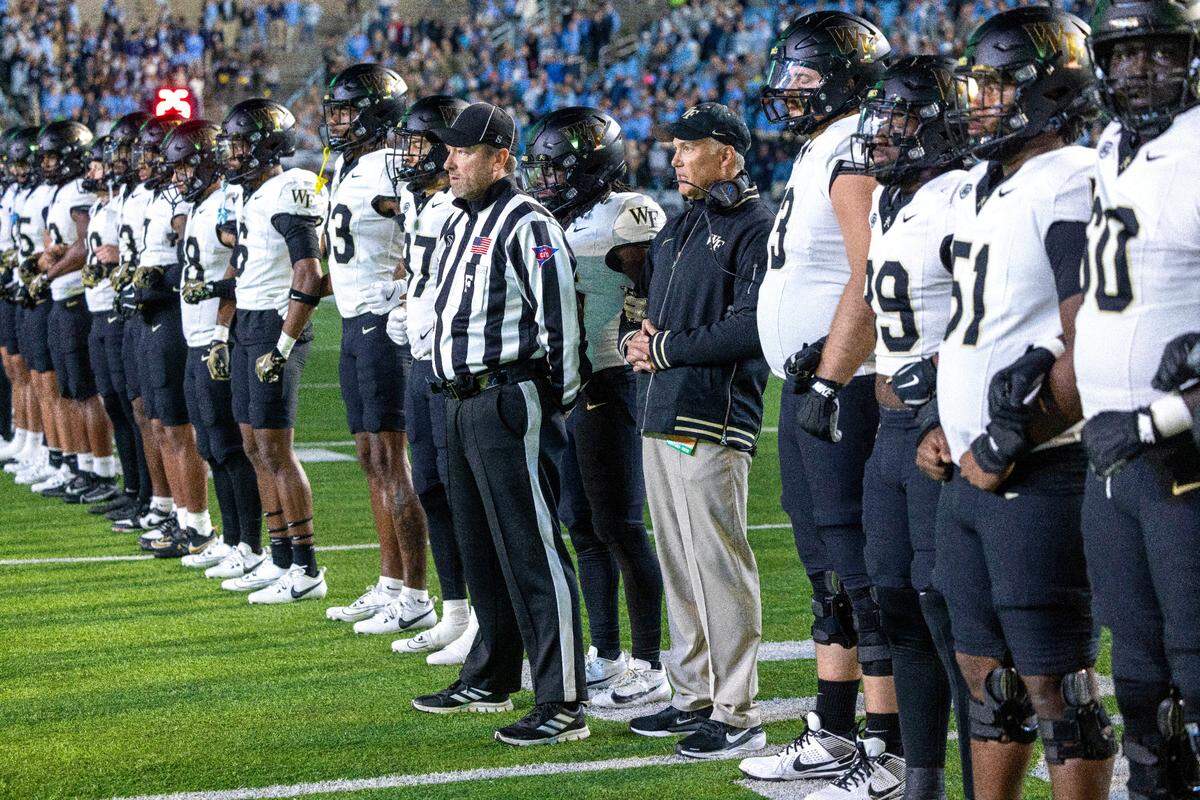
Those players Wake once convinced to hang around for years and develop? It’s just not happening that way, nearly as often, as it once did. The larger problem for Wake is how it fits into this landscape, overall. One could argue, successfully, that over the past 25 years or so Wake Forest has out-performed North Carolina on the field (which isn’t saying much, but still).
The Demon Deacons have the (much) more recent ACC championship between the two (2006, for Wake, compared to 1980 for UNC). They have the more recent 10-win season (2021, compared to 2015). They have the seven-year bowl streak, compared to the six-year streak the Tar Heels are on. And yet who is the (much) more desired school in this supposed realignment sweepstakes? Hint: It’s not the one with the more successful football program going on the past quarter century.
It all underscores the absurdity of an absurd sport. Not so much that UNC would be desired in such a way by the Big Ten or SEC because, sure — the Tar Heels have the name recognition and the athletics pedigree, at least in basketball and several other sports. But if they belong at the table, then so does Wake Forest. So does Duke. So does N.C. State. In the sport that’s driving all this change, UNC is hardly better (and often worse) than its Big Four rivals.
The greater question, as we approach the end of a pretty middling college football season in North Carolina, is what any of these schools can really be in a sport that is becoming less and less about how good you actually are between the lines. And what do North Carolina’s seven FBS schools even really want to be?
How do Appalachian State, Charlotte and ECU, for instance, try to keep up when the highest levels of the sport keep distancing themselves? What do the state’s small private ACC schools, Duke and Wake Forest, have to do just to maintain their place — and are they willing to do those things over the long term? And if they are, how do they maintain their academic reputations? And for State and Carolina, how do they get off the hamster wheel of mediocrity? Can they, really?
Just a few years ago, it was possible for a school like Wake to, you know ... build a program and actually find a way to compete. It’s not that easy any more, and it hardly was easy back then. In a way it was the same as always at Kenan Stadium Saturday night, with Wake Forest punching up and proving pesky and hanging around, giving itself a shot. In another way, though, the distance between Wake and UNC grows wider — and has nothing to do with anything on the field.
ONE BIG THING
Just how good has Omarion Hampton been this season? Consider: his 1,422 rushing yards rank second nationally, behind Boise State’s Ashton Jeanty (with an even more ridiculous 1,893 yards). Hampton’s 244 yards Saturday night tied for 11th in a single-game in school history.
Considering that UNC has played 1,284 football games over the past 103 years, that’s pretty good. After Saturday, Hampton is now fifth in rushing yards in school history, behind Michael Carter, Leon Carter, Mike Voight and Amos Lawrence. Hampton should easily move up to third by season’s end.
CAROLINAS RANKING
1. South Carolina (Gamecocks have now won four in a row. Outside of Curt Cignetti at Indiana, has any coach done a better job than Shane Beamer?); 2. Clemson (Tigers have won eight of nine against South Carolina but could find themselves losers of two of the past three when they play later this month); 3. North Carolina (UNC is now bowl eligible for the sixth straight season — its longest such streak since seven seasons in a row in Mack Brown’s first tenure there); 4. Duke; 5. Wake Forest (outside of losses to Ole Miss and Clemson, Deacs have had a shot in their other four defeats. That’s something?); 6. N.C. State; 7. Coastal Carolina; 8. ECU; 9. Appalachian State; 10. Charlotte.
FINAL THOUGHTS, IN NO PARTICULAR ORDER
▪ I think the regular format for this weekly roundup — complete with a rundown of things to like, etc. — will return next week.
▪ I think Omarion Hampton is making a strong case to crack my Heisman Trophy ballot. There’s been no better power conference running back in the sport this season, which figures to be his last in college. With two games remaining (assuming Hampton doesn’t play in the bowl game), he needs 299 yards to break UNC’s single-season rushing record. That’s ... doable? It is.
▪ I think if UNC wins its next two, against Boston College and N.C. State, and ends the season on a five-game winning streak, Brown would have done enough to earn another season, if he wants it.
▪ I think, going back to Wake Forest, another way to measure the Demon Deacons’ year-in and year-out ACC competitiveness is to put it like this: It hasn’t had a 10-loss season since 1995. Florida State, which is suing the conference because it thinks it’s too good for the lowly ACC, appears headed toward a 10-loss season this very instant. But again: brands. Ratings. In this backward college sports world, that’s what matters.
This story was originally published November 18, 2024 at 10:11 AM.