ACC expanded West for football TV money. Basketball teams, among others, pay the price
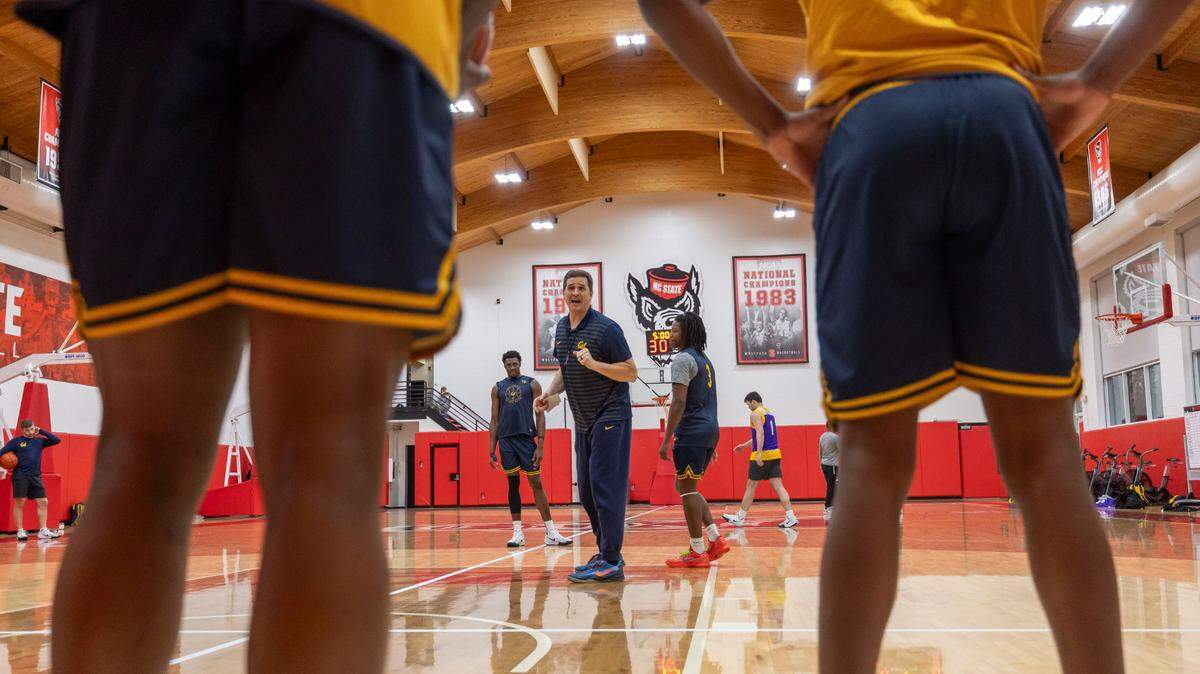
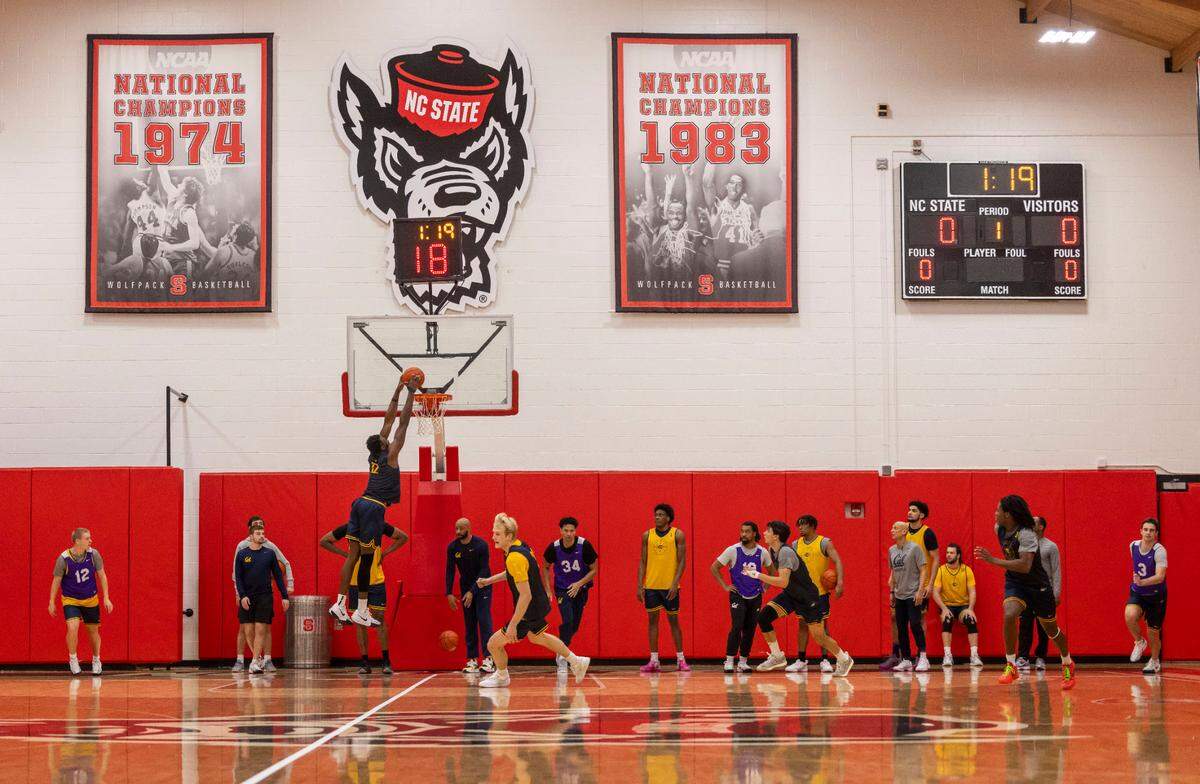
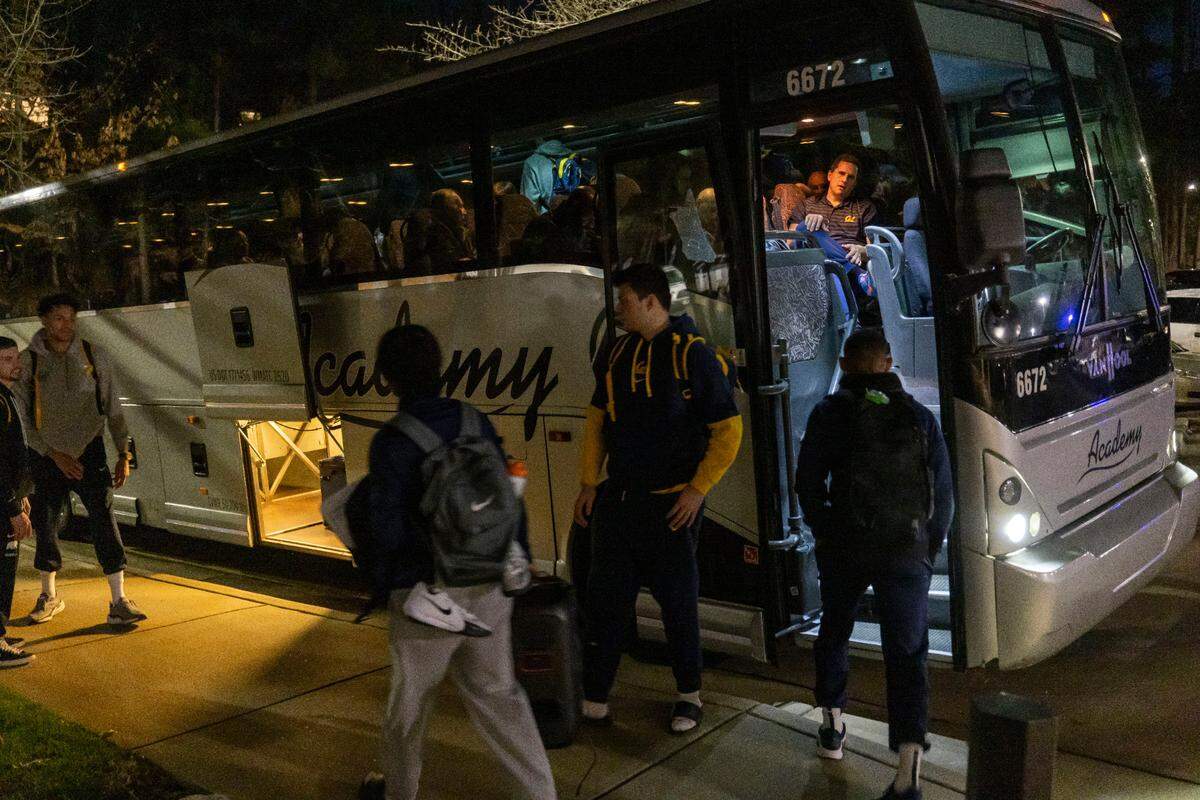
On the fifth night of a six-day trip to the East Coast, the California men’s basketball team gathered for a practice at N.C. State’s on-campus facility, the Golden Bears preparing for a conference game 2,800 miles from home. They settled into a familiar cadence of drills while their second-year head coach, Mark Madsen, barked orders and a lot of it looked normal. Perfectly normal.
But then there was the reality that they were three time zones from their own campus, and in their second hotel since arriving in North Carolina; there was the reality that they were still on the road, college kids turning in a Monday-to-Friday work week across the country in this bizarro world of major college athletics — these abnormal times that have become, well, more and more normalized.
This wasn’t the NCAA Tournament, in which long trips are sometimes and even often part of the experience. This wasn’t some November or December invitational somewhere warm, in Maui or the Bahamas. This was a week in the life of the new ACC, once America’s most geographically-constrained major conference but now a bicoastal behemoth of a league.
Cal’s practice session at N.C. State came last month during the second of the Golden Bears’ four extended trips East for what are now conference games. After something of a travel reprieve of a few weeks, Cal, along with Stanford, is back East this week — the Golden Bears at Duke on Wednesday and Georgia Tech on Saturday and Stanford at those same schools on opposite days. States in the ACC’s traditional footprint — North Carolina, South Carolina, Georgia; but North Carolina, especially — are becoming a home away from home for rivals a short ride away from the Pacific Ocean.
The figurative and literal heart of Tobacco Road has always run through North Carolina, and through the Triangle, in particular, but metaphorically it once stretched into Maryland and down into South Carolina, too. And now there’s a feeder highway that runs all the way to the Pacific, not that teams from Cal and Stanford will ever have to traverse it.
Flying back and forth across the country, though, has proven difficult enough.
‘This is college sports. Things change’
When Madsen became Cal’s head coach in late March, 2023, he was enamored with the thought of coming back to the Pac-12. A native of California’s Bay Area, he grew up around the conference and then was an All-American in the late 1990s at Stanford, where he helped lead the Cardinal to the 1998 Final Four.
The history and tradition of the Pac-12 meant something to Madsen. So did the culture of the conference and its rivalries. The league already found itself in a precarious place when Madsen accepted the job at Cal, but then it collapsed in the months that followed.
In July of 2023, Colorado announced its intention to leave for the Big 12. Then Oregon and Washington in early August of that year accepted invitations to the Big Ten. Arizona, Arizona State and Utah soon announced they were leaving, too, for the Big 12. By the end of that month, after weeks of fraught negotiations, Cal and Stanford found lifelines in the ACC — and Madsen suddenly found himself destined for work in another league, based on another coast.
“Everything fell apart,” Madsen said recently, toward the end of his team’s practice at N.C. State. “And my wife was looking at me and said, ‘I thought you said you were going to be on the West Coast.’ And I said, ‘Well, baby, this is college sports. Things change.’”
The reasons for those changes, as it relates to the destruction of the Pac-12 and major conference realignment, are well understood. Conferences have grown larger and wealthier — and others more in danger of being poached — on account of the relentless chase of more television money, which is driven in large part by the strength of a conference’s football television ratings.
Leagues have grown larger in hopes of becoming more attractive to their television broadcast partners. Schools have been eager to align themselves with the Big Ten and SEC, the two wealthiest conferences. The Pac-12 “fell apart,” as Madsen put it, because its TV deal fell apart first. And the ACC added Cal and Stanford (and SMU, which officially joined the conference in 2024 at the same time) in large part because of the additional television “inventory” they’d bring.
And yet the often-overlooked question about all the conference movement in college athletics is also the most obvious (and perhaps ignored): If football has driven all of these changes, where does that leave every other sport? “Often on an airplane,” is one reasonable answer, especially in the newly-reconfigured and now coast-to-coast ACC and Big Ten.
‘Tougher than the NBA’
The logistics of it all is one of the primary challenges but hardly the only one. Shasha Brown, in his second season as Cal’s do-everything director of basketball operations, learned one thing early on while preparing for this season and all the travel that was to come:
“There’s no real blueprint,” he said. It wasn’t like “we could sit and convene with others in the field in terms of best practices, because it’s literally the first time” regular coast-to-coast travel like this has become the norm in college sports.
“You know, Coach played in the NBA for 10 years,” Brown said of Madsen, who spent nine NBA seasons with the Los Angeles Lakers and Minnesota Timberwolves. “And even in the NBA, you don’t make trips like this, right?”
It’s true, according to Madsen. During his years with the Lakers, first as a back-up to Shaquille O’Neal and then as an assistant coach, he became accustomed to the rigors and rhythm of the NBA travel schedule. It could be difficult at times, he said, and relentless — but, to him, what he’s doing this season with his players at Cal is even more difficult.
To make their ACC schedules work, both Cal and Stanford are making four trips across the country in the span of about 12 weeks. That doesn’t include another trip they’d make for the ACC Tournament in Charlotte, if they both qualify (out of the conference’s 18 schools in basketball, only the top 15 will make the league tournament — Stanford, which is 8-5 in league play, is virtually assured of making it and Cal, 5-8 in the ACC, is also in good position to qualify).
Though the sample size is small, and not exactly scientific, teams traveling the farthest in the newly expanded ACC have often fared poorly. At least outside of Wake Forest. The Demon Deacons last week went West and defeated Stanford and Cal. Outside of Wake, though, ACC teams are 4-16 in conference games three time zones from their campus. Cal and Stanford are both 1-3 out East; the ACC’s East Coast schools, meanwhile, are 4-10 out West.
Each of Cal and Stanford’s four regular-season trips across the country requires them to be on the road for almost a full week. Cal and Stanford arrived two days before their recent Wednesday games in North Carolina and didn’t return to California until Saturday night — or Sunday morning. A similar schedule awaited both teams this week.
It is not so much the length of those trips but the repetitiveness that most concerns Madsen. In the NBA, coast-to-coast travel is maximized so that the visiting team plays several road games in any given trip. One of Madsen’s former teams, the Lakers, for instance, will play four games during one upcoming East Coast trip that begins with a Jan. 30 game in Charlotte.
The team’s next trip to the East Coast doesn’t begin until a March 8 game at Boston. In contrast, Cal and Stanford are making trips East more often, and for fewer games. Madsen said it “would never happen” in the NBA — that a team would travel across the country to play only two games at a time, before traveling back across the country within a few weeks to play twice more.
“In some ways,” he said while his team finished practicing at N.C. State, “this is tougher than the NBA.”
Finding a rhythm
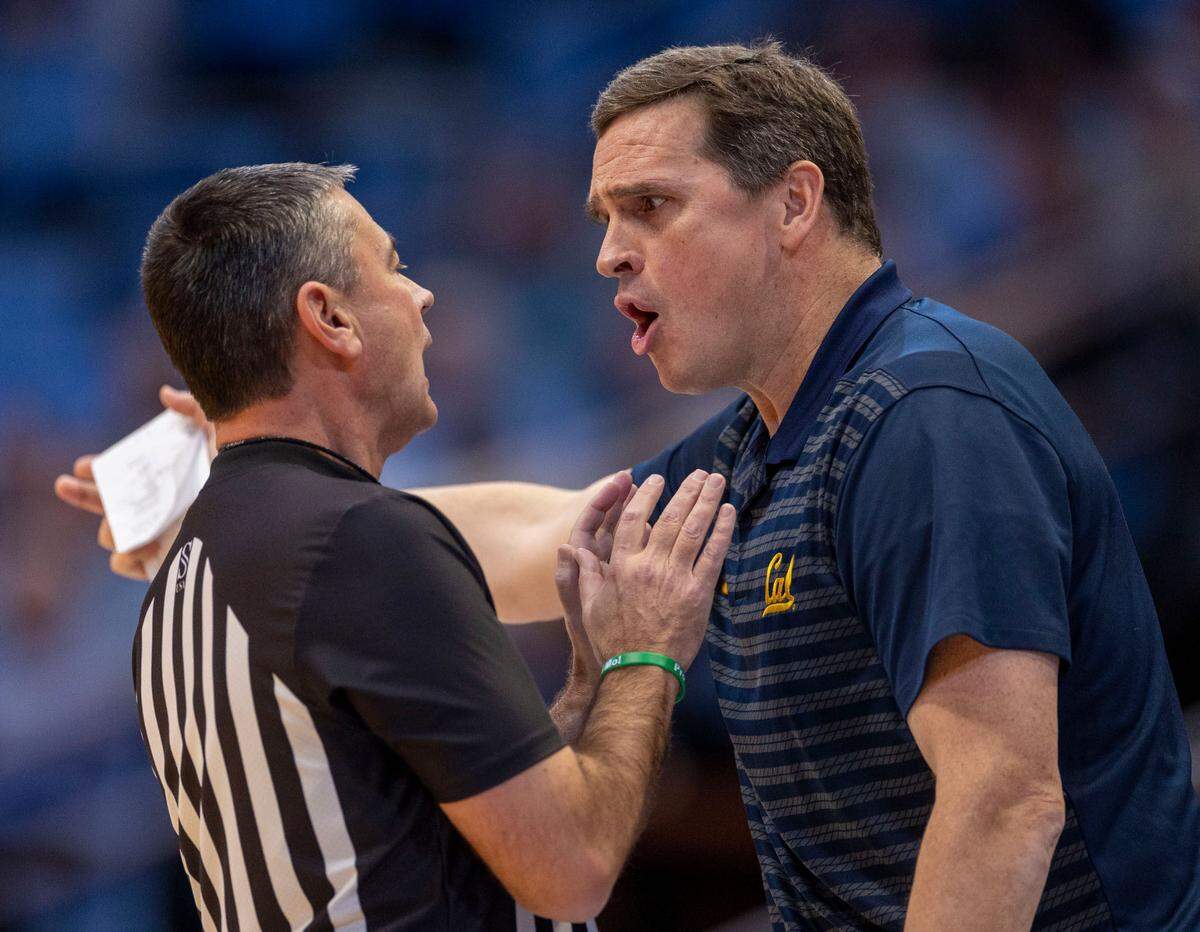
Madsen, a colorful personality remembered for his affable demeanor as a pro, and for his viral antics during two Lakers championship celebrations in the early 2000s, has retained his relentless positivity and charm over the years. He has put a good spin on Cal’s place in college athletics, and in its foreign conference, and he said recently that “I love that we’re in the ACC.”
And yet in the same breath, he acknowledged the other side of it: “That in a way, I am bummed.”
The feeling of loss is among the main reasons why. During his years at Stanford, Madsen loved the road trips throughout what was then the Pac-10 — and loved silencing the crowd at UCLA’s Pauley Pavilion, especially. Cal has lost those regular chances to compete against most of its old rivals, and among those with deep ties to the conference “all of us were devastated” by its demise, Madsen said.
As a coach, though, he has found himself bummed for a different reason. He worries about what all of this travel will do to his players, and about its emotional and mental toll.
“And ultimately,” he said, “you’re missing out on some aspects of the college experience because you travel so much.”
Both Cal and Stanford tried to prepare for it in scientific ways. At Cal, Madsen and members of his staff consulted with two “sleep guys,” as Madsen described them — including one scientist, “a Cal grad,” Madsen said, “who works with NASA astronauts on recovery across time zones.” Brown, the operations director who’s in charge of setting the travel schedule and team’s itinerary on the road, has helped keep the team on West Coast time as much as possible early in these East Coast trips.
The goal there, Madsen said, is to “get some element of circadian rhythm.”
A moment later, he added: “You’re looking at me like I’m crazy.”
Madsen was serious about adhering to the circadian rhythm. Upon arrival in North Carolina, for instance, the Golden Bears spent Monday and Tuesday on West Coast time. The team ate breakfast on Tuesday at around noon. It approached its game on a Wednesday night at North Carolina as if it was in the afternoon.
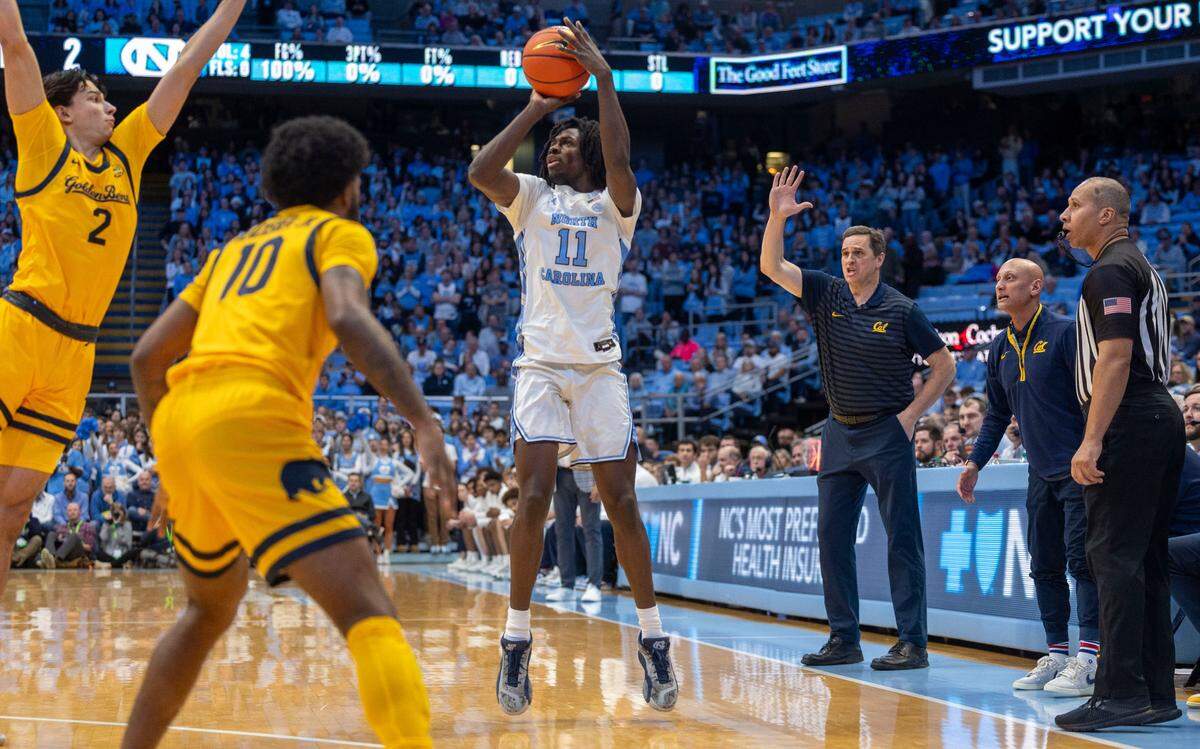
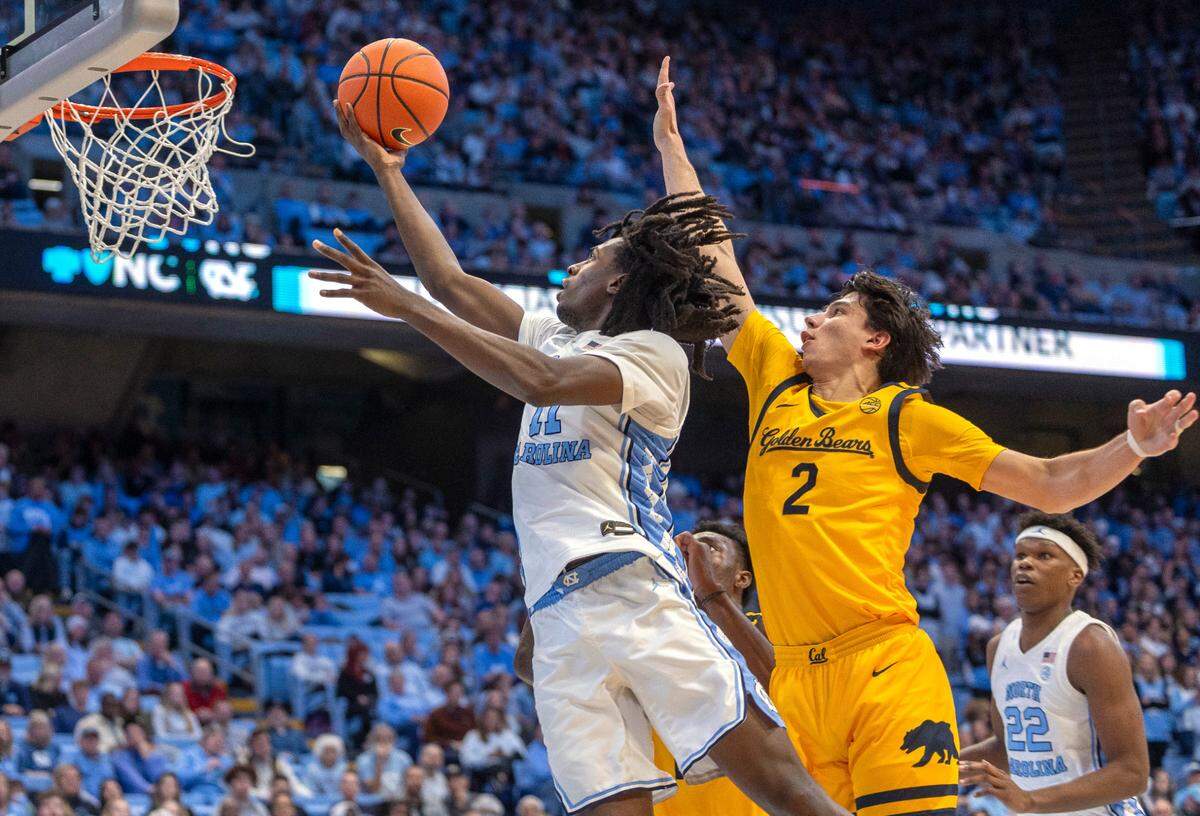
And yes, it felt unmistakably strange in the Smith Center when it began: UNC and Cal playing each other in Chapel Hill as conference opponents, separated not by eight miles of pine trees — as an old melodramatic ESPN promo went about the Duke-UNC rivalry — but almost 3,000 miles of pine trees, piedmont, mountains, plains, prairie, more mountains, desert, some more mountains and a bunch of interstate.
“It did definitely feel weird,” UNC junior guard Seth Trimble said, “ seeing the team come all the way from California, just warm it up on a court getting ready to play” a conference game.
“It felt weird with SMU. It’ll feel extremely weird if I’m here next year and I’ve got to go to California. That would be crazy.”
After a one-sided UNC victory, he said he didn’t envy his new ACC rivals, and their life on the road.
Team bonding
It hasn’t been all bad, though. The travel has allowed Cal and Stanford visits to places their coaches and players and support staff otherwise might never see. A couple of Cal staffers, for instance, walked around the Smith Center wide-eyed about 30 minutes after their team’s defeat there, taking in the history on the walls; the pieces of two Final Four courts hanging in one of the tunnels.
Madsen had never played or coached a game at UNC. Same for any at Duke. Before his team’s trip to North Carolina to play against Wake Forest and UNC, Stanford coach Kyle Smith praised the chance to visit “the heart of Tobacco Road.”
“We want to be a part of it and prove we belong,” he said.
These long trips also allow team bonding opportunities that otherwise might not exist. Teammates can learn a lot about each other during a long plane ride, and during extended stays in hotels.
“These long trips have brought out a couple different personalities,” said Andrej Stojaković, the Golden Bears’ sophomore guard. “Especially bringing on card games and the stuff that we do in our free time during traveling.
“And it’s just great getting to know the guys on another level besides basketball.”
Stojaković, whose father, Peja, excelled during a 13-year NBA career, said he’d never spent any time in North Carolina before Cal’s trip to the state. He hadn’t been farther East — in the United States, at least — than New Orleans.
Is earlier better?
The consequences of this kind of travel, though, are only beginning to be understood. Both Cal and Stanford’s first ACC trip to the East Coast — and Cal’s second — coincided with a gap in their academic calendars. But Stanford’s final three regular trips East, and Cal’s final two, will force their players to miss about a week’s worth of courses.
“Some of our guys are in online classes,” said Brown, who arrived at Cal when Madsen began his tenure there. “Which makes it a little easier. Some of them take asynchronous classes, which just means there’s not a set time.
“But again, you know, we have Rytis Petraitis, who’s an engineering major — like a mathematical engineering major, right? So he has to be in class. So it’s going to be interesting to see how he navigates.”
Brown said the ACC’s East Coast teams have made their academic buildings available to Cal and Stanford during their long trips. During Cal’s next two trips, it will travel with a tutor and an associate athletics director who will proctor exams remotely, if needed.
Both Madsen and Smith, the Stanford head coach, have ideas about how to mitigate the effect of the long travel. Madsen would like to see the ACC maximize his team’s winter academic break and schedule Cal to play at least four East Coast conference games then, when school isn’t in session. That, though, would require East Coast ACC teams, many of which often slow down during their own winter breaks, to alter their schedules.
At the least, Smith has pushed for Cal and Stanford to play earlier games on the East Coast before traveling back West. He recently reviewed his team’s home schedule for Saturday conference games and noticed that none, against the league’s East Coast teams, begin later than 1 p.m. West Coast time.
“So it looks like they accommodated them to get their butts back home,” he said, “and I would advocate for playing our games at 1 o’clock on the East Coast and vice versa.”
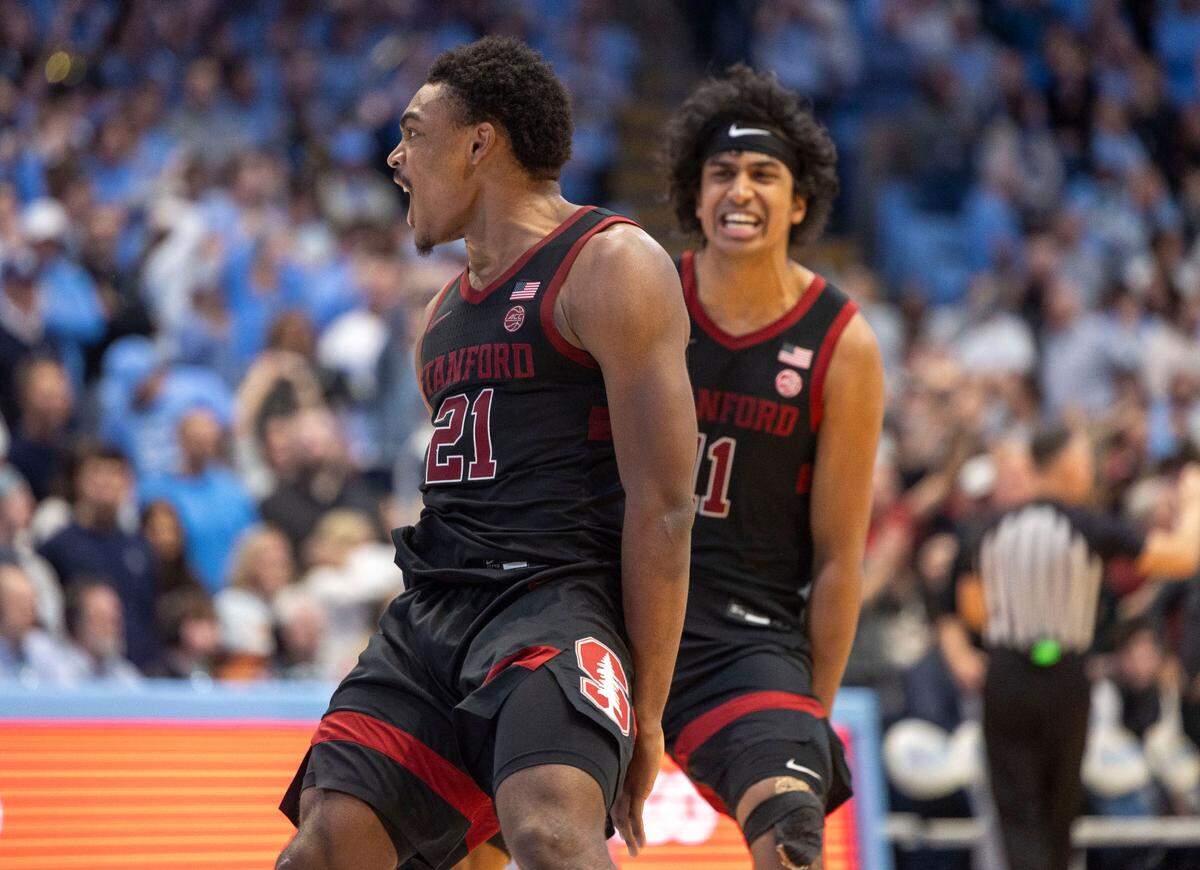
Cal and Stanford lost their first three ACC games on the East Coast, and all by double digits. They finally created some better luck in their most recent games farthest from home, though. At UNC, Stanford’s Jaylen Blakes, who transferred there from Duke, made a shot just before the buzzer to give his team a narrow victory. And later that Saturday, Cal prevailed in a close game at N.C. State.
When it ended, it was time for the Golden Bears to head to the airport. A long flight back to Oakland, California, awaited. First, though, the team’s plane had to stop in Albuquerque, New Mexico for a refuel. The team landed in Oakland a little before 3 a.m., local time.
It’d been a long day, and night. And now, it gets to do it all over again.
The News & Observer’s Inside Look takes readers behind the scenes to illuminate the people and places in our community.
This story was originally published February 11, 2025 at 5:05 AM.