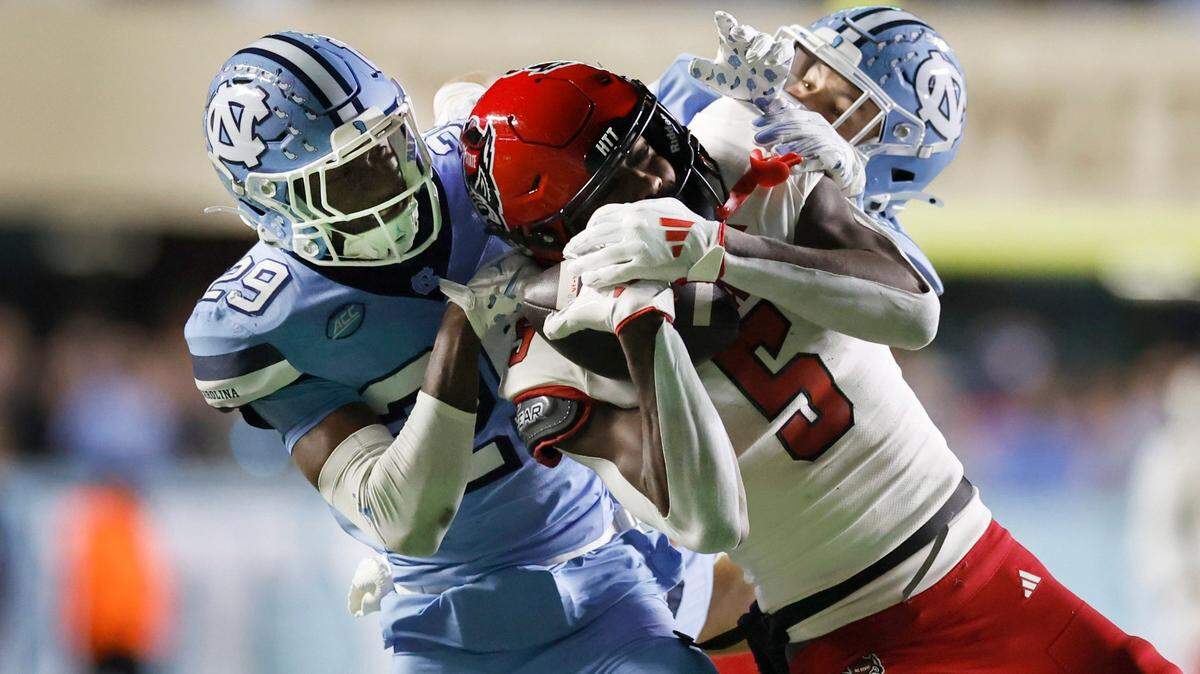
N.C. State wide receiver Noah Rogers (5) pulls in a 44-yard reception while being defended North Carolina’s Marcus Allen (29) and Will Hardy (31) late in the fourth quarter of N.C. State’s 35-30 victory over UNC at Kenan Stadium in Chapel Hill, N.C., Saturday, Nov. 30, 2024.
Ethan Hyman
ehyman@newsobserver.com
NC General Assembly passed HB 378, shielding NIL contracts from disclosure laws
Critics argue new exemptions limit transparency on publicly funded NIL payments
Gov. Stein faces 10-day deadline to veto or sign bill impacting student-athlete data
RALEIGH
Information about name, image and likeness contracts will not be subject to public records laws under House Bill 378, passed by the North Carolina General Assembly last week.
Gov. Josh Stein signed the bill Tuesday. He had 10 days from June 26 to sign, veto or automatically allow the bill to become law. He did not comment.
The bill includes multiple proposed changes to education-related laws, including the authorization of NIL agency contracts and regulations. It also adds language to General Statute 132-1.2, which discusses confidential information.
The new wording, added two months after the bill was originally filed, says public agencies would not be required to share information that “reveals records related to a student-athlete’s name, image and likeness contract,” exempting them from public records law. This applies retroactively to student-athlete NIL contracts possessed by higher education institutions.
The bill received bipartisan sponsorship and support from the state legislature, passing 111-0, with nine lawmakers absent.
Local First Amendment and Intellectual Property attorney David McKenzie criticized the lawmakers’ decision to pass this bill and allow for an exemption to be made. He said the bill contradicts G.S. 126-23, which requires disclosure of salary information for state employees. Salary is defined as “pay, benefits, incentives, bonuses, and deferred and all other forms of compensation paid by the employing entity.” This information is public and available to view by any person during business hours.
“It’s a way of taking the public records law and nibbling it to death like they are ducks, if you will,” McKenzie said. “There’s no real good reason to exempt these from public record statutes. Coaches are no different. They’re involved in athletics, and we expect their salaries to be disclosed. I don’t believe it is a situation where FERPA applies.”
FERPA, or the Family Educational Rights and Privacy Act, protects grades, transcripts, disciplinary records and other academically-related records. It does not protect employment records. McKenzie said non-athlete student workers are also subject to open records laws.
Basic salary information can be found online through the state’s higher education database, which includes athletic coaches and other support staff. Universities are required to supply contract information, as well. UNC provides its primary athletic contracts, such as football coach Bill Belichick and men’s basketball coach Hubert Davis, on its website. Non-listed contracts are provided upon request. Other state institutions provide contracts via request.
McKenzie said Stein should veto the bill. He does not believe there is anything else that must be passed immediately.
“It was tacked on at the last minute [and] public resources, in the form of taxpayer money, are going to fund these NIL deals, either directly or indirectly,” McKenzie said. “The public needs to know about the value of these deals — possibly going into millions of dollars. No credible person, in politics or otherwise, can claim to say that how taxpayer money is spent is worthy of secrecy. It seems to me that a pretty basic constitutional expectation is to be able to share that information with the public.”
History of the bill
Rep. Ray Pickett, a Republican from Watauga County, originally filed the bill on March 11 allowing community colleges to release education records to the parents of dependent minor students who have dual enrollment. It did not include language about NIL deals, admissions evaluations, technology costs or capital project appropriations.
Reps. Tricia Cotham, a Mecklenburg County Republican, Zack Hawkins, a Durham Democrat, and Ya Liu, a Democrat from Cary, are also listed as primary sponsors of the bill.
NIL guidelines were originally presented in Senate Bill 229. That was originally filed on March 4 and passed multiple readings before being merged into the house bill.
Sen. Bob Brinson, a Republican from Beaufort County, said on April 2 in a Senate Higher Education meeting the purpose of the bill was to expand the definition of agency and contracts, and it would differentiate between professional and NIL contracts and the agents involved.
“NIL contracts reviewed by the educational institutions for compliance with laws or eligibility policies would be exempt from public records request,” Brinson said. “This did pass the Senate last biennium, unanimously, and I know of no opposition to this bill.”
Guidance regarding NIL contracts, as part of HB 378, was presented on June 12, after the original bill was read by the House and Senate, according to the General Assembly’s website. Representatives voted on the bill 12 days later.
The public records exemption was last in the 10-page bill, following several other issues.
“I think that was by design, and it certainly doesn’t pass the smell test,” McKenzie said. “It was included at the last minute. There was no room for meaningful public debate. In fact, I don’t even think that the public knows about it.”
The News & Observer called all four representatives offices multiple times seeking clarity about when the NIL terms were added to the bill, by whom, why the contracts are not being considered employment records and why they were included in the particular House bill, as opposed to remaining separate. At the time of publication, no answer had been received from any of the primary sponsors.
McKenzie said the funding could be used to support early childhood education or children who need academic support. Instead, money is being used to pay players for athletic competition.
Since Stein did not veto the bill, McKenzie said recourse would be to sue the universities’ major administrators as a violation of the state constitution, under G.S. 126-23.
“The problem is going to be that other states have already passed these bills but they did it with very little discussion, as well,” McKenzie said, prior to the governors’ approval. “The buck needs to stop at Stein on this one.”
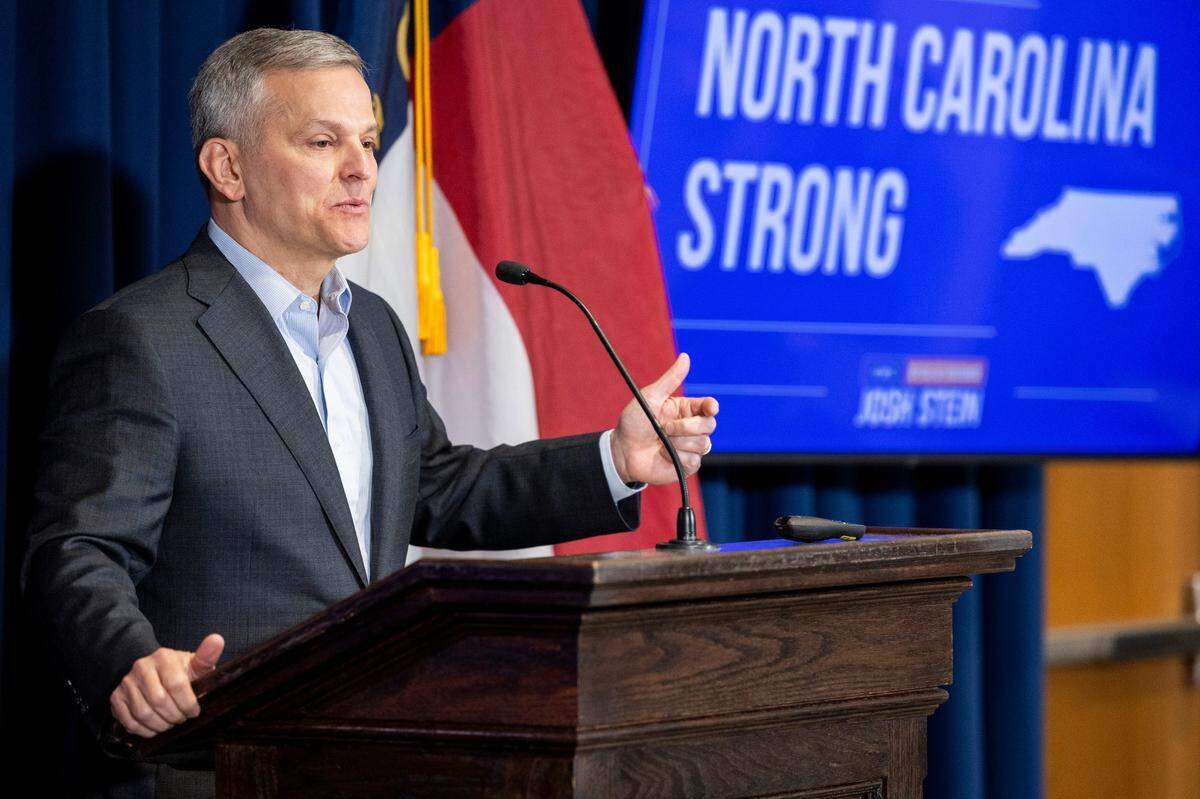
Gov. Josh Stein announces his 2025-27 state budget proposal during a press conference Wednesday, March 19, 2025, at the Albemarle Building in Raleigh. Travis Long tlong@newsobserver.com
Are student-athletes university employees?
No. Although, McKenzie said they should be and universities should not be allowed to classify student-athletes as independent contractors. He said it seems obvious that student-athletes not only have less agency than a contractor but they have less freedom than most traditional employees.
Student-athletes must abide by dress codes, specific schedules, they are told what drills to perform, and even when to eat, McKenzie said.
“It’s pretty much preposterous to claim they’re an independent contractor, not subject to an employee-employer relationship, and therefore subject to the public records law that would disclose this information,” McKenzie said.
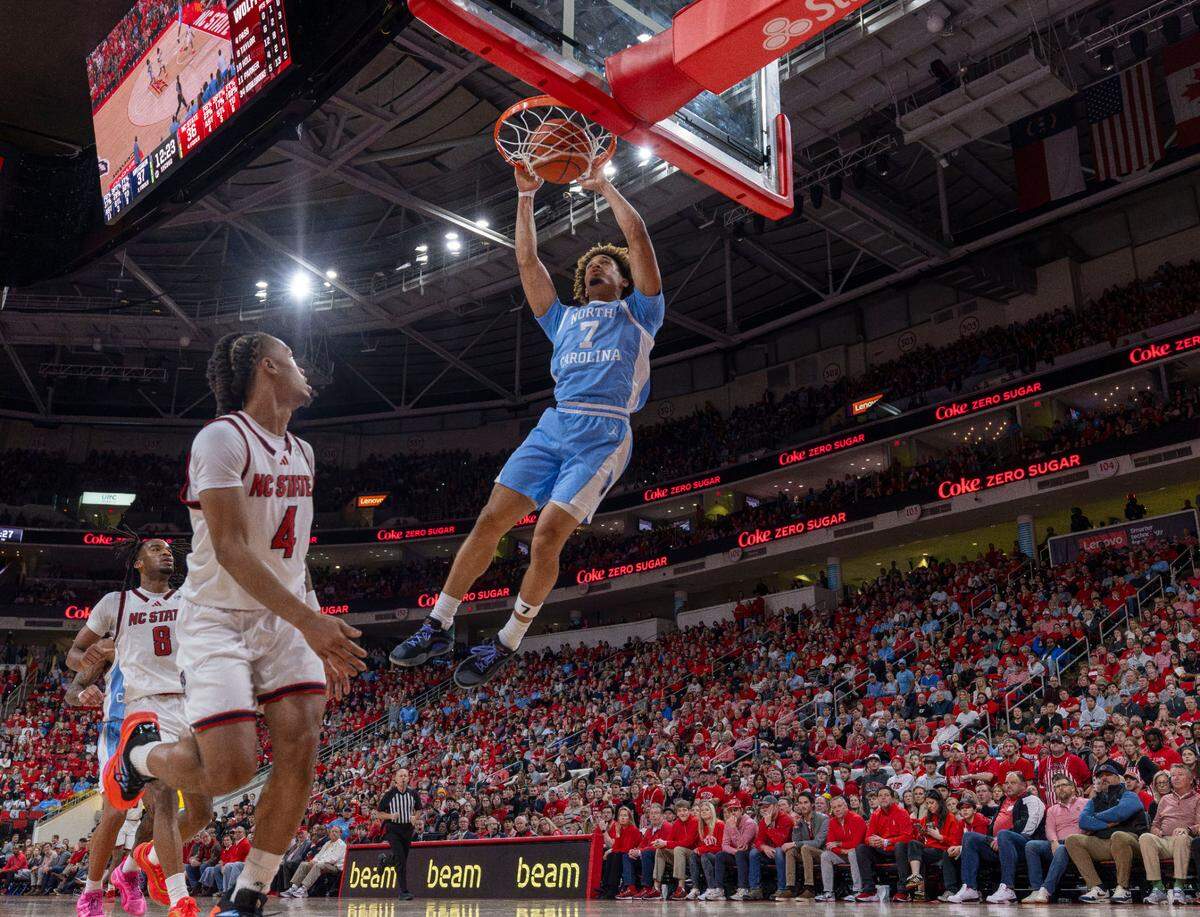
North Carolina guard Seth Trimble (7) breaks to the basket for a dunk over N.C. State’s Breon Pass (4) in the second half on Saturday, January 11, 2025 at Lenovo Center in Raleigh, N.C. Robert Willett rwillett@newsobserver.com
Tar Heels, Wolfpack could receive sports gambling revenue
UNC and N.C. State could become the latest of the state’s universities to receive funding through taxes collected on sports gambling. Previously, the two were not among the universities to receive tax revenue. They were included in the state budget proposals, but the Senate and House proposals give the two flagship universities different amounts.
Online sports betting was legalized in March 2024 and the state has collected more than $143.7 million from the operators, who pay 18% on gross wagering revenue. Based on the House proposal, the Wolfpack and Tar Heels would be set to receive an estimated $26.3 million each over the next two years, matching what Charlotte, East Carolina and Appalachian State receive.
The Senate budget proposal would give N.C. State and Carolina nearly $56 million over the next two years, while Charlotte, ECU and App State would receive $11.6 million.
A new budget has not been passed after the House and Senate were unable to agree to a new financial plan, so UNC and N.C. State are still not included.
Despite this not passing, more than a dozen state institutions receive funding through sports gambling revenue and N.C. State and UNC are public universities. Open records laws should still apply, McKenzie said.
“If you don’t like sharing information with the public,” McKenzie said, “don’t take the public’s money.”
Higher education reporter Korie Dean and politics reporter Dawn Baumgartner Vaughan contributed to this report.
This story was originally published July 1, 2025 at 3:17 PM.