
What we learned about Duke football in its 28-26 loss to Pittsburgh on Saturday
Duke losing a football game to Pittsburgh is far from shocking news, given the Blue Devils have only defeated the Panthers once since the school entered the ACC in 2013.
The how on Saturday, when Pittsburgh prevailed 28-26, offers clues about the ways Duke approaches football this season and the manner in which the Blue Devils are playing currently.
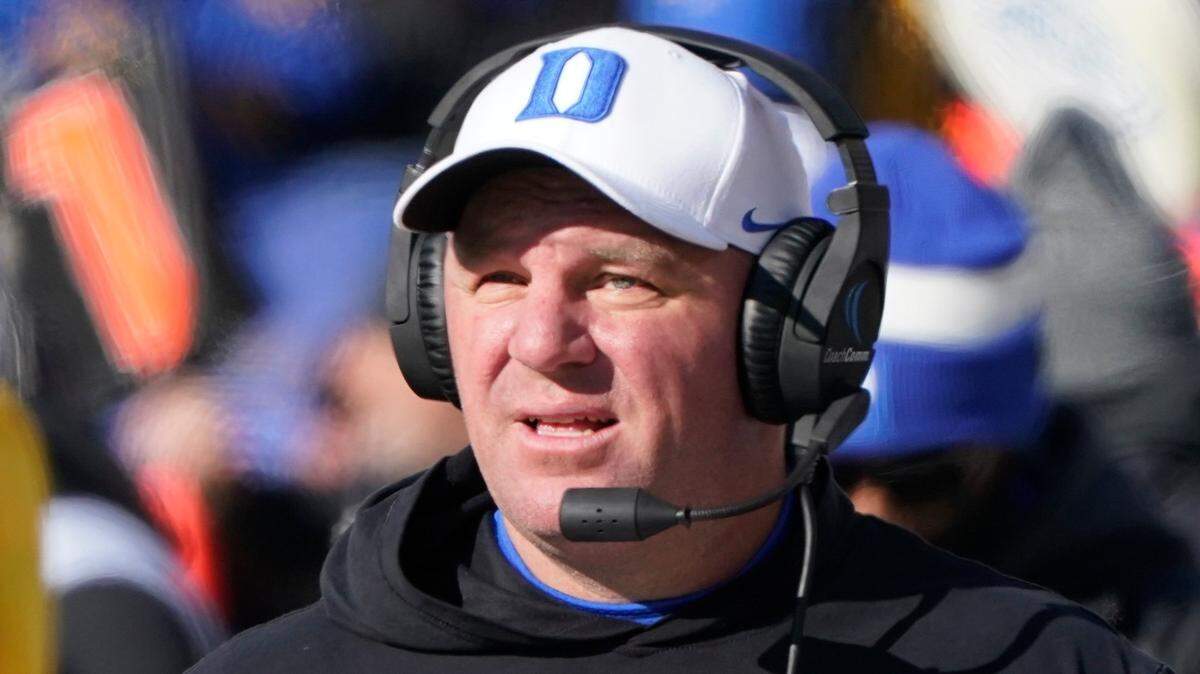
The Blue Devils (7-4, 4-3 ACC) entered the game having won three consecutive league games for the first time since 2015. First-year head coach Mike Elko fully employs analytics in decisions on whether or not to punt, when to try a field goal or not and in two-point conversion calls.
The goal, each time, is to put the Blue Devils in the best position to win.
On Saturday, a cold, raw November day at Pittsburgh, Elko took stock of the weather conditions and his team’s sputtering running game (a rarity this season) and factored those into analytics as well.
That’s why, when Duke trailed 28-14 but scored a fourth-quarter touchdown, Elko instructed the team to go for two points rather than kicking an extra point to cut the deficit to seven points.
He was playing to win in regulation.
“We didn’t think overtime was going to be our best way to win that football game,” Elko said.
The reasons why Elko believed that to be true say plenty about the current state of the Blue Devils.
Here’s what we learned about Duke after its three-game ACC winning streak narrowly came to an end on Saturday.
Running game is hurting
Pittsburgh puts a solid defense on the field, so Duke having its lowest rushing yardage production of the season isn’t a big surprise.
Still, Duke’s 63 yards were so far out of the norm it deserves a deeper explanation.
The Blue Devils average 203 rushing yards per game. Their previous low total this season was 139 in a 35-27 loss to Kansas on Sept. 27.
But this is the second consecutive week Duke’s running game hasn’t met expectations. The Blue Devils produced 165 yards in beating Virginia Tech 24-7 last weekend.
Why the struggles the past two weeks? Injuries are certainly part of the blame.
Three starting offensive linemen — left guard Maurice McIntyre, right guard Jacob Monk and right tackle John Gelotte — are not playing due to injury. Andre Harris, who has become the starting right tackle with Gelotte unavailable since the win over Virginia on Oct. 1, left the Pitt game Saturday with an injury before later returning.
Redshirt freshman Justin Pickett is starting at right guard while grad transfer Chance Lytle became the starting left guard upon McIntyre’s season-ending leg injury on Oct. 8.
Brian Foley, a transfer from Holy Cross, is now a top reserve at guard.
In the backfield, Duke is without reserve running backs Terry Moore and Jaquez Moore (no relation) due to injury. Jaylen Coleman, Duke’s leading rusher over the first five games, is playing again after missing four weeks with a knee injury.
That leaves Jordan Waters as the only back who has played in all 11 games.
That attrition is starting to take a toll on Duke’s production. It can’t be overlooked.
Young receivers need to do more
Duke’s passing offense only produces 215 yards per game, No. 11 in the ACC. But the Blue Devils use it efficiently by completing 64.% of their passes (No. 2 in the ACC) and limiting turnovers (five interceptions).
Quarterback Riley Leonard has two steady receivers in Jalon Calhoun, who caught a touchdown pass at Pitt, and sophomore Jordan Moore, who caught 14 passes for 199 yards against Pitt. But he is missing injured senior Eli Pancol, whose season ended after eight games due to injury.
At Pitt, Duke also played without starting tight end Nicky Dalmolin due to injury.
Pancol’s injury pressed freshman Sahmir Hagans and junior Jontavis Robertson into more snaps.
Hagans caught only three passes for 18 yards against Pittsburgh on a day Leonard only completed 53% of his throws. Robertson didn’t catch any passes, notable because he dropped a touchdown pass in the third quarter after Leonard delivered the pass to him in the end zone.
Last week against Virginia Tech, Robertson had his best game of the season, catching five passes for 81 yards and a touchdown.
Hagans caught a season-high five passes when Duke beat Boston College, 38-31, on Nov. 4.
The Blue Devils need one, or both, of them to become more consistent to boost the passing game.
Defense improving
Of late, Duke hasn’t needed its offense to keep scoring and scoring to make up for its defense’s failure to keep teams from doing the same.
That was the case at times this season, but the Blue Devils defense has played better the past two weeks, starting with the 24-7 win over Virginia Tech on Nov. 12.
Against Pitt on Saturday, the Panthers barely cleared the 300-yard mark in total offense (310 yards). Only twice in ACC play has Duke allowed its opponent to gain more than 400 yards.
One of Pitt’s touchdowns was on a fumble return by its defense. Another came after the Panthers started a drive on the Duke 6 due to a special-teams fumble by Calhoun.
The Duke defense has three interceptions over the past two games, including two in the second half at Pitt.
Now, Wake Forest and quarterback Sam Hartman will certainly give Duke a serious test in the regular-season finale on Saturday at Wallace Wade Stadium.
But Duke looks more up to the task now.
This story was originally published November 20, 2022 at 6:10 AM.