
What’s wrong with Duke basketball? Losses to NC State, Wake Forest cause for concern
Having absorbed the most one-sided loss of his nascent head-coaching career Wednesday night, Duke’s Jon Scheyer didn’t mince words about what transpired.
“The theme is they outcompeted us, and they outplayed us,” Scheyer said. “And that’s not OK.”
The No. 16 Blue Devils struggled from the start against N.C. State, seeing the Wolfpack score the game’s first 15 points while Duke missed its first 14 shots. N.C. State led by 22 points at halftime and rolled to an 84-60 win that left the Blue Devils and their first-year head coach searching for answers.
Some of those answers come with preparation. Others are more personal.
“We just let them keep doing what they were doing,” Duke freshman center Kyle Filipowski said. “We didn’t make them feel uncomfortable like how they made us feel uncomfortable. I think just not having that mental fortitude and push back, having some respect for ourselves, was just kind of what made us get killed.”
In previous coach Mike Krzyzewski’s 42-year tenure, Duke never lost by that kind of margin to an unranked team. Still, the Blue Devils suffered uncomfortable defeats that caused the Hall of Fame coach to take extreme measures, like locking the team out of its locker room or having them practice in gear without any Duke emblems to make them earn back the right to represent the school.
This time, it’s the 35-year-old Scheyer’s turn to correct things. He felt like the team prepared well for the N.C. State game and that the game plan was sound. Still, the results were poor as the Blue Devils (11-4, 2-2 ACC) looked uneasy on offense and passive on defense, unable to stand their ground.
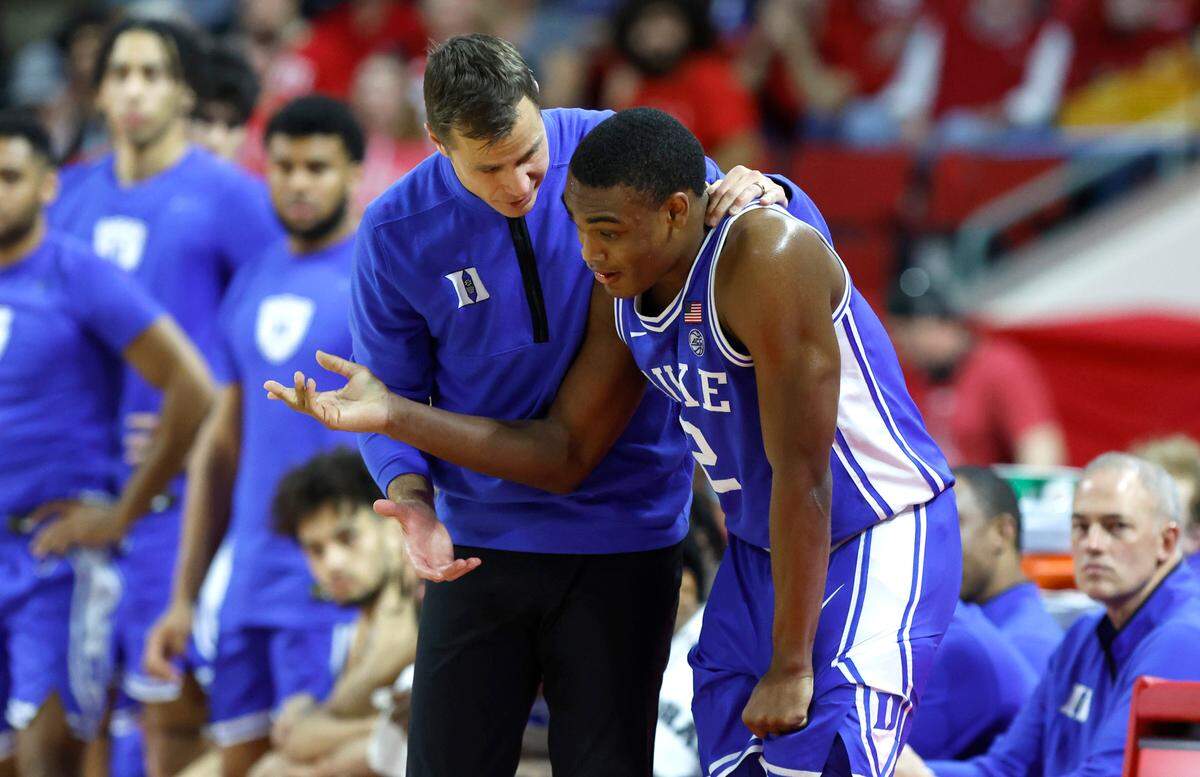
“For us, we have to figure that out,” Scheyer said. “That can’t be the way. That’s not how I’ve ever approached this team. That’s not how I’ve played, coached. I want these guys to play that way. I want us to be aggressive and go for it. So we have to do that. That’s the bottom line.”
Through the season’s first 15 games, Duke displayed plenty of good things while collecting wins over two teams currently among the NCAA Evaluation Tool (NET) ratings top 30: No. 9 Ohio State (81-72) and No. 26 Xavier (71-64).
Two of Duke’s losses are to teams in the NET top 10 — No. 5 Kansas (69-64) and No. 7 Purdue (75-56).
But consistency is missing, particularly in ACC road losses at N.C. State and Wake Forest (81-70).
Here’s a look at the concerning areas of Duke’s play:
Shot making not elite
Even when Duke wins games, it usually does it with its defense. The Blue Devils have scored 72.9 points per game, which is No. 159 nationally, while making 44.12% of their shots from the field (tied for No. 209 nationally).
Filipowski, the team’s leading scorer who’s averaging 13.8 points per game, is shooting 42.5% overall, and just 27.5% on 3-pointers.
Junior guard Jeremy Roach, in a 5-for-25 slump over the past three games, is shooting 35.9% overall and 32.3% on 3-pointers.
Freshman Dariq Whitehead is at 39.3% overall and 32.4% on 3-pointers.
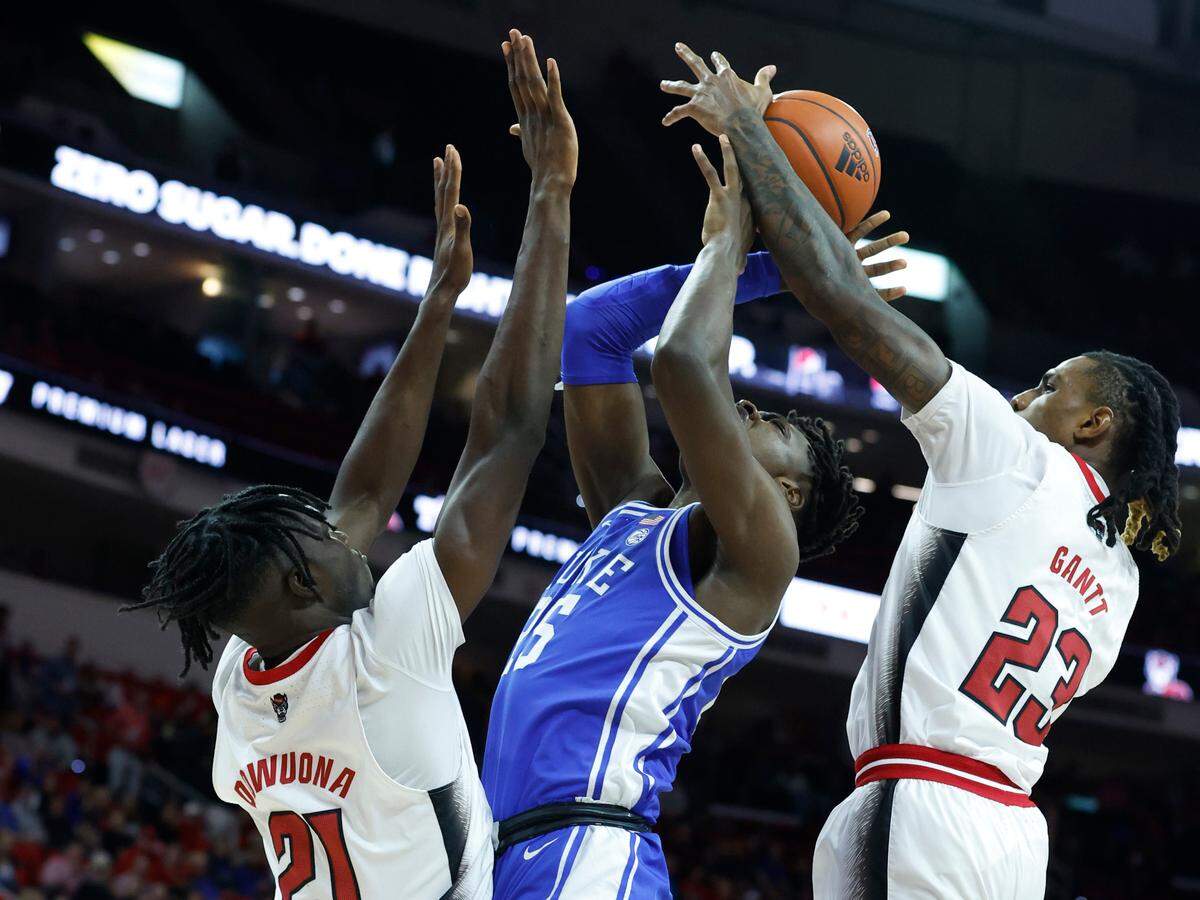
There’s a way to take an even deeper look at shooting skill. Synergy Sports, this week, introduced metrics tracking shot quality and expected points per shot based on that information. Players with positive Synergy Shot Making numbers are doing well, those in the negative aren’t.
So, who are Duke’s culprits? Which perimeter shooters aren’t making the shots an average player would?
Filipowski, Roach, Whitehead, sophomore guard Jaylen Blakes and freshman guard Tyrese Proctor all have negative Synergy Shot Making scores.
Conversely, graduate transfer Jacob Grandison is in the positive, along with freshman forward Mark Mitchell.
Because of these performances, this Duke team has to work harder than some vintage Duke teams of the past to score points. Those lightning-strike 10-1 runs over a two-minute span aren’t happening nearly as often.
Duke averages one point per shot taken. By comparison, Gonzaga leads the nation in field goal percentage at 52.9% and averages 1.16 points per shot. That’s 16% better than the Blue Devils.
Dereck Lively’s lack of impact
The 7-1 freshman entered his college career as an expected one-and-done player, projected to be an NBA Draft lottery pick in June.
Instead, he’s averaging 3.8 points and 3.5 rebounds per game while playing 16.7 minutes per game. He’s been far more impressive on defense, blocking 1.9 shots per game.
But Duke needs help scoring, and Lively has yet to show the acumen on that end befitting a future NBA player.
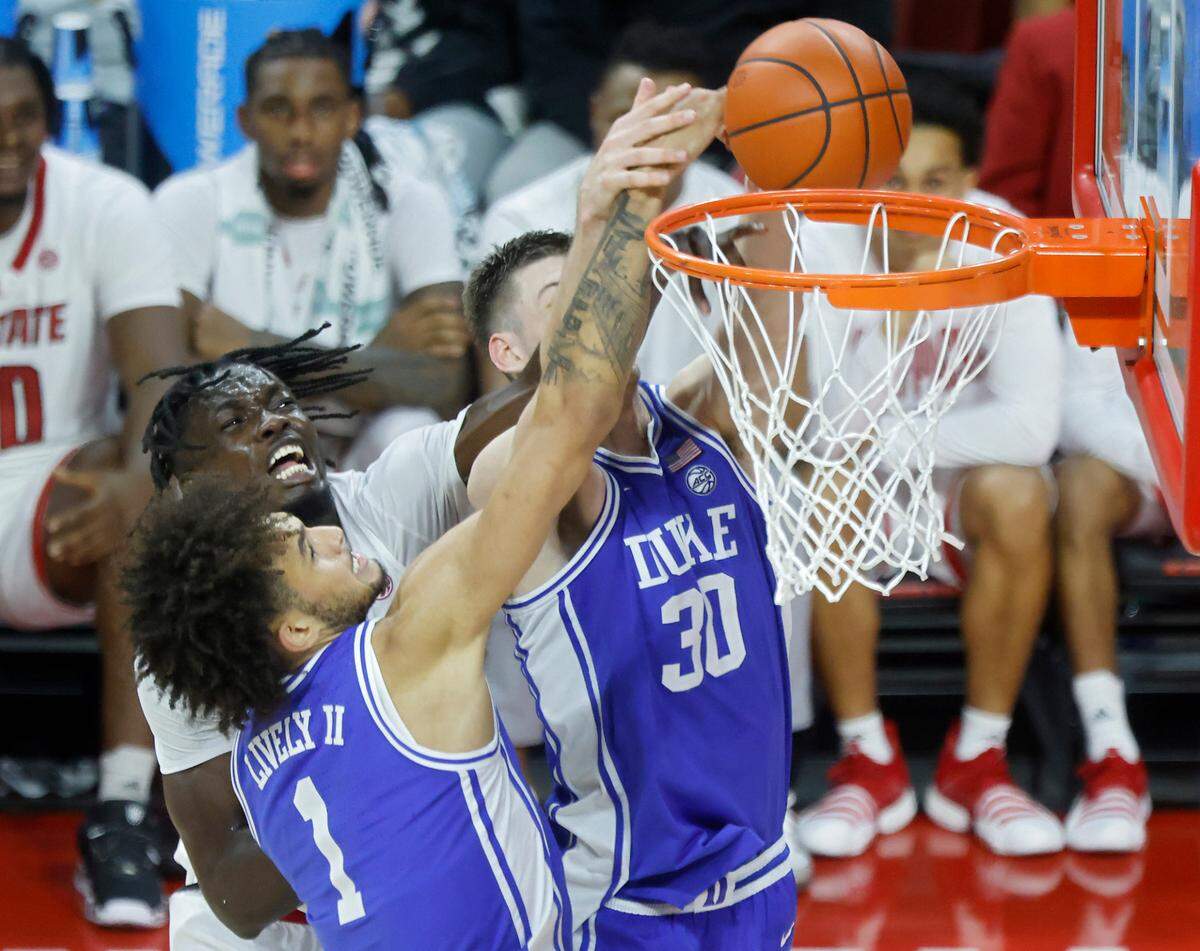
He’s only taken 36 shots in 13 games, 2.7 per game. While he’s shooting 58.3%, 30 of his shots have been at the rim — dunks, layups or tip-ins. His expected points per shot, based on shot quality, should be 1.54 points per shot, but he’s produced 1.4, so he’s in the negative.
He’s missed his only two hook shots and missed all four of his unguarded catch-and-shoot attempts.
The expectation was Lively and Filipowski could work in tandem to dominate rebounding and in a high-low game where one can either pass the ball down low to the other, take a shot or drive to the basket when defense sags off.
So far, Lively’s been adept at scoring on lob passes over the defense from a driving guard every now and again. Hence, his high number of shots at the rim. But it’s not enough.
Defense showing cracks
For the most part, the Blue Devils have made it hard for teams to score this season. Duke opponents have made 28.7% on 3-pointers and 47.8% on 2-pointers, both below the national averages of 33.5% and 49.8%. Overall, Duke’s foes have hit 41.1% of all shots.
But that’s not been the case in Duke’s two ACC losses, both on the road. In a season in which Duke has allowed 62.4 points per game, both Wake Forest and N.C. State topped 80 points.
The Demon Deacons shot 49.3% overall while N.C. State hit 47.1%.
Other top teams, like Kansas (46.3%), Purdue (44.8%) and Ohio State (47.3%) also hit shots better than most teams against Duke.
Duke did limit Xavier to 38.5% and Iowa to 39.7% in winning those games.
So the defense has some teeth, but the performances against Wake and N.C. State are cause for concern.
This story was originally published January 6, 2023 at 5:40 AM.