Jimmy V said championships would return to NC State. For 30 years, Wolfpack still wait
Out on the basketball court at PNC Arena on Wednesday night, the N.C. State students were still shoulder-to-shoulder, arms in the air as if in a mosh pit, reveling in a moment they wanted to savor. About 10 minutes had passed since the end of the Wolfpack’s 88-66 victory against Duke, and those who’d rushed the court in celebration were in no hurry to leave.
Many of them held cellphone cameras high, recording the scene for posterity. A few sat atop the shoulders of their classmates for a better view. From a few rows up it looked like the court had disappeared, replaced by a joyful mob of red, none of whom were alive, or even close to being born, when these kinds of moments were not so unexpected.
Through a tunnel and down a hallway, N.C. State’s players continued their own celebration in their locker room. They embraced each other, and the moment. A voice rose above the noise, and the player it belonged to screamed that he’d be staying up all night. Soon, Kevin Keatts, the Wolfpack’s third-year head coach, met with reporters in another room.
And soon came the kind of question whose answer, in the positive, has eluded the Wolfpack for 30 years: How can it turn one night of excellence into sustained success? How does it build?
“You’ve got to let me enjoy tonight,” Keatts said, smiling.
For one night, N.C. State looked like the team he’d hoped to see for months. For one night, N.C. State resembled not the program that has so often been a punchline during the previous three decades, but the one that was, in a bygone era, a force in the ACC. For one night, the Wolfpack provided a reminder of what it was, and perhaps a glimpse of what it still could be.
Yet the aftermath told a story, too. Students rushed the court in an act of mass catharsis. Later, some of them moved the celebration to the N.C. State belltower, off Hillsborough Street. A video the school shared on Twitter showed Keatts arriving in the middle of the party, students swarming him on sight. Thirty years in the basketball wilderness make the highs feel higher.
Jimmy V
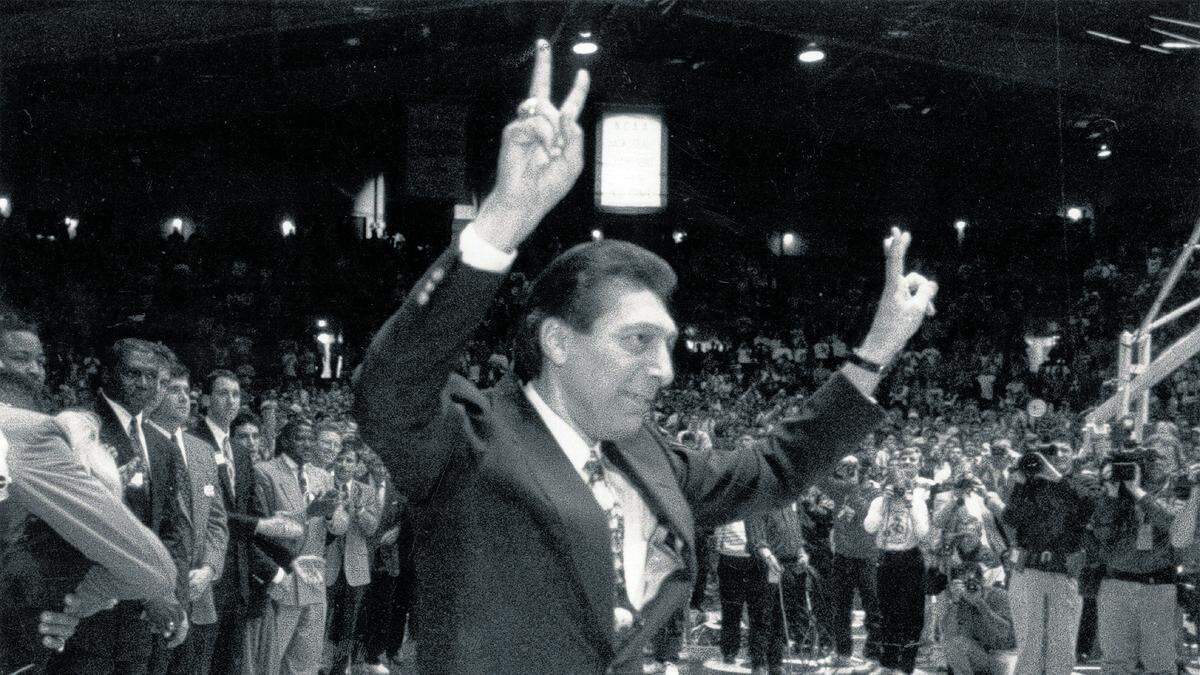
This is the 30th anniversary of Jim Valvano’s last season at N.C. State. He coached his final game in March 1990, and was fired a month later, after 18 months of controversy and allegations of wrongdoing, some of which went unproven. He died three years later, but not before he became a symbol of courage and hope amid his public fight against cancer.
Since Valvano’s death in 1993, he has come to be mythologized. He is a permanent fixture in the NCAA tournament highlights every March, when he’s forever looking for someone to hug after the Wolfpack’s championship victory against Houston in 1983. Ten years later, frail in his final months, he delivered the speech with the phrase that has defined his legacy: “Don’t ever give up.”
In recent years, N.C. State has built a statue in Valvano’s honor. It named the arena inside Reynolds Coliseum, where the Wolfpack women still play, after him. In many ways, 30 years after Valvano coached his final game, N.C. State is still attempting to duplicate the magic he created. The Wolfpack hasn’t recovered from his departure and the circumstances that surrounded it.
Wolfpack’s new reality
What would N.C. State supporters have said in 1987, after their school’s most recent ACC tournament championship, had a grim specter from the future appeared and portended the doom to come? What would they have said if someone told them they’d be waiting 33 years, and counting, for another conference championship?
“I would have told them they’ve lost their freaking mind,” Charlie Bryant said, laughing, during a phone interview earlier this week. “Yeah, that’s hard to believe.”
Bryant is 88 now, his mind still sharp. During the 1960s and ‘70s, he served as an assistant basketball coach at N.C. State under Everett Case, and then under Press Maravich and Norm Sloan. Bryant became the executive director of the Wolfpack Club in 1975 and spent 22 years in that position. In the early ‘90s, he found himself in a particularly unenviable position.
Bryant’s job then, as it had been, was to raise money. N.C. State boosters, however, were in no mood to donate given their dissatisfaction with the university’s handling of the trouble that engulfed Valvano and led to the end of his tenure. He was fired in April 1990 amid wide-ranging allegations of corruption and academic negligence.
A book called “Personal Fouls,” by Peter Golenbock, portrayed Valvano as unscrupulous, a villainous character who personified the ills of big-time college athletics in the mid-to-late 1980s. An extended NCAA investigation, though, uncovered no evidence to substantiate the most egregious of allegations. Nonetheless, N.C. State decided to fire Valvano, in large part because of his players’ poor academic record and questions surrounding their eligibility.
“Had he not encountered the problems he had, I’m sure our program would have stayed up near the top,” Bryant said.
Instead, three decades have come and gone with the Wolfpack in a near-constant state of rebuild.
Personal Fouls
Golenbock did not offer any apologies during a phone interview last week. He defended his work. Upon its publication in 1989, “Personal Fouls” created a firestorm. It portrayed Valvano, who also served as N.C. State’s athletic director from 1986-89, as the architect of an out-of-control program, with little regard for rules or the players he coached.
As damning as the allegations were, though, Golenbock’s credibility suffered. Misspellings and other factual errors plagued his copy. He misidentified places. He confused dates. He didn’t identify sources, and based the book on interviews with approximately a dozen people — a number more fitting for a newspaper or magazine story.
Even so, the book prompted the University of North Carolina system to launch an investigation. That investigation uncovered academic impropriety. Golenbock is aware of his place in N.C. State history, just as he is aware of how the Wolfpack has never quite recovered from the aftermath of Valvano’s firing.
“Not my fault,” Golenbock said.
His defense has remained consistent, when critics confront him.
“What I say to that is why did they fire him?” he said. “Why did the chancellor quit? Why didn’t they stand up and fight?”
He blamed the factual errors on Simon & Schuster, the book’s original publisher that ultimately decided to pull out of the project. Golenbock said it refused to provide him with an edited copy of his manuscript and that the second publisher, Carroll and Graf, “did not do nearly as good of a job” editing. Golenbock said he would not do anything differently with “Personal Fouls.”
“I can’t imagine what differently I could have done,” he said.
The Les Robinson Invitational
From his house on Sullivan’s Island, near Charleston, Les Robinson can see the ocean. He said he was looking at it Wednesday afternoon, while he recounted his six seasons as N.C. State’s head basketball coach.
Robinson, an N.C. State alum, succeeded Valvano in 1990. He inherited a talented team, with Rodney Monroe, Chris Corchiani and Tom Gugliotta, that won 20 games and reached the second round of the 1991 NCAA tournament.
Then, amid self-imposed scholarship reductions and increased academic standards, N.C. State entered a basketball abyss. The Wolfpack remained there throughout the rest of Robinson’s tenure and throughout much of the 1990s.
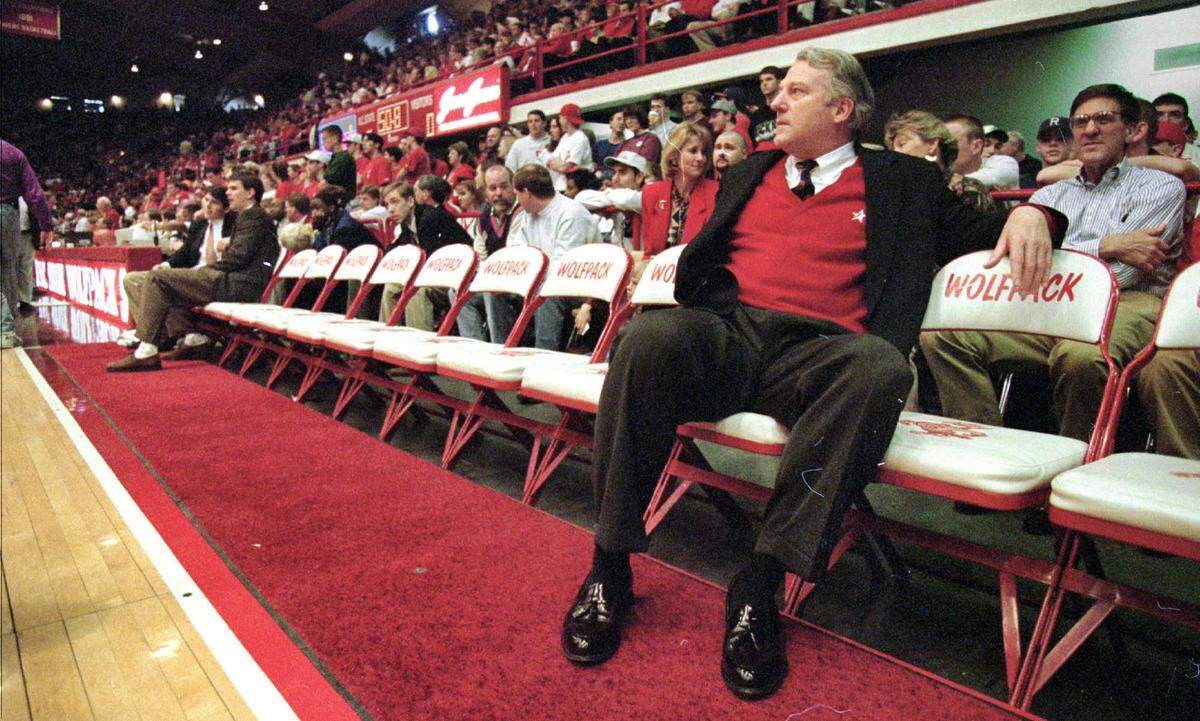
Robinson does not view his tenure as a failure. Winning, he said, was not necessarily the priority.
“I was there to clean up academics,” he said.
He likes to tell a story about that, and he told it again earlier this week.
“I tell people I had the two best guards in America,” Robinson said of his first season, when he coached Corchiani and Monroe. “I was a great coach, we beat the national champions, Duke, (another that made the) Final Four, North Carolina. I said the next year, I had a first-team average SAT of 1250, 1300, I was one of the worst coaches in America.”
Ten years after N.C. State’s 1983 national championship, the Wolfpack finished 8-19. Valvano died not long after. Robinson coached four more seasons, none of them ending with winning records. N.C. State so often played in the ACC tournament play-in game (between the two lowest-seeded teams) that it became known as the Les Robinson Invitational.
“You’ve got to know me,” Robinson said, laughing again. “I understood that, and it never bothered me. I laughed at it. I knew what I was there for at State. I knew I wasn’t a bad coach.
“I used to turn it around and say, ‘God, I’m the only coach in the league that’s got an ACC game named after him.’”
ACC woes
If an N.C. State fan in 1990 entered a 30-year coma and woke up today, they would not have missed much.
No ACC championships — either regular season or tournament; no NCAA tournament runs beyond the Sweet 16, and only three that lasted that long; no top-10 seasons. They would have awoken to a world in which the Wolfpack shares an arena with an NHL team — and one, at that, that has won a Stanley Cup more recently than N.C. State has won its conference.
Arguably the wildest contrast of all between the past 30 years, and the 30 years that preceded them, are illustrated by the ACC tournament results. Between 1960 and 1990, the Wolfpack won the conference tournament six times — an average of once every five years. Only North Carolina (10 times) and Duke (seven) more often won the ACC tournament.
Since 1990, though, N.C. State’s basketball misery has known no bounds. The Wolfpack has rarely advanced deep enough in the ACC tournament to give itself a chance and, on the few occasions that has happened, the journey has ended in cruel despair, none crueler than 2003, when it surrendered a 15-point second-half lead in a defeat against Duke.
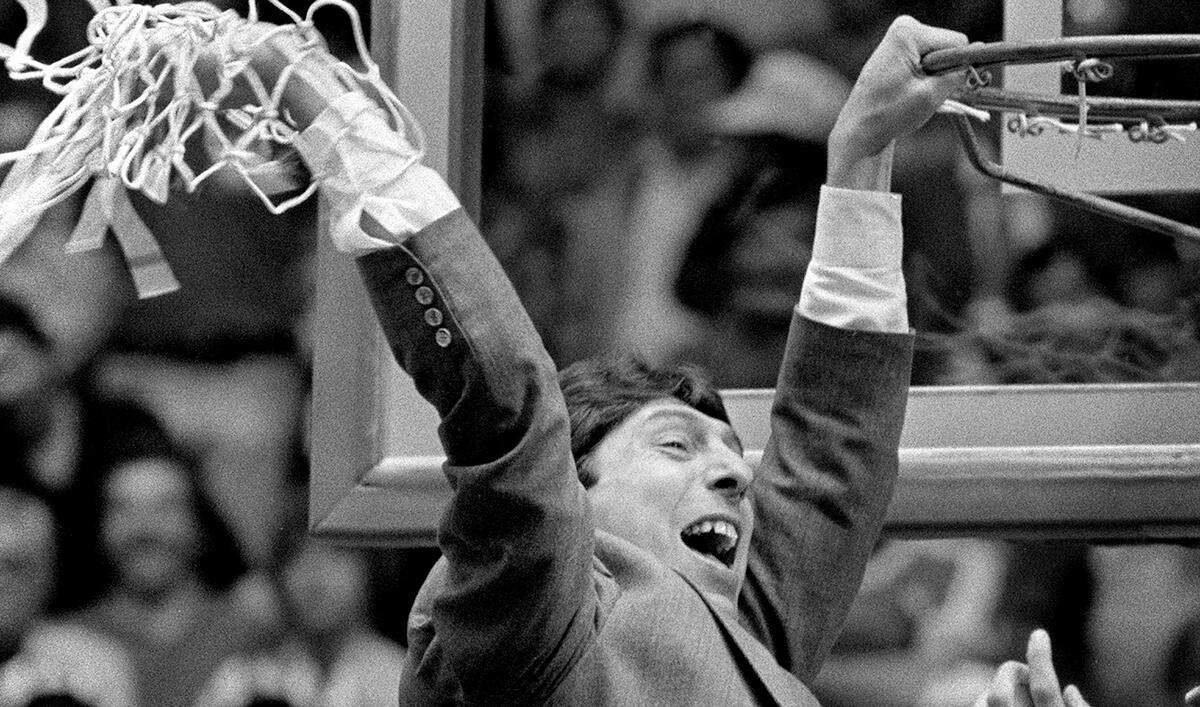
Long gone are the days when N.C. State could claim, with merit, to be the basketball equal of UNC and Duke. Through 1990, the Wolfpack and Tar Heels had both won the same number of NCAA championships — N.C. State’s in 1974 and ‘83, UNC’s in 1957 and ‘82. At the time, N.C. State had two national championships to Duke’s zero.
And then the next 30 years happened.
But what happened, exactly?
The collapse of N.C. State basketball, and the brief but unsustained spurts of revival, cannot be explained simply. It is easier to trace a line to a turning point — to a firing, or a hiring — than it is to understand how three decades of relative futility manages to persist. It was one thing to struggle in the years after 1990, said Bryant, the former director of the Wolfpack Club.
“Since then,” he said, “I don’t think there’s any excuse for our program not being up at the top with the rest of them.
“... It’s kind of hard to put your finger on everything. I guess when you stop and think about things, number one, it’s recruiting. Look over at Chapel Hill right now. Roy Williams is the same coach he’s always been. But he’s sitting on the bottom right now. And the reason he’s sitting on the bottom is he doesn’t have the talent and depth of talent that he normally has. And that’s a problem that I think we’ve encountered over the years. We haven’t had the consistency in coaching and had our recruiting reach the level that it needs to be.
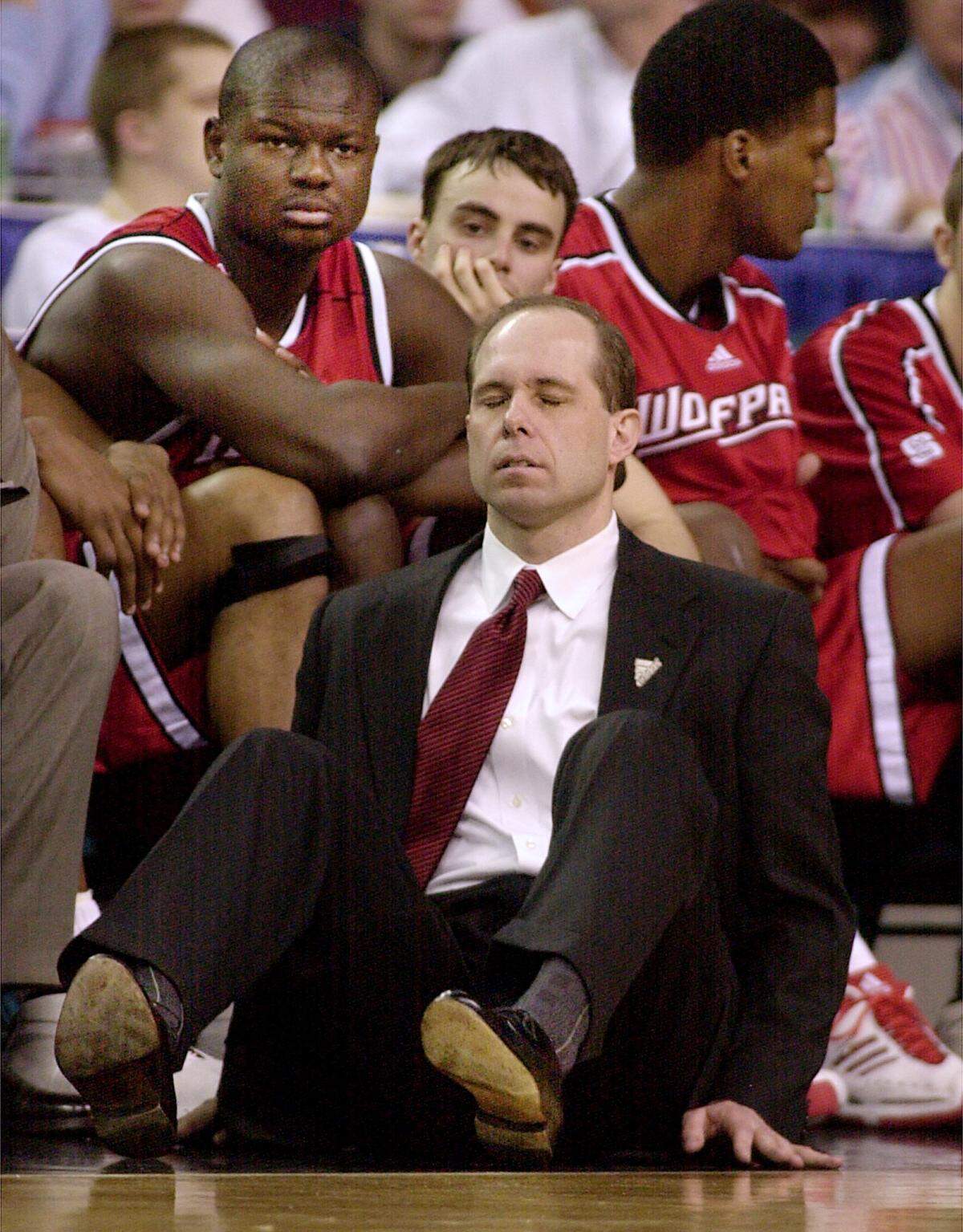
Robinson and Todd Turner, who was N.C. State’s athletic director from 1990-96, argued another point: That N.C. State never should have abandoned the loud, hostile Reynolds Coliseum. After the 1998-99 season, the Wolfpack moved into the cavernous Entertainment and Sports Arena, now known as PNC Arena, which it shares with the Carolina Hurricanes.
Robinson, who succeeded Turner as N.C. State’s athletic director in 1996, recalled a conversation with Herb Sendek, then the Wolfpack head coach, in the late 1990s.
“We sat in the car together there, at Reynolds,” Robinson said, “and he said ‘Coach, is there any chance we can stay here, in this arena? I said Herb, Valvano tried, I tried — it’s over. No, they want to have something as big as Carolina.’
“If State had played there, versus where they went, they wouldn’t have made as much money, (but) won 20 to 25 percent more of their games. That place was worth five, six, seven points.”
Bryant dismissed the idea of remaining in Reynolds as something of a fantasy.
“Even if we could have renovated it, he said, “we didn’t have the parking.”
Wolfpack still waits
N.C. State’s attempt to resurrect its men’s basketball program is now entering its fourth decade. Every previous attempt has been measured against the past. Mostly, it has been measured against one man. For better or worse, no one has compared to Jimmy V.
No one has won like he did, for one. Nor have any of his successors inspired the kind of hope Valvano did — not only in ‘83 but a decade later, when he returned to Reynolds in his final days, during halftime of a game against Duke, and left many in the crowd in tears amid his speech.
That day, N.C. State celebrated the 10-year anniversary of its ‘83 championship. Valvano told the crowd that the team taught him about hope, about dreams — “never, ever quitting,” he said — and about the power of love. He spoke of the future.
“It’s gonna happen all here again,” he said of N.C. State, and championships.
Still, the Wolfpack waits. None of Valvano’s successors have inspired the same belief.
Robinson was a part of the N.C. State family, folksy and charming, but he didn’t win, and didn’t have much of a chance to win given the restrictions he inherited. Sendek guided the Wolfpack to five consecutive NCAA tournaments, but his stoic nature and unaesthetic offense drew ire.
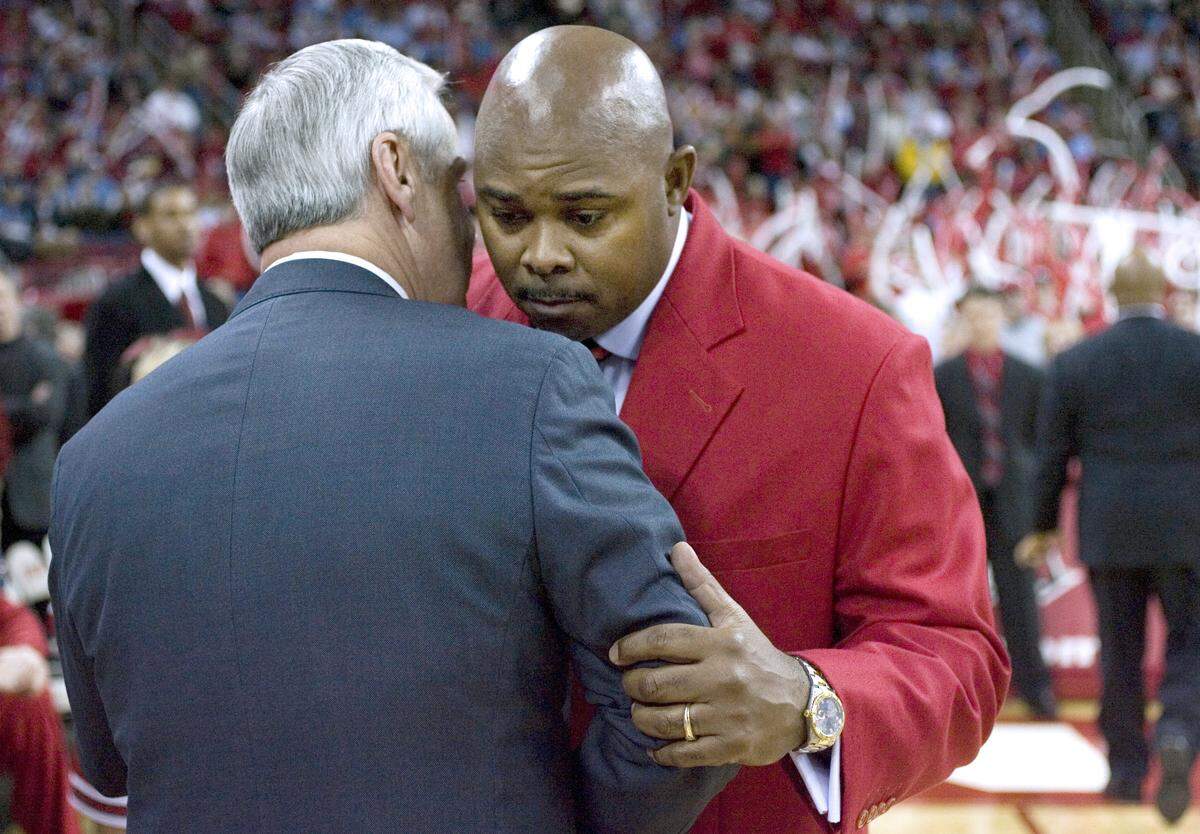
Sidney Lowe lasted five seasons after N.C. State flirted with, and failed to land, John Calipari and John Beilein. Next came Mark Gottfried, who reached two Sweet 16s in six seasons but left N.C. State with an NCAA investigation related to the recruitment of Dennis Smith, whose one-and-done season was perhaps best remembered for a dunk that didn’t count.
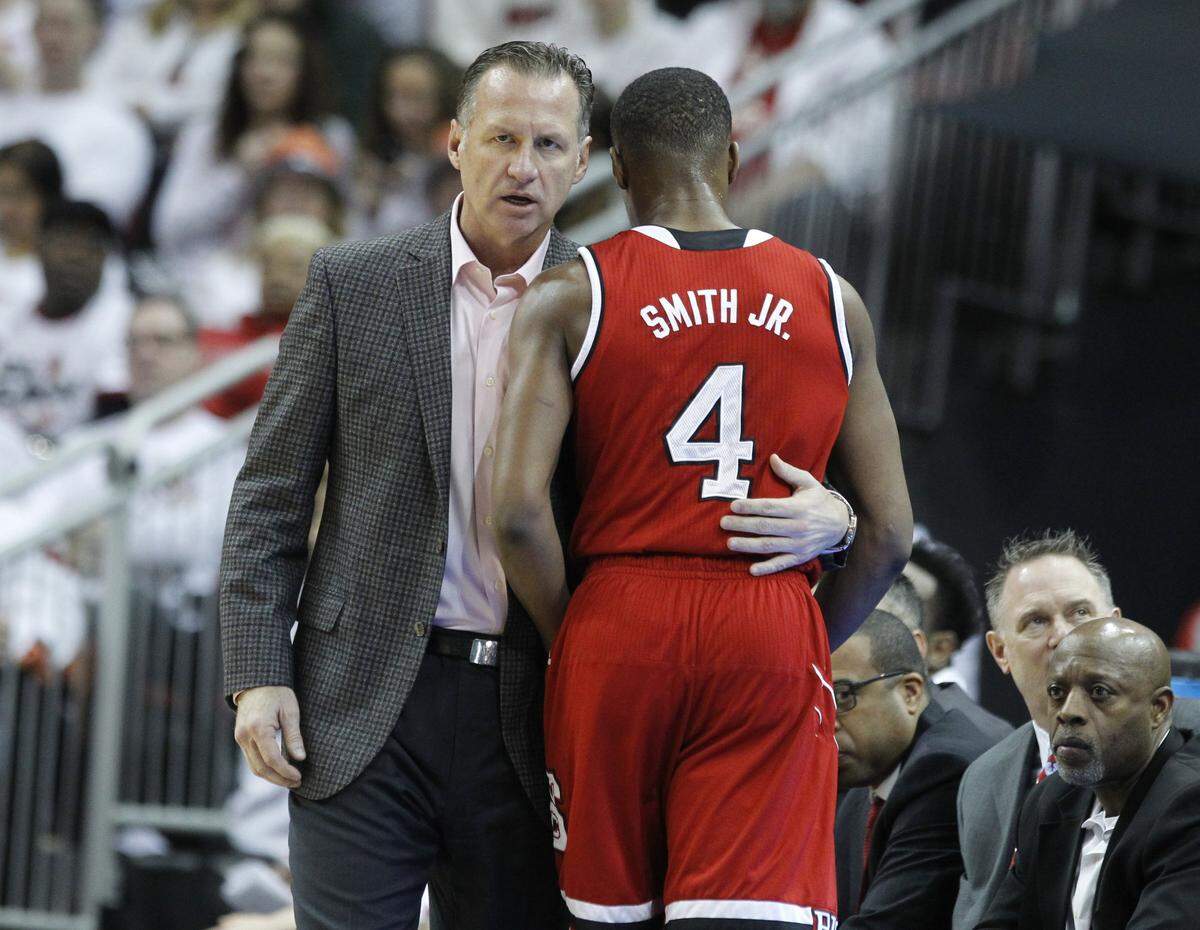
And now here is Keatts, attempting to succeed where his four predecessors have failed.
The victory against Duke on Wednesday came days after an uninspired defeat at Boston College, which came days after a victory at Syracuse. That has been N.C. State’s season: Inconsistent and maddening.
Late Wednesday night, some of N.C. State’s players sat in front of their lockers and spoke of possibility.
“We know what we’re capable of,” said Devon Daniels, a guard who scored 25 points. “ … We know how good we can be.”
The Wolfpack had beaten Duke for the 13th time since the end of the 1989-90 season — 13-47 in the past 30 years. Soon, players walked out of the arena, past a crowd of cheering students who were waiting on a bus to carry them back to campus. The celebration continued outside.
Nowadays, nights like Wednesday only come around so often.
This story was originally published February 21, 2020 at 6:00 AM.