
Is Clemson’s Travis Etienne really ready to pass NC State’s Ted Brown? It’s hard to tell.
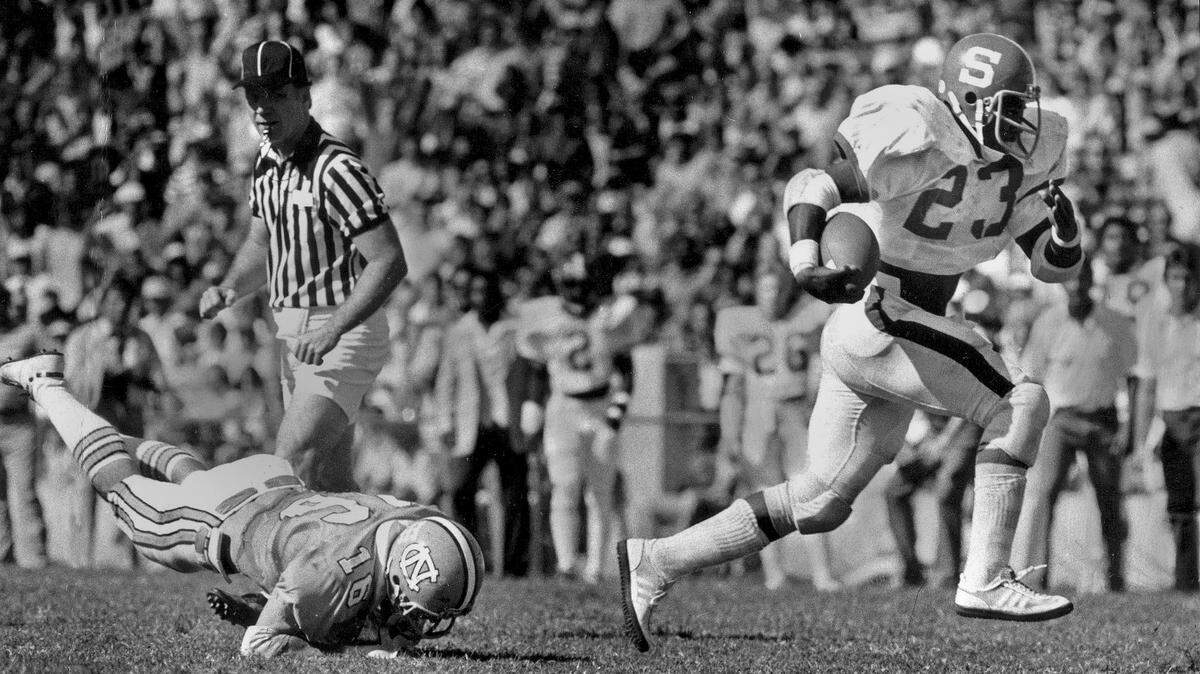
Clemson’s Travis Etienne is closing in on the ACC career rushing record N.C. State’s Ted Brown has held for more than 40 years.
Officially, Etienne needs 565 yards this season as a senior to surpass Brown’s record of 4,602.
That’s how the record book sees it, anyway.
Brown, though, actually gained an additional 399 yards in bowl games during his Wolfpack career, which if counted would make his record tougher for Etienne to break.
But those yards aren’t counted for Brown even though the yards Etienne has gained playing in three ACC championship games and five College Football Playoff games are counted toward his total.
That’s right — the NCAA, and ACC by extension, each counts eight additional games for Etienne that it wouldn’t have counted for Brown. Etienne rushed for 625 yards in those eight games. If Clemson makes the postseason this year, Etienne can possibly end his career having played in 11 postseason games that count toward his statistics — almost a full season’s worth — while Brown’s three bowl game performances don’t count at all.
Is this fair? And how can this be?
Well, it’s a statistical oddity of the NCAA’s creation that remains a source of debate within college football circles. While some want it fixed, others are against it.
Back in 2002, the NCAA decided to count postseason football statistics toward a player’s career totals. The NCAA had been following that practice in other sports, most notably basketball, for years so the decision was made to do the same for football.
But while making that decision, the NCAA decided not to retroactively add bowl stats to career totals for players prior to 2002.
That means Brown’s 159 yards in the 1975 Peach Bowl, 114 yards in the 1977 Peach Bowl and 126 yards in the 1978 Tangerine Bowl aren’t part of his record total.
In an email on Tuesday, NCAA media and statistics director David Worlock said, back in 2002, the consensus of the member schools was against adding past bowl games.
In the years since, the idea of going back to add those stats has been discussed and bandied about among NCAA staff and college football sports information directors. But the NCAA has yet to make the move.
Whenever the discussion occurs, Worlock said a couple of points make it improbable the move will be made.
“We don’t have complete statistics for all bowl games ever played, meaning we’d have to accept that we were going to not include every game,” Worlock said. “If we did just add in the games for which we have stats, the next problem is that we wouldn’t have all of the data from those games. Leading rusher? Sure, we probably could track that down. But other data isn’t always available.”
Then, Worlock said, there’s the tricky case of rewriting history.
If Etienne breaks the record, Worlock doesn’t think it would be correct if, sometime in the future, the NCAA changes course and adds Brown’s bowl game statistics to his total and he ends up with more yards than Etienne.
“If Travis Etienne becomes the ACC’s all-time leading rusher next season, we shouldn’t have to change it 10 years down the road because we went back in and added Ted Brown’s stats from bowl games,” Worlock said. “However, if N.C. State wanted to count those stats, that would be up to them to do it. Officially though, we are not inclined to go back and change history.”
The NCAA, of course, changes history all the time when it forces wins, and sometimes championships, to be vacated as part of sanctions for rules violations. The difference, though, is history is rewritten due to improper behavior in those cases.
Worlock’s point about finding all statistics for every bowl game played has some merit. While a simple Google search allows for box scores of bowl games to be found dating back to the mid-1970s, others are harder to find.
The 1970 Astro-Bluebonnet Bowl, for example, featured Alabama and Oklahoma playing at the Houston Astrodome on Dec 31, 1970. Even with those two major programs playing in a nationally televised game, the newspaper box score showed score by quarters, scoring plays and team statistics but not comprehensive individual statistics. Some stats can be found in a story in an archived Jan. 1, 1971, edition of the Tuscaloosa (Ala.) News, but not all.
So, as it stands, Etienne has gained 4,038 rushing yards over his first three seasons with Tigers. That leaves him in striking distance of the Brown’s ACC record 4,602 yards gained between 1975-78.
Etienne’s postseason statistics count. Brown’s don’t.
The NCAA saw a problem with this in 2002 when the membership decided to start adding bowl games from that point forward.
It brought football in line with basketball.
Cincinnati’s Oscar Robertson, for example, played 10 NCAA tournament basketball games from 1958-60 and the 324 points he scored in them count toward the 2,973 points that leave him No. 11 on the college basketball’s all-time scoring list.
But troublesome statistical situations still remain in football.
Former N.C. State quarterback Phillip Rivers finds himself on both sides of the rule’s dividing line. The 310 passing yards he amassed as a freshman while leading the Wolfpack to a 38-30 win over Minnesota in the 2000 MicronPC.com Bowl aren’t included in his career statistics.
But the 228 passing yards he compiled in the 2002 Gator Bowl win over Notre Dame and his 475 passing yards in a 56-26 win over Kansas in the 2003 Tangerine Bowl are part of his ACC-record 13,484 career passing yards.
Wisconsin’s Ron Dayne rushed for 728 yards while playing in four bowl games from 1997-99. Those yards, though, aren’t counted in his career statistics, meaning the 6,397 his credited with the NCAA record book aren’t a true representation of his accomplishments in college football.
At the same time, the 6,405 yards San Diego State running back Donnel Pumphrey amassed to surpass Dayne and become college football’s all-time leading rusher in 2016 include his yardage in two Mountain West championship games and four bowl games.
“Each year,” Worlock said, “we publish official data for football and many other sports. Sure, sometimes we have to correct something that either we made, or a school or conference made. But if we went back and added stats, we’d be run into situations where a player would become the single-season rushing champion when we’ve acknowledged a different player for the past several years or decades. This has a trickle-down effect for schools and conferences, which have used our official data for decades to come up with their own top performers.”
This story was originally published June 1, 2020 at 6:00 AM.