Second-half lapse dooms Wolfpack: 3 takeaways from NC State basketball’s loss to Virginia
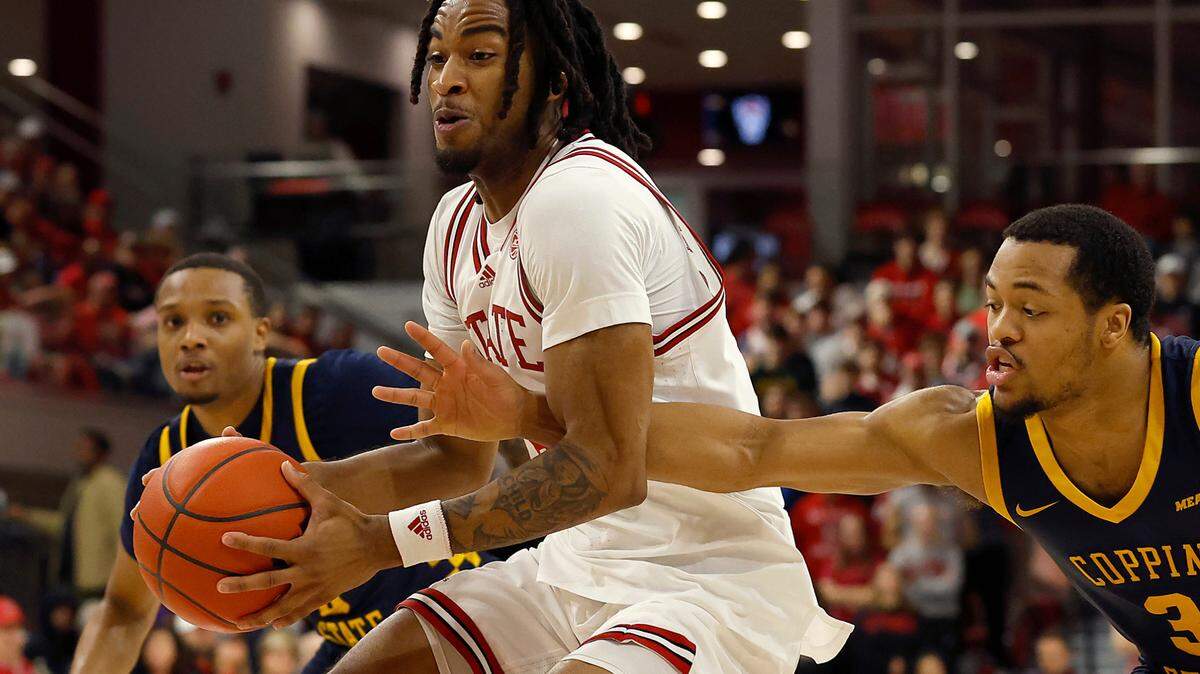
N.C. State had a chance to end 2024 on a high note and return to Raleigh with another ACC win. Instead, just like it did in the last matchup in Charlottesville, the team finished with disappointment.
The Wolfpack fell to the Cavaliers on Tuesday, 70-67, after a second-half collapse at John Paul Jones Arena.
N.C. State (8-5, 1-1 ACC) and Virginia (8-5, 1-1 ACC) traded points for the first seven minutes, which featured three ties and six lead changes. Then the Wolfpack used an 8-0 run to take a six-point lead, and turned that into a double-digit advantage by halftime.
N.C. State couldn’t extend that lead in the first seven minutes of the second half, and, under pressure from the Cavaliers, the Pack committed five fouls, turned the ball over twice and shot 3 of 12. Defensively, it allowed Virginia to shoot 7 of 9 from the field to retake the lead, 51-50.
N.C. State held Virginia to 29 first-half points and gave up 22 in the opening nine minutes of the second.
The Wolfpack attempted to claw its way back, led by guard Jayden Taylor and forward Brandon Huntley-Hatfield. The duo combined for 26 points and eight rebounds. Marcus Hill added 12 points, eight rebounds and a pair of assists.
But the Pack couldn’t stop Virginia, which seemed to hit nearly everything, especially in the second half, going 26-for-48. Elijah Saunders led all scorers with 22 points, while Isaac McKneely finished with 14.
Here are three takeaways from N.C. State’s last loss of 2024.
Depth at frontcourt takes hit
N.C. State started the game down a player — Ben Middlebrooks was unavailable due to illness. That meant Huntley-Hatfield started and Ismael Diouf came off the bench.
Diouf played meaningful first-half minutes, despite his limited role in the first half of the season. When the Virginia defense ran N.C. State off the 3-point line — following two quick buckets from the Pack — Michael O’Connell found the junior from Canada open under the basket for a layup. On the other end, Diouf provided a deflection.
The team hoped Middlebrooks would be available in the second half, but officially ruled him out after the break.
Diouf added additional minutes in the second half, but his production dropped and he played just six minutes. The forward finished with two points and four rebounds.
Having an additional body would not have guaranteed a win, but a healthy Middlebrooks probably would have helped.
Kevin Keatts confirmed the team planned to play Huntley-Hatfield and Middlebrooks together, but Middlebrooks spent Monday night and part of pregame activities vomiting for an undisclosed reason.
Offense finds a rhythm
N.C. State and Virginia are two of the ACC’s best defensive teams through the first half of the season, allowing no more than 66 points per game. The Cavaliers give up, on average, just 60 points per outing, but the Wolfpack had 39 by halftime.
Defense has been the Pack’s calling card all season, but it was nice to see shots fall consistently.
The Wolfpack shot 13 of 21 (61.9%) from the field in the first half and made 6 of its 3s (54.5%). It entered the game making 32% of its attempts from the perimeter, ranking No. 233 out of 364 teams, and 46.5% overall.
The team’s offensive success wasn’t limited to its scoring but its shot creation and movement. N.C. State recorded 11 assists on its 13 baskets, with Taylor tying his career high (5). O’Connell added four first-half assists.
One of Taylor’s assists came via smart decision making. When driving to the basket, he handed the ball to Dontrez Styles — also under the iron — instead of trying to muscle his way through the traffic. Styles, who had a clearer path, made the layup. In previous games, Taylor often got tunnel vision. It needed his awareness, and it will continue to need that going forward.
Pack unable to force turnovers
The Wolfpack’s defense has been one of the most effective in the ACC at forcing turnovers while limiting its own miscues on offense. It struggled to do that against Virginia, especially after the intermission.
N.C. State forced six first-half turnovers and one in the second. It entered the game forcing 14.5 opponent turnovers, which ranks No. 3 in the ACC.
Virginia committed a turnover on 12.7% of its possessions, under its season average of 19.3%, while scoring on nearly 60% of its trips down the floor.
Meanwhile, N.C. State committed 11 turnovers and the Cavs turned those into 10 points. The inability to create opposition mistakes and disrupt the Virginia offense led to the Pack’s demise and Virginia’s comeback.
This story was originally published December 31, 2024 at 2:18 PM.