
Roy Williams expressed concerns about classes, report states
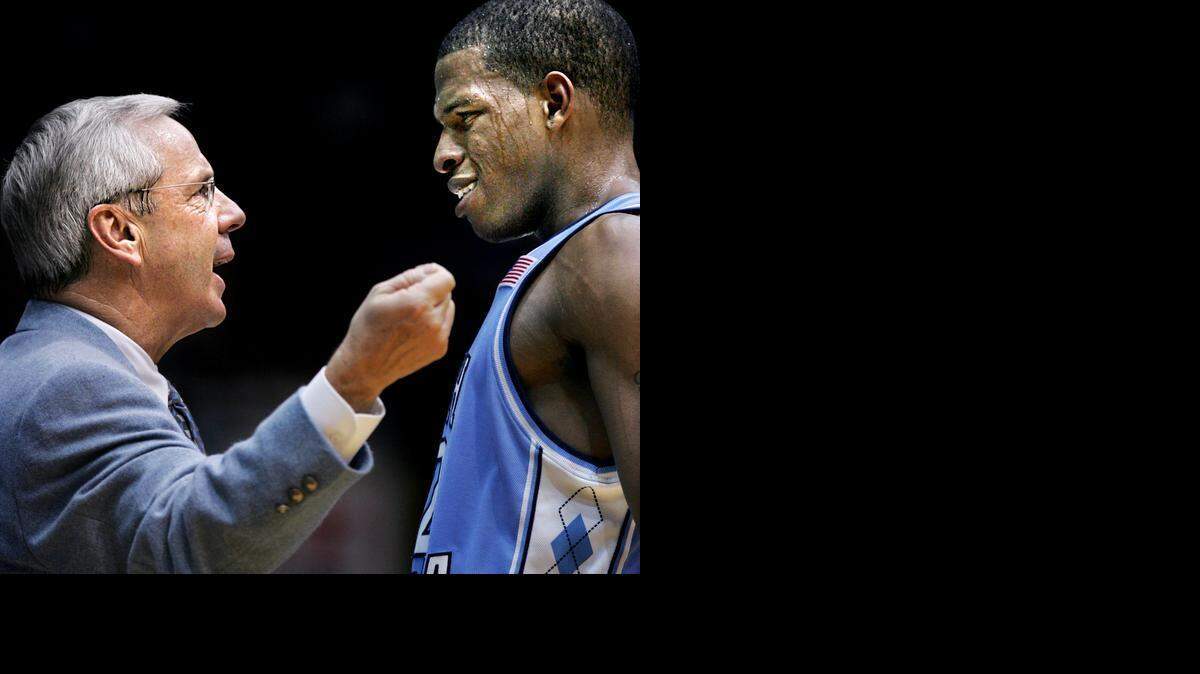
Asked once why his basketball players at North Carolina gradually stopped enrolling in no-show Afro- and African-American Studies courses, coach Roy Williams said maybe they started to have other interests.
“Maybe guys, girls, just decided not to take certain classes,” Williams said two years ago when asked directly about the no-show AFAM courses that were the focus of Ken Wainstein’s 131-page investigative report, which was released on Wednesday.
That report, though, told a different story – one in which Williams expressed concern not too long after arriving at UNC about the large number of his players who were majoring in AFAM and who were enrolled, some of them, it turned out, in no-show courses that often resulted in artificially high grades.
“It actually is something that caused him some discomfort,” Wainstein, a former U.S. Justice Department official, said on Wednesday while presenting his findings.
Wainstein’s investigation concluded that men’s basketball players made up 12.2 percent of the athletes who were enrolled between 1993 and 2011 in “paper classes” – a course that only required a paper for a grade – and that, overall, athletes comprised nearly 50 percent of the enrollments in the suspect classes.
According to the data in Wainstein’s report, the men’s basketball team’s enrollments in paper classes peaked during the 2003-04 season and declined slightly and remained steady over the next three years. Enrollments declined sharply during the 2007-08 and 2008-09 seasons.
The numbers helped shape Wainstein’s conclusion that concerns raised by Williams and former assistant Joe Holladay led to a decrease in the number of the team’s enrollments in paper classes.
“You had Roy Williams and Joe Holladay taking these steps to reduce the number of paper classes that their players were taking,” Wainstein said.
The paper class “scheme,” as Wainstein often described it, was hatched by Deborah Crowder, a former administrative assistant in the AFAM department, and Julius Nyang’oro, the AFAM chairman. Crowder often created the classes herself and graded the papers on her own. Both were described as being sympathetic to athletes, especially those who needed help academically.
Williams, according to the report, said he didn’t know that the paper classes included no actual guidance from a professor, or that Crowder was grading papers on her own. Williams was not available for comment on Wednesday.
Suspicions
Wainstein’s investigation concluded that, among all sports, football was most reliant on the paper classes. The basketball team took advantage of the scheme, too, and did so until Williams and Holladay, his former assistant who oversaw the team’s academics, began to grow suspicious. Holladay retired in 2012.
“(Williams) asked Joe Holladay after a couple of years, ‘Please make sure we’re not steering kids (to paper classes),’” Wainstein said. “And try not to steer kids into other classes just so they get a fuller experience. Joe Holladay corroborated that.”
Wainstein and his investigative team interviewed former UNC coach Matt Doherty, Williams, Holladay and Wayne Walden, an academic counselor who Williams brought to UNC from Kansas when he became the Tar Heels’ coach in 2003.
Walden replaced Burgess McSwain, the basketball team’s former academic counselor who had a close relationship with Crowder. When Doherty became the team’s coach in 2000, he told investigators that he was told by former coaches Dean Smith and Bill Guthridge to not make changes to the academic support system.
“As a result, the McSwain-Crowder pipeline continued to operate,” the report said.
In an interview in 2011, Walden, who left UNC in 2009, denied steering players to bogus classes. He told Wainstein, though, that he worked with Crowder, the former AFAM administrative assistant who hatched the paper class system, on getting basketball players into paper classes.
“He understood that there was an established channel of moving basketball players into these classes,” Wainstein said of Walden. “He continued that channel. He coordinated with Debby Crowder.
“And he admitted that at some point, he realized that Deborah Crowder was doing some of the grading in those classes and he recognized he didn’t see a professor being involved.”
Athletes and non-athletes benefited from inflated grades in the paper classes but athletes benefited more. On average, according to the report, they had a GPA of 3.55 in the paper classes and a GPA of 2.84 in regular AFAM courses.
Non-athletes had a 3.62 GPA in paper classes and a 3.28 GPA in regular AFAM courses. The paper classes, the report concluded, “had a significant impact” on academic standing and, in turn, athletic eligibility.
Wainstein and his team examined enrollments in AFAM paper classes dating to when Dean Smith, who retired in 1997, was still coaching. The investigation concluded that under Smith, there were 54 player enrollments in AFAM independent studies courses, though the report noted it was impossible, due to record keeping then, to tell then which of those enrollments were in legitimate independent studies and which were not.
Under Bill Guthridge, who coached from 1997 through 2000, there were 17 basketball enrollments in paper classes. Under Doherty, who coached from 2000 through 2003, there were 42 enrollments in paper classes. And under Williams there were 167 enrollments in paper classes.
The “Crowder-Nyango’oro scheme,” as Wainstein described it, ended in 2011 – two years after Crowder’s retirement inspired a panic among the UNC football team’s academic counselors, who relied significantly on the paper classes Crowder orchestrated.
By the time Crowder retired, though, men’s basketball enrollments in the paper classes had decreased significantly. When Williams arrived in 2003, five members of the 2003-04 team majored in AFAM. Ten players majored in AFAM off the 2005 national championship team.
Wainstein interviewed 126 people but Rashad McCants, one of the players most responsible for leading UNC to the 2005 national championship, was not among them. McCants in a series of high-profile ESPN interviews in the summer accused Williams of being aware of the “paper class system.”
McCants also alleged that tutors wrote papers for him, and that Williams told him that he would “swap” a class to prevent an eligibility issue. Williams, who denied those claims in an ESPN interview over the summer, was “emphatic,” according to the report, that McCants’ allegations were false.
Wainstein said he attempted to contact McCants before and after he made his allegations.
“He never submitted to our interview request,” Wainstein said. “We would have been very interested to talk to him. And as a result, as you’ll see in our report, we say that there is no evidence to support his allegations because he didn’t talk to us.”
It’s unclear what repercussions the basketball program might face, if any, from the NCAA, which relaunched its investigation into UNC during the summer. The university provided the NCAA with the Wainstein report, and now that waiting game begins – the one to see how long the NCAA investigation lasts.
Bubba Cunningham, the UNC athletic director, said it would be “really speculative” to consider potential penalties any sport might face. He said he didn’t know, too, why Williams offered one account two years ago of why his players’ enrollments in paper classes decreased while offering another account to Wainstein.
“I don’t have any way to explain coach Williams’ statement two years ago or what his thinking his today,” Cunningham said. “That’s a great question for coach Williams.”
This story was originally published October 22, 2014 at 7:39 PM with the headline "Roy Williams expressed concerns about classes, report states."