
Jacobs: Smith represented the best of the ACC and UNC
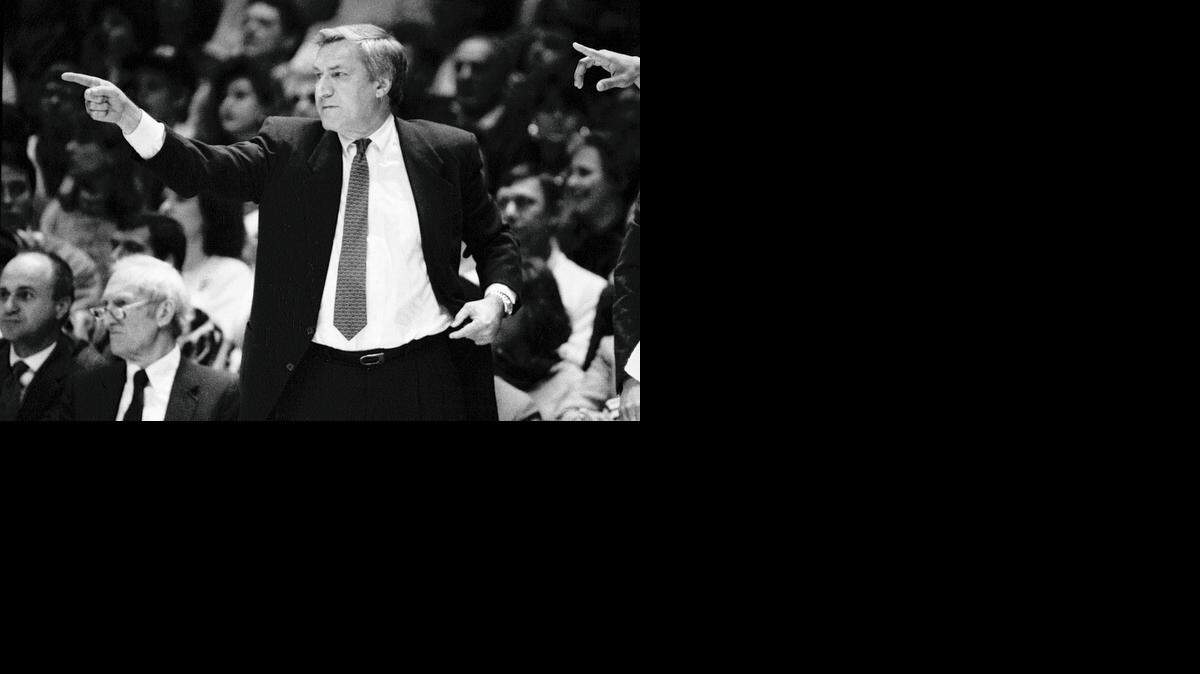
Dean Smith did not put ACC basketball or the University of North Carolina on the map. Instead Smith, who died on Saturday night, three weeks short of his 84th birthday, defined the best of both the league and the university he proudly represented.
Smith embraced the notion he and his program must uphold high standards, to the point he masked personal foibles such as smoking cigarettes by indulging out of sight of any cameras. His players were taught an intricate system of behaviors on and off the court that stressed teamwork and selflessness, intelligence and decorum, discipline and circumscribed creativity. North Carolina basketball media guides proudly listed “Dean Smith’s Letterwinners” by class, degree, graduate work, and employment. Of his 232 lettermen, 224 graduated by the time he retired in 1997.
Education was never far from the mind of the son of Vesta and Alfred Smith, public school teachers in Emporia, Kansas. Smith, who attended Kansas on an academic scholarship, had assistant coaches randomly visit players’ classes to make sure the young men were in attendance. In the early 1980s, when players such as James Worthy and Michael Jordan were among the first in the ACC to jump to the pros without graduating, he insisted incentives be included in their contracts to encourage earning an undergraduate degree.
Smith was a humanist who nonetheless regulated everything from the order in which players drank water at practice (seniors first) to the proper way to advance the ball. When point guard King Rice threw a behind-the-back pass on a two-on-one break during a December 1989 home game against DePaul, Smith dispatched a substitute to the scorer’s table even as the ball sailed out of bounds. Although the college math major balked at having his exacting approach to the game called a system, he assiduously attended to the minutest details, inventing ways to track all manner of basketball actions long before the existence of video replay, personal computers and advanced analytics.
One way to define Smith’s achievements – apt to make him squirm if cited in his presence – was by recounting his successes: 879 victories, all at North Carolina and the most in major-college history when he retired; two NCAA championships, in 1982 and 1993; 11 Final Four berths between 1967 and 1997; 13 ACC titles; 17 first-place league finishes; and 23 consecutive NCAA tournament bids.
“In our society, there is a ‘We’re No. 1 syndrome,’ ” Smith said in a 1980s UNC class on sports in American society. “It’s a success fantasy, it really is. Have you noticed, we’re all caught up in this?” Certainly beating No. 1 became a theme during the decades UNC emerged as the ACC’s enduring constant, a model of consistent excellence whose ability to win was matched by its commitment to recruiting within the rules and upholding the educational mission of the university.
Outstanding ACC programs rose and fell during Smith’s 36-year tenure: Duke under Vic Bubas in the mid-1960s, N.C. State with David Thompson in the mid-’70s, Virginia with Ralph Sampson in the early ’80s. Duke finally became preeminent under Mike Krzyzewski in the early ’90s en route to consecutive NCAA titles. Through it all, Smith’s Tar Heels were the standard of measure and, until the last few years, the team that precipitated a celebratory rush of fans onto the court when it lost on the road.
Modest yet competitive
Smith inherited a program left on probation by Frank McGuire. In 1964, after three years on the job, he was twice hanged in effigy on the Chapel Hill campus. “You don’t forget a thing like that, ever,” Smith said later. Surely the incidents informed his resistance to external measures of success and the fickleness of the multitude, as did the admonition on handling criticism from his coach at Kansas, Forrest (Phog) Allen.
“If the postman kicked at every dog that barked at him, he’d never get the mail delivered,” said the Hall of Famer, for whom the 5-10 Smith played reserve guard on a pair of Final Four teams in 1952 and 1953. The Jayhawks won it all in ’52.
If Smith, himself a Hall of Famer, was loathe to acknowledge the remarkable fruits of his coaching efforts, his closest associates are not.
“I wish Dean would have coached longer because he could have been right up there on the number of wins,” Bill Guthridge, his 30-year assistant, said after Mike Krzyzewski became the top career winner among Division I men’s coaches. Given the unenviable role of following a legend, Guthridge took the Tar Heels to an 80-28 record and two Final Fours in three years as head coach. “I wanted Dean to coach forever, and he was really set that he was not going to be the head coach and he wanted me to do it, and I did it,” Guthridge said. “But I wish that Dean would have stayed.”
Roy Williams, who in 1988-89 became head coach at Kansas on Smith’s recommendation after a decade as a Carolina assistant, confided recently that even his mentor had second thoughts about stepping aside when he did. “Coach Smith one time made me promise, he said: ‘I quit too early. I quit at 66. You can’t quit at 66. You’ve got to go past that.’ ”
Smith, a man with bushy eyebrows turned up at the ends, a large, fleshy nose, and a much-mimicked Midwestern twang, constantly waged an internal war between the humility and sense of proportion instilled by his parents and Baptist religion, and the competitiveness and public nature of his chosen profession. His desire for control in seeking victory had him adopt decision-making roles starting in high school – catcher in baseball, quarterback in football, point guard in basketball.
To outsiders, the battle sometimes surfaced as false modesty or contradictory actions. Smith could declaim on the beauties of basketball, insist he preferred an uptempo pace and supported a shot clock, then muck up a game by stalling away minute after minute with the Four Corners delay.
“It was not a stall tactic, but a tactic to score,” insists Al Wood, an All-American under Smith in 1981. “We always got the boring chant. That was not unusual: ‘Bor-ing!’ That wasn’t a bad thing. We loved that.”
Unbelievable equanimity
The Carolina coach was an innovator celebrated for his jump-switch defense, secondary break, and exacting passing game. He was concomitantly notorious for seeking advantage in gray areas of the rules – positioning for a jump ball, a sideline huddle after a player was disqualified, strategically milking the clock with fouls and timeouts. Not entirely trusting of others’ motives, he once dispatched Guthridge to observe a coin toss over seeding in the ACC tournament.
Sometimes Smith’s equanimity was almost unbelievable, as when he reminded players during the climactic moments of a key outing that there were a billion people in China who didn’t care about the outcome. Typically, after losing the 1995 ACC tournament championship game to Wake Forest on a floater by Randolph Childress with 4 seconds left in overtime, Smith observed of the contest, “It wasn’t a pretty start, but it became a very exciting game for those of you who didn’t care who won.”
The flip side of the coin surfaced earlier in the same tournament when Smith nearly came to blows in front of the scorer’s table with Clemson coach Rick Barnes, nearly a quarter-century his junior, over what the Tar Heel coach considered dirty play by Tiger forward Iker Iturbe. Both coaches were later fined by the league, with Smith giving his money to a charity that would “fight beer advertising on televised ACC basketball games.”
That bent toward social activism set Smith apart from most colleagues. While serving as McGuire’s assistant, Smith accompanied Robert Seymour, his pastor at Chapel Hill’s Binkley Baptist Church, and a black divinity student to a previously segregated local restaurant. Before any ACC team had an African-American on its roster, Smith nearly landed Lou Hudson, a star from Greensboro. He later brought Willie Cooper to UNC, but his first black player quit basketball prior to the 1965-66 varsity season.
Charles Scott finally competed on North Carolina’s varsity in 1968, after several other African-Americans had played at Maryland and Duke. But Scott was the only great player among the ACC’s racial pioneers. His televised presence in a Tar Heel uniform had lasting repercussions nationwide and particularly among black Southerners.
Smith fought other progressive political battles, from demonstrating against the Vietnam War to speaking out in support of a nuclear freeze and a halt on capital punishment.
“When I think of Coach Smith, I don’t think of him within the parameters of a basketball court. I think of him as a person who impacted other people,” says Eric Montross, an All-American at UNC in 1993 and 1994. “And I don’t think it’s just desegregation. He lived it every day.”
Recently, health setbacks slowed Smith. Mental degeneration sapped his lively mind and encyclopedic memory. Smith didn’t entirely lose perspective, however. He visited his office several times weekly in his wheelchair, and shared his displeasure with a devoted secretary when she wore N.C. State red.
Upon his retirement, Smith was asked how he would like to be remembered as a coach.
“I don’t know, nor have I given it any thought,” said the man taught as a boy “that you don’t brag about yourself.” Then he rose to the challenge, and the occasion, and forever filled in the blank the questioner had provided. “He knew a little basketball,” he said of himself, “and he did a good job and then lived happily ever after, and loved his players and received loyalty in return.”
This story was originally published February 8, 2015 at 4:19 PM with the headline "Jacobs: Smith represented the best of the ACC and UNC."