
ACC football record book: UNC Don McCauley’s toughness, records shine 50 years later
Editor’s note: This is part of a 10-story series focusing on ACC football records. See the bottom of this story for a list of all the other content in the series.
CHAPEL HILL — Don McCauley became more irritated with each snap.
It was midway through the fourth quarter in North Carolina’s November 1970 matchup against Duke in Kenan Memorial Stadium, and the Tar Heels led by more than two scores.
Still, it was much of the same each down: Hike the ball, drop back, hand it off to McCauley.
“I remember coming in and I’d be carrying the ball three or four times in a row and taking some pretty good hits,” McCauley said. “It was like, ‘Jeez. You know, Coach, you’re getting your money’s worth out of me today.’”
McCauley — a 6-foot-1, 212-pound bulldozing running back — averaged more than 27 carries per game heading into the contest.
But for head coach Bill Dooley to continue feeding him this late in a blowout was unusual.
“I’d go, ‘Don, I know you’re tired but we really need this,’” said Paul Miller, the team’s starting quarterback. “He was probably thinking, ‘Well, why don’t they take me out? We’ve got this game won.’”
Soon enough, the stadium’s PA announcer made the announcement: McCauley had broken O.J. Simpson’s NCAA record for most rushing yards in a season. With 47 carries for 279 yards, the then-senior finished the regular season with 1,720 yards, topping Simpson’s mark of 1,709 yards set in 1968.
“I put a smile back on my face,” McCauley recalled. “I wasn’t feeling sorry for myself any longer.”
After another 100-plus-yard outing in the Peach Bowl against Arizona State, McCauley ended the 1970 season with 1,863 rushing yards. That number wasn’t eclipsed by an ACC player until former Boston College running back Andre Williams rushed for 2,177 yards in 2013.
Now 70, McCauley’s 360 rush attempts and 375 plays from scrimmage in 1970 are still the most by any player in a season in ACC history.
But his impact on UNC football can’t simply be measured by records or stats. Though no one knew it when he arrived in Chapel Hill in 1967, McCauley would go on to become a catalyst for the program reaching new heights.
“Don was the one that basically put all the attention on Carolina to really help Coach Dooley recruit,” Miller said. “After a while, because of Don, the nickname of Carolina was Tailback U.”
‘A glimmer of light’
As McCauley walked through the lobby of Garden City High School in Long Island, New York, as a senior in 1967, a friend pointed out a man in the distance who looked familiar. McCauley looked up and froze.
“He goes, ‘Isn’t that the coach in North Carolina coming this way?’” McCauley said.
Dooley had heard that McCauley — not a very highly-touted recruit — was considering committing to Maryland. Primarily used as a defensive back at Garden City, McCauley wanted to play offense in college but didn’t get much attention from schools because he only carried the ball a few times a game. The then first-year coach offered McCauley the opportunity to play running back.
Both Dooley and McCauley took risks. Dooley took a chance on a player who hadn’t yet demonstrated he could be an offensive weapon; McCauley bet on a program that had one winning season in eight years before his arrival.
NCAA rules prohibited freshmen from playing varsity football at the time, so McCauley started his collegiate career on North Carolina’s freshman team. In a preseason scrimmage against the varsity squad, some of McCauley’s teammates caught a glimpse of the player he’d eventually become.
John Swofford, a quarterback in Dooley’s first recruiting class and current ACC commissioner, saw McCauley’s ability to break tackles. He also noticed what he describes as a “terrific combination of moves and balance and durability and toughness.”
“It only took one scrimmage for that defensive back possibility to be out the window,” Swofford chuckled.
An early dominant showing didn’t mean consistent success would come easily, though.
Dooley was trying to turn things around quickly. When he took over, UNC had only one bowl victory and one ACC championship in its history. So he looked to push his players to extremes in order to weed out those who weren’t as physically or mentally tough as he’d like them to be.
He never allowed his players to hit lightly during practices and was known for making the entire team get on mats and “wrestle like defensive tackles.”
McCauley and his roommate, Paul Hoolahan, an offensive tackle, initially questioned if they belonged when they were freshmen.
“There were many nights we looked at each other and said, ‘Is this worth it?’” Hoolahan recalled. “‘Are we going to stay? Are we going to wait this out?’ That’s how tough it was at times.”
But they stayed the course.
Hoolahan was also from Long Island, so the two began working out together over summers.
By the time McCauley was a junior, his carries more than doubled — from 75 rush attempts as a sophomore to 204 as a junior.
“He was probably the strongest guy on the team from the waist up,” Miller said. “When he would run the ball, he would lean forward. And when people would tackle him, he would hit them with his forearm and neutralize them and stay on his feet. Then he would bounce off and keep running.”
McCauley finished the 1969 season with 1,092 rushing yards, becoming the first UNC player to rush for over 1,000 yards in a season.
North Carolina started taking steps toward respectability. The Tar Heels ended the season 5-5, their first time posting a non-losing record in five years.
“When Don had that breakout,” Miller said, “that was a glimmer of light for all of us.”
‘They all want to be him’
Now, nearly 50 years later, McCauley’s 1970 performance against Duke is almost folklore.
As Miller puts it: “People today go, ‘Hey, I was there. I saw Don.’”
Swofford can still see the scene of McCauley walking off the field to check out of the game as the announcement rang through Kenan’s PA system. Later, teammates lifted McCauley onto their shoulders as fans swarmed the field in celebration.
His 1,863 rushing yards — or 1,720 yards, excluding the postseason, which is the official number recorded in the ACC Record Book — remain the most by any UNC player in a season.
“I find it impossible to compare athletes from one era to athletes of another era,” said Swofford, ACC commissioner since 1997. “And yet, there are those who sort of transcend the eras … There are athletes that you know whichever era they played in, they would’ve been great players. Don is one of those.”
After McCauley was drafted 22nd overall by the Baltimore Colts in the 1971 NFL Draft, he continued to keep up with the Tar Heels and the ACC. He’d often read newspaper clippings, especially in his early NFL years, to check if anyone had broken his school or conference records.
“You’re kind of looking like, ‘Geez, I hope he has a great game,’” McCauley laughed. “‘But you know, don’t break that rushing record.’ … That’s just human nature.”
North Carolina won back-to-back ACC championships after McCauley graduated. The program won eight or more games in four of Dooley’s final seven seasons in Chapel Hill before he departed in 1978 for Virginia Tech, where he served as the athletic director and head coach.
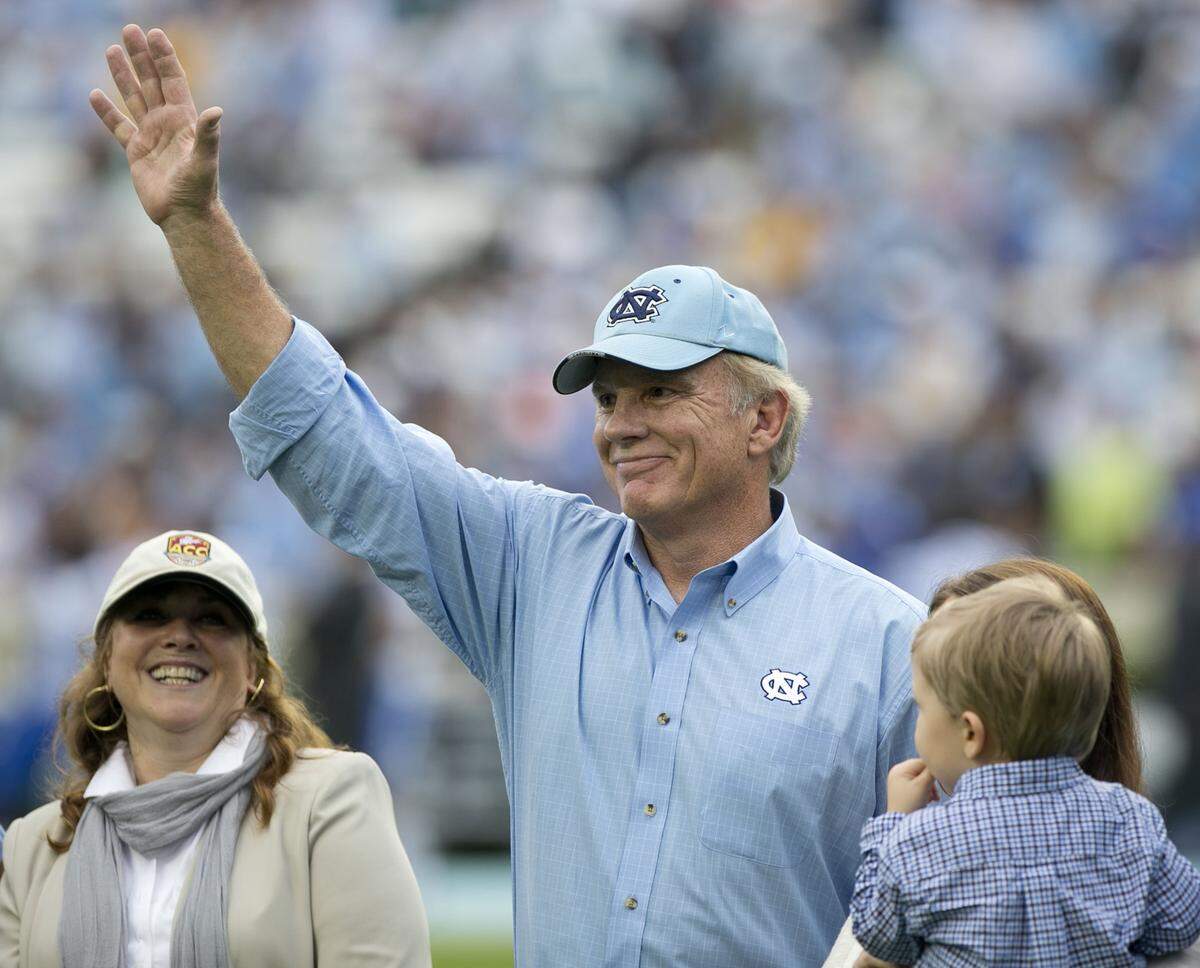
McCauley — a College Football Hall of Famer — takes pride in laying the foundation the team built off of.
Though McCauley’s collegiate career was half a century ago, UNC head coach Mack Brown doesn’t want that history to be forgotten. So last season, when Brown returned to the helm for the Tar Heels, he had McCauley speak to his team.
Players gathered to watch videos of McCauley running the ball at UNC and during his 11 years in the NFL.
“They all want to be him,” Brown said. “They all want to be a great pro player. They want to be in the Hall of Fame. So what they all do is they glue themselves to every word that he says, because they want to see if he can give them some advantages over other players.”
Brown certainly hopes one of his players can follow in McCauley’s footsteps: Help lead a turnaround for the program and etch his name into college football lore while at it.
And McCauley wouldn’t mind that at all, either.
“I’m trying to figure out who will be that player that could break this (UNC) record someday,” he said. “I would love to see it. Fifty years is enough. Let’s see somebody else do it.”
THE SCHEDULE FOR THIS SERIES
(Dates the stories will be posted online)
MAY 28 — Don McCauley, a UNC running back from 1968-70, has the ACC record for most rushing attempts in a season with 360 in 1970. He also owns the ACC record for the most plays from scrimmage in a single season with 375 that same year. The most interesting stat associated with McCauley is that he broke the ACC record for most rushing yards in a season with 1,863 yards in 1970, a record that stood for 43 years.
MAY 29 — Duke receivers Conner Vernon and Jamison Crowder are tied for the ACC career receptions record with 283 apiece. They were teammates for a time in the early 2010s.
MAY 31 — North Carolina’s Kendric Burney has the record for most interception return yardage in a game — 170 against Miami in 2009.
JUNE 1 — N.C. State’s Ted Brown still holds the ACC career rushing record, a mark he set from 1975-78.
JUNE 2 — Wake Forest’s Tanner Price has the ACC passing record by a left-handed quarterback.
JUNE 3 — A quick roundup of other interesting and important ACC footbal records leads with the 2011 Clemson team, which became the first in ACC history to win three straight games against ranked opponents. That team had a bevy of kids from the state of North Carolina.
FROM THE ACC RECORD BOOK
Career rushing yardage — 1. Ted Brown (North Carolina State, 1975-78) — 4,602; 2. Dalvin Cook (Florida State, 2014-16) — 4,464; 3. Amos Lawrence (North Carolina, 1977-80) — 4,391; 4. LaMont Jordan (Maryland, 1997-2000) — 4,147; 5. Lamar Jackson (Louisville, 2015-17) — 4,132
Season rushing yardage — 1. Andre Williams (Boston College, 2013) — 2,177; 2. Thomas Jones (Virginia, 1999) — 1,798; 3. (tie) James Conner (Pittsburgh, 2014) — 1,765; 3. (tie) Dalvin Cook (Florida State, 2016) — 1,765; 5. Don McCauley (North Carolina, 1970) — 1,720*(Does not include Peach Bowl performance that year. At that time, postseason numbers were not included in the totals).
Career rushing touchdowns — 1. James Connor (Pittsburgh, 2013-14, 2016) — 52; 2. Lamar Jackson (Louisville, 2015-17) — 50; 3. Ted Brown (North Carolina State, 1975-78) — 49; 4. James Davis (Clemson, 2005-08) — 47; 5. Dalvin Cook (Florida State, 2014-16) — 46
Season rushing touchdowns — 1. James Conner (Pittsburgh, 2014) — 26; 2. Travis Etienne (Clemson, 2018) — 24; 3. (tie) Ryan Williams (Virginia Tech, 2009) — 21; 3. (tie) Lamar Jackson (Louisville, 2016) — 21; 5. (tie) Robert Lavette (Georgia Tech, 1982) — 19; 5. (tie) Don McCauley (North Carolina, 1970) — 19; 5. (tie) Dalvin Cook (twice) (Florida State, 2015 and 2016) — 19