
Three takeaways from North Carolina basketball’s Maui Invitational loss to Auburn
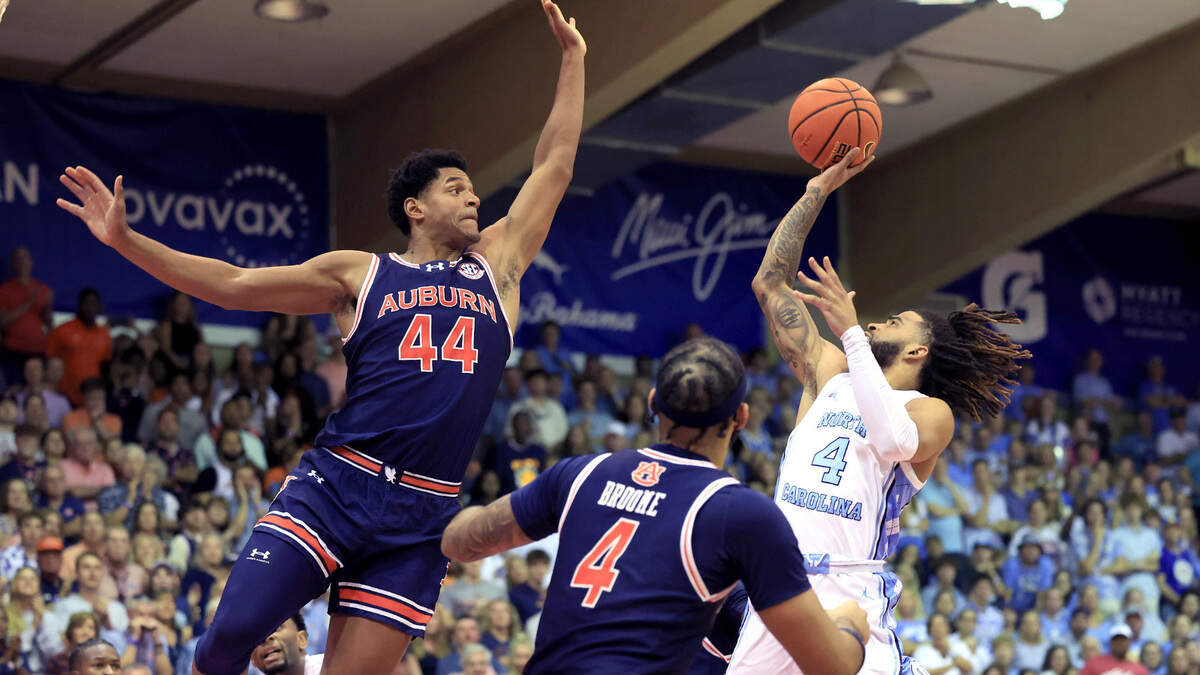
The No. 12 North Carolina Tar Heels (4-2) failed to complete another miraculous comeback in the Maui Invitational, falling 85-72 on Tuesday night to the No. 4 Auburn Tigers (6-0) at the Lahaina Civic Center in Hawaii.
The Tar Heels couldn’t overcome their slow start, falling behind by as many as 19 points in the second half. Ball control was once again a problem for North Carolina, as the Tigers scored 15 points off nine UNC turnovers.
North Carolina needed another big rally after erasing a historic 21-point deficit Monday night in its Maui Invitational quarterfinal win over Dayton. But after UNC cut its deficit to two in the first half against the Tigers, Auburn raced back ahead with ease.
With the loss, North Carolina plays in the third-place game against Michigan State at 9:30 p.m. on Wednesday. That game will be broadcast on ESPN2.
Here are three takeaways from the game:
Preseason All-American Johni Broome Dominates
By the time Johni Broome opened the game by scoring seven of the Tigers’ first nine points, it was evident the Tar Heels were in trouble.
Broome’s performance against North Carolina was nothing short of spectacular, as he proved a force on both ends of the floor. His stat line — 23 points, 19 rebounds, five assists and three blocks — illustrated his all-around contribution and showed exactly why he was tabbed a preseason All-American by the Associated Press.
In the first half, Broome was dominant on offense — to put it lightly. His ability to finish in traffic, along with a couple of smooth outside shots, kept the pressure on North Carolina.
Then, in the second half, Broome showcased his defensive prowess. As North Carolina tried to mount a comeback, Broome was everywhere on the defensive end — protecting the rim, crashing the glass and altering shots. His 13 offensive boards were pivotal in keeping Auburn in control, while his presence in the paint disrupted UNC’s offensive flow.
Broome’s dominance was the epitome of a complete game. His showing, while a likely outlier when compared to the rest of UNC’s competition, once again raises concerns about the Tar Heels’ personnel (or lack thereof) in the post.
Questionable Tar Heel shot selection
One of the critical issues that plagued North Carolina throughout the game was its tendency to force questionable shots, particularly under pressure. A glaring example came with Drake Powell’s contested step-back 3-pointer. That shot was taken directly in front of the bench with 23 seconds remaining on the shot clock and under two minutes left in the game.
This attempt not only symbolized the overall lack of offensive fluidity but also highlighted the growing disarray within UNC’s offensive system. In high-stakes moments, instead of executing with patience or looking for better shots, the Tar Heels often opted for tough, contested attempts that were not in rhythm. North Carolina recorded seven assists on the game — a stark contrast from the team’s average of 15.6.
Throughout the game, RJ Davis struggled against Auburn’s length — specifically 6-foot-6 Miles Kelly and 6-7 Chad Baker-Mazara. Davis was effectively neutralized by the Tigers’ defense, forcing himself and his teammates into awkward, contested shots.
Whether it was forced step-back threes, ill-timed drives or just a general lack of ball movement, the Tar Heels never found a rhythm. From the opening tip to the final buzzer, UNC played catch-up — never leading once in the game.
Yet another sluggish start
North Carolina’s sluggish starts in multiple games this season have been a troubling trend. The Tar Heels’ performance against Auburn — scoring a season-low 32 points in the first half — only highlighted this ongoing issue.
UNC came out flat, allowing the Tigers to quickly establish an early rhythm and a 15-point lead in the first half — after roughly five minutes of play. This slow start is now a recurring theme that’s been visible in the Tar Heels’ previous matchups against Kansas and Dayton.
Against Kansas, UNC struggled to find its footing early, trailing by 20 points in the first half. Dayton on Monday night was a similar tune. Slow beginnings also plagued the Tar Heels last March in their first two NCAA Tournament games.
Against Auburn on Wednesday, the Tar Heels’ sluggishness manifested in a porous defense (the Tigers sank eight of their first 11 shots) and an offense that lacked fluidity in half-court sets.
For a team with championship aspirations, these slow starts should be a major concern. And if UNC wants to hang its hat on playing with breakneck speed and pace, the Tar Heels can’t ease into every game with a light jog.
This story was originally published November 27, 2024 at 5:30 AM.