
UNC tennis player Reese Brantmeier’s comeback leads to US Open qualifier — again
AI-generated summary reviewed by our newsroom.
- Reese Brantmeier rebounded from knee injuries to lead UNC to an ACC title in 2025.
- She is suing the NCAA over outdated prize money rules amid evolving NIL policies.
- Brantmeier’s fundraising helped restore public tennis courts in Whitewater, Wisconsin.
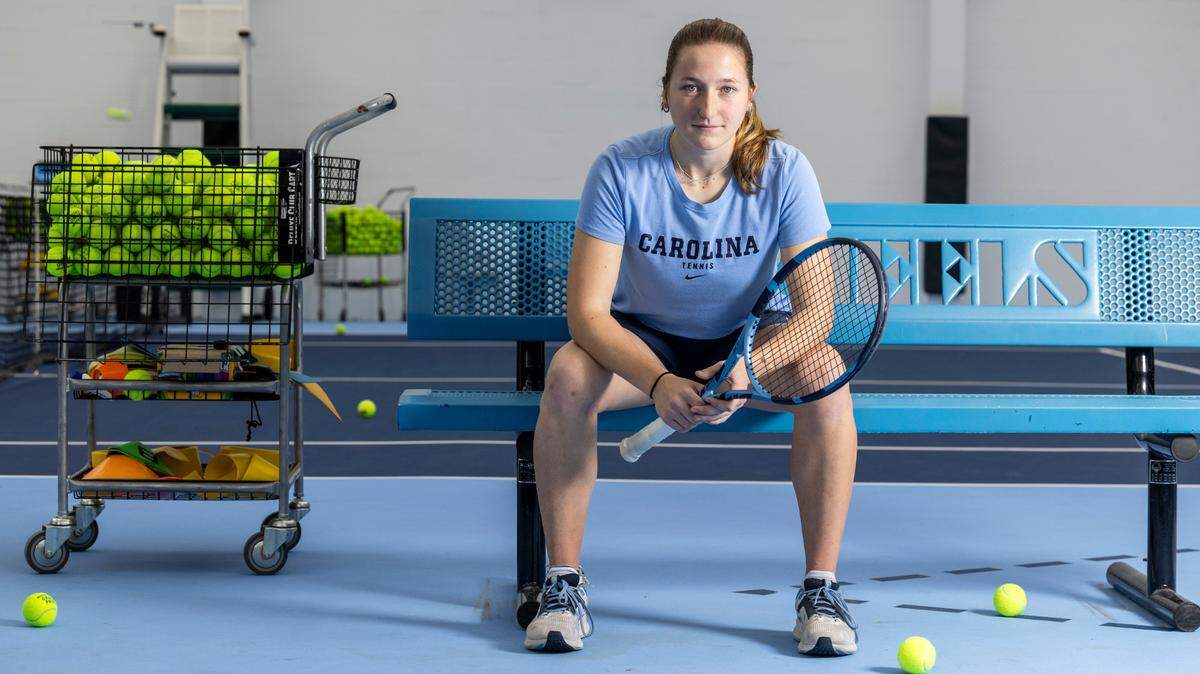
Eight-year-old Reese Brantmeier stared out her classroom window at a pair of tennis courts, where overgrown weeds sprouted from cracks in the green and red surface.
A rusted fence surrounded the neglected space outside of Washington Elementary in Whitewater, Wisconsin. There was no net; only the empty poles, faded white lines — and memories.
Frustration consumed the fourth-grader when she packed her gear into her mom’s car to take tennis lessons in Lake Geneva, 45 minutes away. The two courts at her elementary school mocked her from afar.
A teammate on her basketball team had picked up tennis, but hated making the 45-minute commute alone, so she asked Brantmeier to join her.
Brantmeier enjoyed it enough to keep going, but the future UNC women’s tennis star wished she could play in Whitewater. Her school was only 10 minutes away from her house in rural Cold Spring, population: 786.
But, she had no choice. Wisconsin is a tennis desert. It’s difficult to play year-round, and it’s expensive.
A large portion of the population of the east side of Whitewater — which includes Washington Elementary – is classified “low-income.” Twenty-nine percent of Whitewater’s residents live in poverty, according to U.S. Census data.
Even as her tennis skills and ambition have outgrown Wisconsin, Brantmeier hasn’t forgotten the sight of those courts outside her classroom window.
She thought about the courts as she qualified for the U.S. Open at 14, and again at 16. They remained on her mind when a dispute with the NCAA over prize money cost her the first semester of her freshman year — and as she led UNC to its first-ever national championship in spring 2023.
They were certainly on her mind when a torn meniscus ripped her away from the sport and shattered North Carolina’s chances of going back-to-back — and when she sued the NCAA over those prize money rules.
And now, as the 20-year-old Brantmeier works to come back from a second meniscus injury and earn a U.S. Open doubles wild card at a playoff in Orlando on Tuesday, the thought of those courts has not abandoned her.
“Since she was in the fourth grade,” Her mother, Becky, said, “she said, ‘I’m gonna become famous, and I’m gonna fix those courts.’”
Now, the rusted chain-link fence is gone. The weeds and cracks, too — replaced with new, smooth asphalt. It’s not completed, yet, still a work in progress.
But so is Brantmeier.
‘I knew I was not gonna be playing tennis like I’d been’
Ahead 3-1 in doubles against Southern California with partner Elizabeth Scotty, looking to put UNC ahead in the round of 16 in the 2024 ITA indoor national championship in Seattle, Brantmeier swayed behind the baseline.
North Carolina returned its entire starting lineup from the 2023 NCAA title run, and was aiming for a fifth-straight indoor title that February, with hopes of an NCAA repeat in the spring.
On the serve, Brantmeier split-stepped.
Her right knee popped. Something snapped. Her mother could see the pain on Brantmeier’s face.
“The second I took that step, I knew,” Brantmeier said, “I was not gonna be playing tennis like I’d been for a good amount of time.”
To avoid putting pressure on the rest of the team, Brantmeier stayed, and played standing still, even though it meant watching Scotty cover the court like a singles match.
After the pair won 6-3, trainers carted Brantmeier off the court.
UNC finished off USC, but lost to N.C. State, 4-3, the next day without Brantmeier.
The on-site doctor said she had patellar subluxation — her kneecap had popped out. It moved back into place on its own, so she could be back competing in two weeks.
But she wasn’t.
‘It was just shock’
An MRI back in Chapel Hill revealed a bucket-handle tear of her meniscus, a notoriously slow-healing injury.
“It was just shock,” Brantmeier said. “And a lot of disappointment.”
Doctors gave Brantmeier two options.
One: Repair her meniscus, hoping to increase her health and longevity as an athlete. Sit out for six months.
Two: Remove it completely. Sit out for two months.
She settled on the repair, at her doctors’ recommendation. Brantmeier’s mother, Becky, traveled to North Carolina to be with her daughter.
That repair usually takes four or five permanent sutures. Brantmeier required 12, a record for her surgeon. She was bedridden in her mother’s hotel room.
“It was the most pain I’ve ever been in,” she said.
Then came blood clots, which set back the healing process.
“I told her I’d stay there until she had one day without complications,” Becky said.
She stayed a week.
It didn’t get any easier. Walking to class on crutches exhausted Brantmeier. She skipped some days because of the pain. Still, she traveled to every match. If she couldn’t be on court, she felt she at least owed the team that much.
“Somebody gets injured, something gets taken away, their attitude goes south,” head coach Brian Kalbas said. “Hers never went south.”
But the losses weighed on her.
Confined to the sidelines of the NCAA super regional, Brantmeier watched as the team’s hopes for another national championship crashed.
First, Texas A&M took the doubles point, clinching on Court 1 — where Brantmeier should’ve been playing. Then, three singles matches. Once again, the clinch came at the No. 1 seed. Her court.
“I would have given anything to be able to help out,” Brantmeier said.
Brantmeier’s first fight
Who was Brantmeier without tennis?
This wasn’t the first time she’d faced that question. In the fall of her freshman year, before her first individual tournament, the NCAA began investigating some of her prize money and expenses from high school.
Prior to college enrollment, athletes can accept up to $10,000 per calendar year in prize money from professional tournaments. Beyond that, they can only accept money to cover “actual and necessary expenses” — like meals, lodging, equipment and “other reasonable expenses.”
Brantmeier’s family said they never received an itemization of what was being disputed, only random questions — particularly related to the nearly $49,000 for making it to the third round of the 2021 U.S. Open singles qualifying tournament and the main draw in doubles.
Her mother had bought a receipt scanner to track their expenses. The NCAA questioned if it was necessary, as well as a racket restringing outside of a 14-day competition window and a hotel room 16-year-old Brantmeier shared with her mother at the U.S. Open.
The NCAA refused to certify her amateur status for four months, rendering her ineligible for the fall semester.
“I had come to college to play tennis and that was all I’d done my whole life,” Brantmeier said. “So not being able to do that, I kind of was a little lost. I [didn’t] really know why I’m here.”
The NCAA did not respond to a request for comment.
At the end of winter break, the NCAA ruled she had to pay $5,100 to a charity of her choice. Then she could finally play college tennis.
Remembering Wisconsin
She remembered the courts.
Brantmeier donated the money to the Patrick Ryan Memorial Tennis Foundation — aimed at promoting tennis in Wisconsin. She grew up taking lessons where David Ryan, the organizer of the foundation, also played. She asked him to resurface the courts in her hometown.
After her donation, Brantmeier found out it needed more work. The estimate totaled $200,000. She offered to become the spokesperson.
She fund-raised. Wrote grants. Networked with pro players and UNC donors. Ran clinics.
A year later, she turned to the work during her injury. It made the weeks and months on the sidelines go by a little quicker.
“I hadn’t thought about tennis for myself in a long time,” Brantmeier said. “I was trying to give tennis back to a lot of people.”
In March 2024, she sued the NCAA. The legal action seeks a change in the prize money rules, specifically the ban on athletes’ ability to receive money for outside competitions beyond expenses.
“When the distinction was you cannot make money at all [and] that was the line that they drew, that’s a fair distinction between amateur and pro,” Brantmeier said. “But now in this NIL era that we’re in, it’s just out of date.”
A comeback, and a setback
Eight months after the surgery, Brantmeier’s knee still hurt. It made strange noises when she moved.
A scope procedure in the fall of 2024 revealed the meniscus cartilage never healed. The repair had failed.
So, back under the knife she went. This time, surgeons removed her meniscus, resetting all progress.
“Ending up now without my meniscus, knowing that I could have done that earlier and played for the team by the end of the spring, was really tough to know,” Brantmeier said. “But obviously hindsight’s 20/20.”
She woke up from her procedure in October and felt she could walk on her knee immediately.
Brantmeier couldn’t join the team in practice until January, right before the first match of the season against James Madison. She came back early to school from winter break to train, but only played one practice set.
“I truly had no idea if I was gonna be ready,” Brantmeier said. “But it was to a point if I’m physically cleared, it’s gonna be tough regardless, you’ve just got to rip the Bandaid off.”
She won her first match in straight sets. It was the most fun she’d had playing tennis since she was a kid making those commutes to Lake Geneva.
She was back.
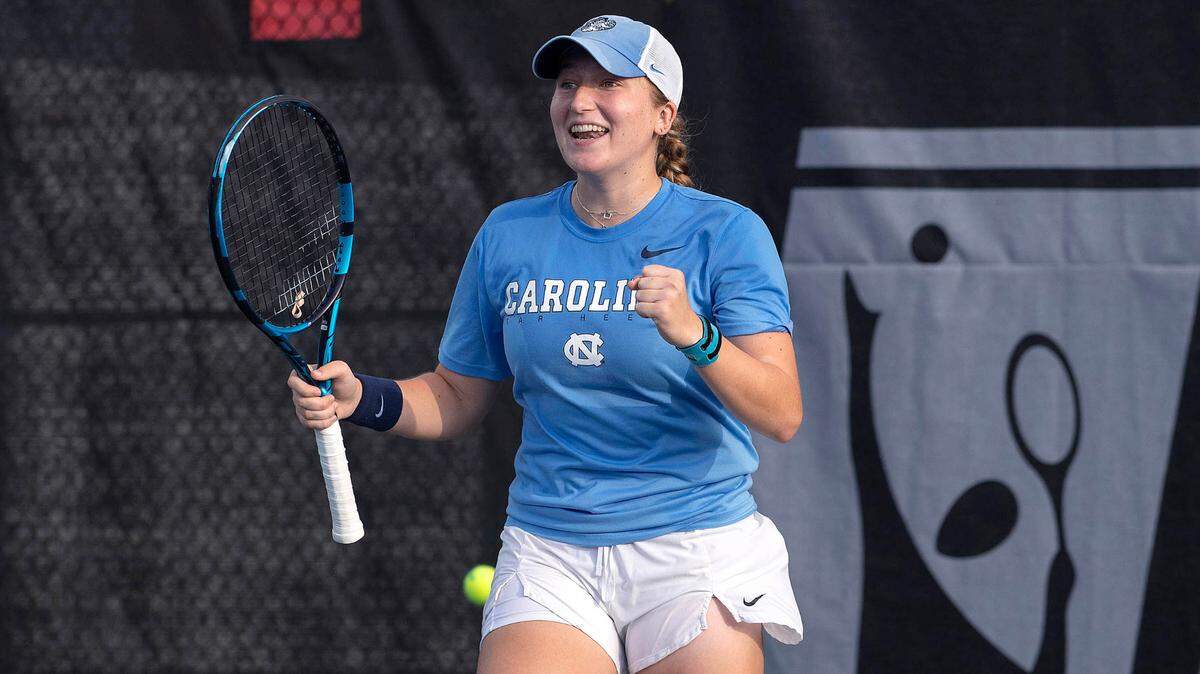
Brantmeier upset the No. 1 singles player in the nation at top-ranked Georgia in February to lead the team to a 4-3 victory. She finished the regular season with a 14-1 singles record and ranked No. 7 in the nation.
In doubles, Brantmeier and her partner, freshman Alanis Hamilton, ranked No. 2 with a 23-3 record.
She clinched North Carolina’s 2025 ACC Tournament Championship and was named Tournament MVP. Four days later, the ACC named her player of the year.
At the height of her game, she led UNC to the NCAA Tournament quarterfinals in May.
Then, after hitting a serve in her singles match against LSU, Brantmeier landed awkwardly. Wincing, hands gripped her right leg.
She called an injury timeout, but the pain in her knee was too much. She retired from the match, recording only her second loss of the season. Trainers carried her off the court. Again.
This time, it was a slight tear in her medial meniscus — the remaining pad of cartilage in her knee.
Two days later, UNC’s season ended in the NCAA semifinals with a 4-0 loss to Georgia.
“She has been playing such good tennis — the best tennis I’ve seen all semester,” senior teammate Lindsay Zink said. “It’s been tough to see her get reinjured, but I know she’s gonna come back better than ever.”
Brantmeier forges forward
Washington Elementary principal Tom Grosinske stood outside the Whitewater school in May. He took out his phone and hit record.
“Hey Reese, it’s Mr. G here,” Gronsinske said in the video. “I thought you wanted to see something pretty awesome.”
He flipped the camera to pan across the scene around him. Every time there’s changes on those no-longer-abandoned courts, he records an update and sends it to Brantmeier.
In the first video, the removal of the rusted fencing. Next, the stripping of the cracked surface down to sand. Most recently, the laying of the base-level pavement.
“Everyone has a vision — a hero or someone [they’ve] admired,” Gregory Stewart, an assistant coach for the girls’ tennis team at Whitewater High, said. “Reese [is] that within our community.”
Weeks have passed since Brantmeier’s latest injury, but she’s returned to training. Tuesday, she and Hamilton will travel to Orlando to face three other collegiate doubles teams. The winner will earn a spot in the U.S. Open.
Meanwhile, Brantmeier v. NCAA is proceeding to discovery. On July 7, nearly seven weeks before the U.S. Open, a judge will decide whether to certify it as a class action suit. If granted, a trial is expected to follow in the summer of 2026.
And as for those courts in Whitewater? Brantmeier has raised more than $159,000 in three years. Until the crew broke ground this summer, a green sign decorated the fence outside as a reminder that she hadn’t forgotten. In white, bold lettering:
Help us renovate these courts and bring tennis back to the East side.
The Reese Brantmeier Project.
That name is apropos for the Whitewater tennis court reclamation project, but also for Brantmeier’s ongoing journey through the tennis world.
The former appears close to a positive resolution.
The latter appears to be just getting started — again.
This story was originally published June 13, 2025 at 6:00 AM.