
Michael Lombardi defends UNC’s 2-point try vs. Virginia, says it was ‘right call’
AI-generated summary reviewed by our newsroom.
- Lombardi discusses UNC's five red-zone turnovers this season.
- He defends Belichick's overtime two-point try as the correct game-ending choice.
- He argues Virginia had an advantage in second OT, so going for two made sense.
UNC football general manager Michael Lombardi discussed red-zone turnovers and coach Bill Belichick’s decision to go for the two-point conversion in overtime against Virginia during his weekly radio show at Top of the Hill Restaurant & Brewery on Monday night.
“Coach Belichick preaches all the time: you have to avoid losing before you can win,” Lombardi said, “and when you turn the ball over three times in the red zone, you’re not avoiding losing.”
While UNC has looked much more competitive in its last two contests, red-zone turnovers have haunted the Tar Heels. North Carolina committed three red-zone turnovers in its last two games — one in the three-point defeat at Cal and two in Saturday’s one-point loss to No. 15 Virginia. That puts the Tar Heels at five red-zone turnovers on the season, which is tied for the most in FBS.
Belichick called the team’s red-zone turnovers its top issue following the team’s 17-16 overtime loss to the Cavaliers.
The first of those two red-zone turnovers Saturday came in the opening quarter when UNC wide receiver Kobe Paysour fumbled at the one-yard line while stretching for the pylon. The ball trickled out of the end zone, resulting in a touchback turnover — the second for North Carolina in consecutive weeks.
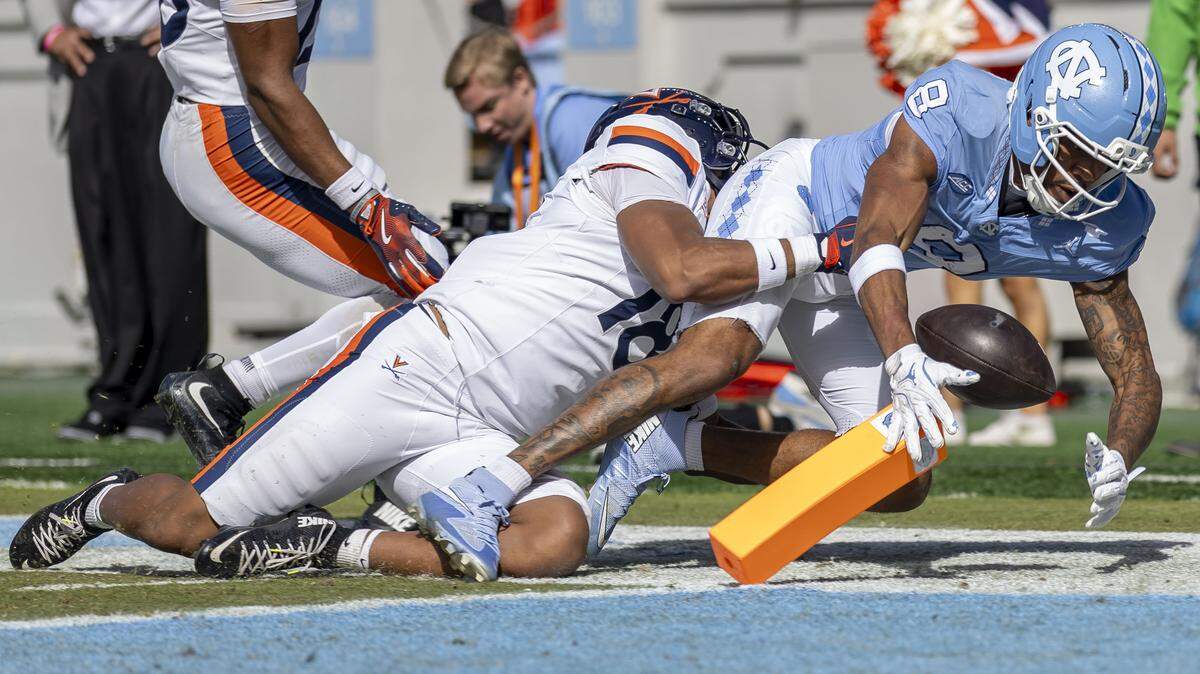
“You’ve got to be able to get the ball to the one-inch line,” Lombardi said Monday night. “I know everybody wants to score, but when you’re going there, you can’t switch the ball from left to right.”
“You’re trying to make a play, but you’re really not,” Lombardi added. “You’re hurting the team by doing that. I think to me, that’s just something that you constantly preach. We do. Obviously, the coaches work real hard on it. But, you know, guys want to try to make a play. And sometimes when you try to make a play, you end up hurting the team, not helping.”
North Carolina turned it over once more in the red zone in the third quarter when UVA’s Mitchell Melton picked off Lopez at the Cavaliers’ five-yard line. Lombardi said Monday that Lopez’s pass was thrown too high.
“When you get down to the red zone, if you’re the quarterback, any throw that is before the goal line has to be low [and] any throw in the back of the goal line has to be high,” Lombardi said. “Those are rules that you have to live by. If you throw the ball in the goal line, it’s got to be low, because if your guy doesn’t catch it, it goes in the ground.
You throw it high, it gets tipped up — like what happened to us down there.”
UNC came up short at the goal line once again in the overtime period Saturday.
After Davion Gause dashed into the end zone — providing the answer for J’Mari Taylor’s one-yard rush to open the OT period — Belichick opted to go for two points and the win.
Quarterback Gio Lopez hit running back Benjamin Hall in the flat, but Hall was stopped just short of the end zone.
“To me, there was a moment where we could capture the game,” Lombardi said of the decision to go for two.
Lombardi argued that it was smarter to go for two and try to win right then rather than kick the extra point and risk playing again in a second overtime. He defended Belichick’s decision, calling it the correct decision given the “shape of the game.”
Lombardi’s logic centered on how college football overtime rules give an advantage to the team that gets the ball second. The team that starts on defense knows exactly what it needs to win — a touchdown, a field goal, etc. — when it takes its turn on offense.
That order changes the math, Lombardi explained.
“When you win the toss and defer, they are really playing in a three-down game,” Lombardi said. “So if we would have stopped them on the quarterback draw, on third-and-seven, they would have kicked the field goal.”
“But when you then tie the game up, now it becomes a three-down game for you and a four-down game for the opponent,” Lombardi added. “It flips. And so the best thing you can do is win the game at that point — especially if you feel like you have a good play and you have something that you can execute.”
In other words, if North Carolina had kicked the extra point to send the game to a second overtime, Virginia would have regained the advantage in Lombardi’s mind — starting on defense and then getting four downs to score after knowing what UNC had done.
“You’ve got one play from two yards out to win,” Lombardi said. “If we give them four downs to score a touchdown, it probably would’ve been harder than us having three and settling for a field goal.”
UNC (2-5, 0-3) travels north to face Syracuse (3-5, 1-4) on Friday, Oct. 31 at 7:30 p.m. at JMA Wireless Dome.
This story was originally published October 28, 2025 at 5:30 AM.