
New ACC Network documentary revisits UNC’s 1993 men’s basketball title run
AI-generated summary reviewed by our newsroom.
- Raycom and ESPN used newly found Montross camcorder footage to reshape narrative.
- Documentary centers on team roundtable, archival clips and Smith’s coaching influence.
- Film argues 1993 title stemmed from discipline, preparation and collective chemistry.
The video is grainy, shaky and unmistakably personal. Ed Mabe wasn’t sure he’d ever seen it.
When the producer began research for a documentary about UNC’s 1993 championship basketball team, he noticed something intriguing during the Tar Heels’ post-title press conference in Chapel Hill. As Eric Montross walked on stage, he carried a small handheld camcorder.
“I immediately thought, ‘Oh my gosh,’” Mabe told the N&O. “‘Where could that footage possibly be?’”
That footage — unseen by the public for more than 30 years — helps form the emotional spine of “We’re #1! 1993 North Carolina Tar Heels,” a new documentary premiering Saturday on ACC Network at 8 p.m. The one-hour film, produced by Raycom Sports in partnership with ESPN, revisits UNC’s 1993 NCAA championship season through archival game video, new interviews and Montross’ first-person home video.
“Getting that footage really changed the whole approach to the documentary. … It kind of switched gears for me,” Mabe said, later adding, “This is everything I could hope for. I used it as best I could.”
The documentary will debut immediately following UNC’s game against Wake Forest on Saturday, with tipoff of that contest set for 6 p.m. It arrives at a moment, Mabe argues, when the 1993 team has begun to slip into the background of UNC lore — remembered for a timeout called by Michigan’s Chris Webber, but not so much for the group that forced it.
Mabe wanted to change that.
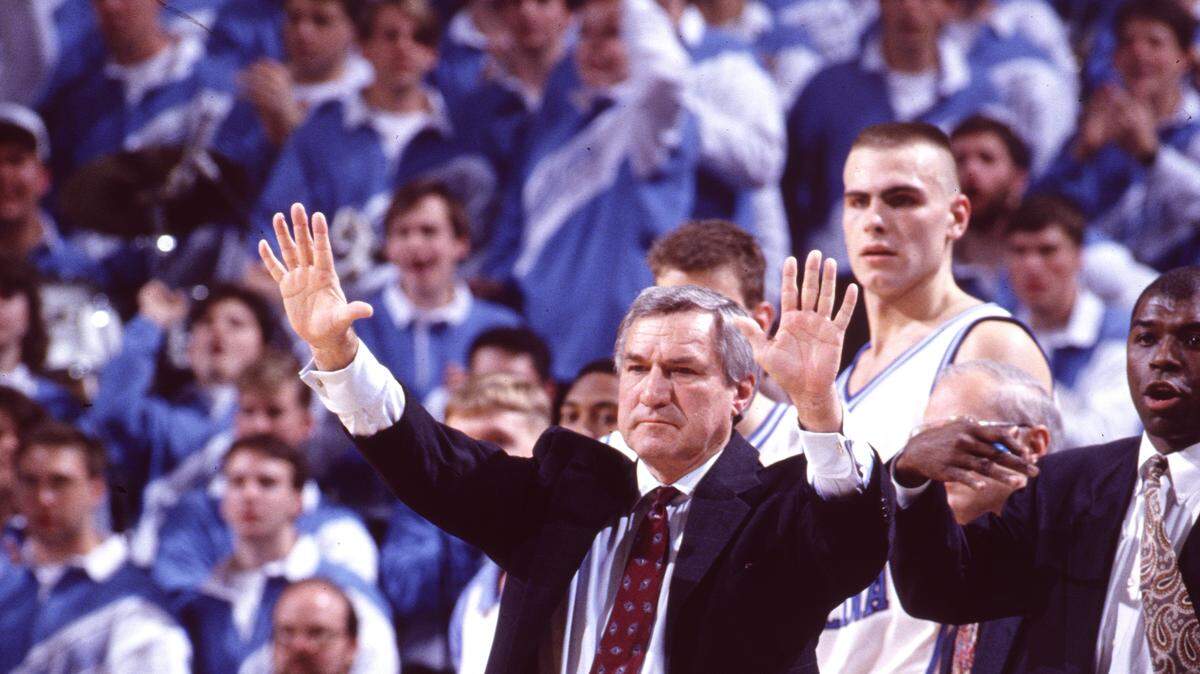
“I wanted to elevate this team … to be talked about more,” he said. “What they had, I think, is truly the embodiment of a Dean Smith team — to play hard, play together and play for each other.”
‘Such a close group’
The documentary’s structure mirrors the team itself.
There’s no single narrator. Voices overlap — former players, assistants, opponents, broadcasters — to tell the story. The centerpiece is a roundtable at Top of the Hill, where many members of the 1993 championship team gathered during an Eric Montross basketball camp weekend.
Players such as George Lynch, Kevin Salvadori, Matt Wenstrom, Pat Sullivan, Henrik Rödl, Travis Stephenson and Ed Geth crowd together alongside former assistant coaches Phil Ford and Dave Hanners.
The documentary returns constantly to this informal conversation. Laughter cuts through, memories linger, and during a few moments, voices choke up with emotion.
“It was such a close group,” Hanners told the N&O. “But, you know, just such a nice bond to know that those guys are always there, that they’ll always help. It’s like family. … You might not see your mom and dad every day, but when you do see them, it’s the same. Nothing’s changed.”
That closeness translated to the court.
Hanners recalls a moment at practice that season when Lynch, driven by instinct, broke one of Smith’s defensive rules and doubled a ballhandler he wasn’t supposed to. After Lynch did this a few times, the rest of the team began to adjust.
Instead of scolding Lynch, Smith adjusted too.
“He said, ‘George has these great instincts,’” Hanners recalled. “‘We don’t want to take that away, because it’s really good for our defense for him to have these instincts.’”
A whirligig mind
Though Mabe lacked extensive archival interviews with Smith, the head coach’s presence is felt throughout the documentary.
Behind the roundtable, a black-and-white photo of Smith at Top of the Hill shows the coach with arms folded and a grin on his face — almost as if he’s watching over the discussion.
Around that table, stories drift back to Smith easily. A practice detail, a phrase or a look. Hanners and Ford still laugh when they recall how Smith’s ideas often arrived half-formed.
“His mind was like a whirligig, and it would be spinning around,” Hanners said, “and we knew it was working, but he would throw something out … and he would expect us to understand what he meant when we only got one-sixteenth of the picture.”
Yet, somehow, the players on that team understood.
Hanners remembers watching Smith diagram a new offensive set at practice that year. He barely explained it, from Hanners’ perspective, but the players moved exactly in tune with Smith’s vision.
“It was perfect,” Hanners said. “I thought, ‘How does that happen?’ He didn’t explain that the way they did it. But they were so used to him, their mind started working like his.”
Ford knew the team would be special when he realized how good the Tar Heels could be defensively and on the boards. He knew Smith would take it from there — that the head coach’s play design would set the team up for good shots.
Ford often greeted opposing coaches with the same line before games that season.
“I hope both teams play their best,” he would say. “Let’s let the best team win.”
He knew which team that would be.
Big Grits
Montross anchored it all.
The 7-footer was the center on the court and emotionally, Hanners said.
“Eric’s personality was big and pleasant and compassionate and caring,” Hanners said, “and because of that, I think everybody gravitated to him in a lot of ways.”
Hanners said Montross brought his joy to everything: practice, games, the locker room.
There aren’t many ‘Eric stories,’ Hanners said. He was always on time. He did really well in school. He never tried to draw attention to himself. You could never “get him” on anything except for the most minute instances.
Heading into the 1992-93 season, Montross and Stephenson showed up at Hanners’ office one day, grinning.
They wanted to go fishing. More specifically, they wanted Hanners’ old fly rods.
“I never saw them again,” Hanners said with a laugh.
Hanners didn’t care, really. What he remembers is Montross and Stephenson fishing for 10 days straight. In the documentary, Montross’ presence — just like Smith’s — lingers through memories like this.
His voice surfaces, too, through audio from an interview recorded months before his death in December 2023. Mabe said it was important that Montross wasn’t just seen, but heard.
“I wanted his voice there too. … It’s like the spirit of Eric floating throughout the show,” Mabe said. “That’s sort of what I was going for.”
‘The best loss’
Nothing in the ACC — particularly the Triangle — happens in a vacuum. By the time the 1992–93 season began, Smith was already a Hall of Famer, but he had not won a national championship in more than a decade. Duke, meanwhile, had just claimed back-to-back national titles.
There was talk at the time, as the documentary highlights, that the game was moving past Smith.
The Tar Heels proved that wrong — making it all the way to the Final Four — with impressive wins and revealing losses. There was the early loss to Michigan in Hawaii, sealed by a last-second rebound and fluke of a putback. There was the comeback against Florida State — down 21 with less than 12 minutes to play — which Ford called one of the “greatest comebacks” he’s ever been associated with.
They beat plenty of teams by 30 or 40 points — and scored 100 points in eight games — but there were still more losses after that. Wake Forest and Duke back-to-back. Georgia Tech in the ACC Tournament final.
Hanners calls that last one “the best loss” of the season because it reset the team.
Winning the ACC tournament, he said, would have meant carrying a massive winning streak into March.
“I know the fans didn’t like it, right?” Hanners said. “But I thought, well, now we can go on another run. It’ll be perfect.”
Chemistry and cohesion
There’s no doubt in Ed Wills’ mind about it. From the time the team arrived in New Orleans for the 1993 Final Four, this much was clear to the then-manager: The single focus was winning it for Coach Smith.
Wills remembers that, when the Tar Heels won the Elite Eight game, they didn’t even cut the nets down. There was no massive celebration.
“The guys really felt like the job wasn’t done — that there was more that they wanted to achieve,” Wills said. “And you could feel it in New Orleans. They were focused. The Final Four is, for everybody who’s there, it’s a big party …. that’s even magnified in a city like New Orleans. But that was not for our guys. They didn’t leave the hotel.”
A win over Roy Williams’ Kansas squad in the semifinals set up a rematch against Michigan’s Fab Five. Even Ford will admit that the Wolverines boasted better one-on-one matchups.
“But as a team, I don’t think that Michigan was better,” Ford said. “With our chemistry and our cohesiveness.”
The Wolverines had stars. UNC had answers. The Tar Heels had practiced so many late-game scenarios that nothing felt unfamiliar.
When Webber called a timeout he didn’t have, it wasn’t the mistake that won the championship, Mabe argues, but UNC’s preparation. It was Lynch who doubled Webber — just as he had at that early-season practice —causing the Michigan standout to panic.
“I wanted to dispel that in some way and let everyone know that Carolina was very much in charge of that game before that play happened,” Mabe said, “that it wasn’t because of that play that they won that game. They were in the driver’s seat the whole way.”
Mabe said he aimed to frame the championship as the natural outcome of a group that thought alike, moved alike and believed — deeply — in the coach that brought them there.
Three decades later, gathered around a table at Top of the Hill, many of those voices overlapped again.
The bond is still there.
This story was originally published January 10, 2026 at 7:00 AM.