
UNC’s first Black sport administrator discusses her trailblazing legacy
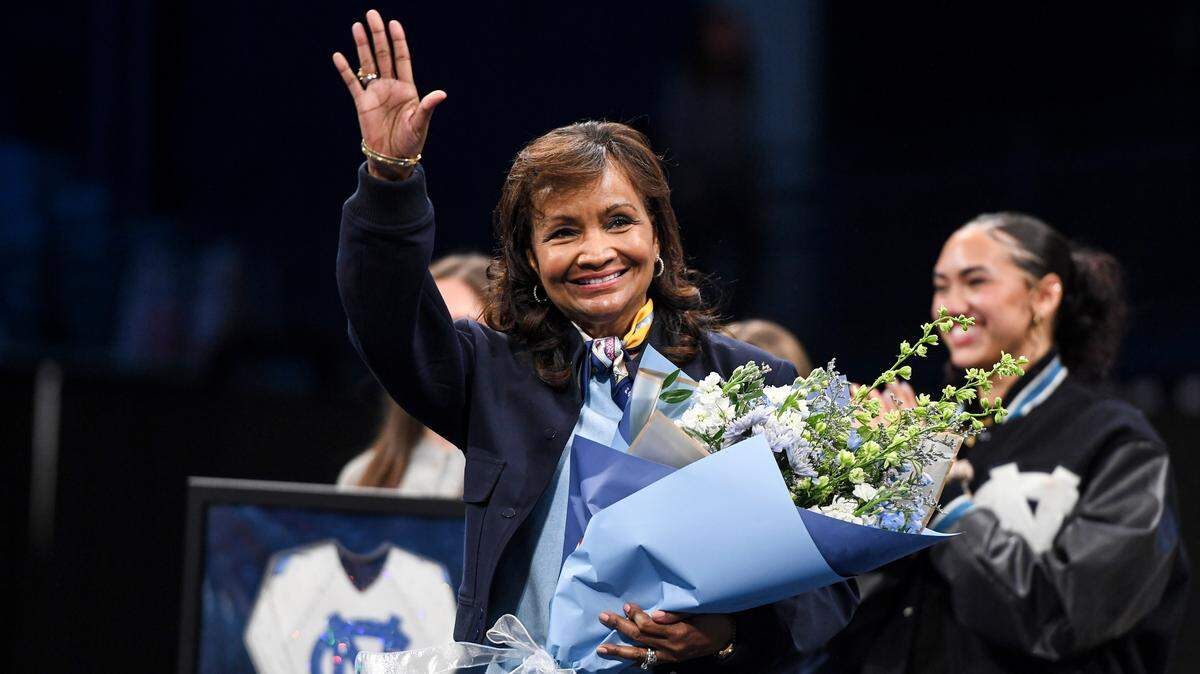
Martina Ballen has often said “you can’t be it unless you see it.” But when Ballen joined the UNC athletic department nearly four decades ago — becoming the school’s first Black sports administrator in the process — there were very few folks in that space who looked like her.
“First of all, to be a woman in that space, was rare,” Ballen told the N&O. “Beth [Miller] and I were the only two females on the senior staff for many years. And then to be a woman of color in that space was extremely rare. And then to be a woman of color in that space and in finance — I was a unicorn.”
Ballen began her career with the UNC athletic department in 1987 as the director of finance. She was promoted to associate director in 1995, senior associate in 2001 and chief financial officer in 2011 — a role she served in until her retirement last week. During Ballen’s tenure, she also served as an administrator for the women’s basketball and gymnastics programs.
But she’s also carried plenty of other unofficial roles, namely: trailblazer and mentor.
“We had a retirement party for her recently, and a number of the young people that she’s worked with came back… they just have tremendous respect and admiration for her,” Cunningham told the N&O. “She led them, mentored them and provided them opportunities to grow and expand and then have great careers.”
Ballen was born and raised in Southern Pines, which she described as “a very close-knit community.” She lived across the street from an uber-athletic family of five. That meant built-in playmates and competitors.
Afternoons after school and summer evenings were filled with baseball, basketball and flag football. Ballen’s first love was basketball, but her first introduction to the UNC athletic department came via football. As an undergraduate student at North Carolina in the late 1970s, she worked with the “Sweet Carolines,” a now-defunct student group that helped with football recruiting.
Ballen graduated from UNC in 1980 with a degree in business administration and went on to earn her MBA from Wake Forest University in 1984. Ballen soon became a commercial lender at what’s now Bank of America. That led her back to Chapel Hill, where she became a branch manager on Franklin Street.
“One of my former deans banked there and he told me about a position that was being created in athletics, director of finance, and he really encouraged me to apply,” Ballen recalled. “He said the administration wasn’t diverse, and really thought there was a need for diversity in that area. And so at first I thought, ‘What do I know about athletics?’”
But Ballen was pretty certain she didn’t want to make banking her career. Upon more reflection, she figured it would be “pretty cool” to work at her alma mater for a few years.
And then a couple of years turned into 38 and a half. During that time, Ballen saw the Tar Heels win more than 44 national championships and worked with three different athletic directors. The athletic department budget has grown from $16 million when she started to more than $180 million.
“In athletics, change is a constant for me, and it also is probably why I was there for 38 and a half years,” Ballen said, “because while I was over the money for that long, my job was not the same for all those years… there’s just so many different elements of athletics that change. NCAA rules change, and most changes will impact resources in some way. So that was a constant, and always trying to figure out, how do we respond?”
Ahead of National Girls and Women in Sports Day, which falls on Feb. 4, Ballen spoke to the N&O’s Shelby Swanson. The following Q&A has been edited for brevity and clarity.
N&O: What was the most intimidating part about starting your professional career in sports?
Ballen: “I was new to the sports world, but I was a Tar Heel, right? But to be a 29-year-old and being there and I am, you know, directing these coaches or telling them what they can and can’t do, from a purchasing or expense standpoint — especially for some of the more senior coaches, like Dean Smith — that certainly was intimidating.”
N&O: Was there anyone, in particular, who helped you through that?
Ballen: “Yes, for sure. Beth Miller, who was an administrator with the senior administration there. And John Swofford, who was the athletic director at the time. When I joined, Beth had done this job, and she was absolutely wonderful. She was right there to help me, guide me, answer many questions that I had. And we became very dear friends. We’re very dear friends to this day, but she was really instrumental in those early years, helping to make my transition a smooth one.”
N&O: You helped lead the launch of the Tar Heel Trailblazers in 2014, which honors UNC athletics pioneers during Black History Month. This year, you’re being honored with that award. Why was that initiative important for you?
Ballen: “Myself and a few other administrators in the department, several years ago, we went to the athletic director, and we thought that we would love to honor pioneers or trailblazers — those who, perhaps, have been forgotten or just hadn’t been recognized in way that we wanted to recognize them. It may not have seemed like much then, and it may have been a challenge then, but to help them understand the path that they opened up and paved for others to come behind them.
“I just thought it was important to recognize what these folks had done, and also show others, especially young people. To help them understand what others went through, so that they could be doing what they’re doing today. It wasn’t always roses. It was sacrifice. It was alienation. Those are stories that I think are worth telling and for people to understand.”
N&O: Your eldest son, Julian, is autistic. You chaired the Autism Society of North Carolina board of directors and this is a personal cause for you. How has Julian shaped you?
Ballen: “As a full-time athletics administrator and a mom of two young sons, and the older son being special needs, was very challenging. It’s funny how you look back and you wonder sometimes, how in the world did I do it? But you know what? We rise to the occasion and we do what needs to be done, and we somehow figure it out and make it work. Having a son on the autism spectrum has opened my eyes and shaped me in terms of being patient, empathetic and understanding of whatever challenges one might have. And I think it also helped me to be a great manager of people as well.”
N&O: What advice would you give to young women who want to go into athletic administration?
Ballen: It’s still very difficult to get your foot in the door. I would say for young people, don’t get discouraged. Network. Meet as many people as you can, especially people who look like you or are the same gender. Try to be involved. Go to career fairs, go to conferences if you can. Networking is key. If you’re in an area where there’s an athletics program and you have an interest in an area, go to some informational interviews. Just see if there’s a way you can help, if there’s some way you can provide some help, even just a few hours a week. It gives you an idea of how things actually work. You can figure out what it is you’re interested in, or what you thought you might have been interested, but you’re not interested in now. It’s developing those relationships when and wherever you can.
This story was originally published February 4, 2026 at 5:15 PM.