
From court to coach: inside UNC staffer Kayla McPherson’s homecoming in Duluth
When the ACC announced last year that its 2026 women’s basketball tournament would be held just outside Atlanta, Kayla McPherson immediately thought about playing there.
The former North Carolina guard grew up about an hour and a half from the host site in Duluth — in Hull, Georgia — and imagined the moment: family in the stands, familiar territory, a rare chance to compete close to home.
“I was hoping I would be playing in it,” McPherson told The News & Observer earlier this week. “Because it’s super cool to be like, ‘I’m playing right in Georgia where everything kind of started for me.’”
Instead, when the No. 3 seed Tar Heels (25-6, 14-4 ACC) open tournament play Friday night at 7:30 p.m. against Virginia Tech, McPherson will be on the sideline.
The former five-star recruit and McDonald’s All-American will experience the homecoming as a student assistant coach — a role crafted by North Carolina coach Courtney Banghart specifically for McPherson after a long run of knee injuries forced her to medically retire last summer.
Over the past several years, McPherson has undergone seven knee surgeries dating back to the ACL tear she suffered in high school. She briefly returned to the court during the 2022-23 season for 13 games, and again for seven games in the 2023-24 season. Both times, she flashed the scoring ability that made her one of the nation’s top recruits, but further injuries continued to derail her career.
Eventually, the physical toll — and the risk to her long-term health — became impossible to ignore.
“It just got to a point where it’s like, this is just going to be a cycle of just hurting myself,” McPherson said, later adding, “The decision was easier than I thought.”
Now, instead of leading North Carolina on the court in her home state, McPherson is helping guide the Tar Heels from the sideline — a different role than she once imagined, but one she has quickly embraced.
‘I was crushed’
Injuries have followed McPherson for nearly as long as her college career has existed — beginning before she even arrived in Chapel Hill.
As a senior at Madison County High School in Georgia, the McDonald’s All-American tore her ACL, forcing her to begin her college career at North Carolina in rehab rather than on the court.
“I was crushed,” said Robert Swain, McPherson’s trainer based in Georgia. “I was sad, man, but I know she’s so strong, and her mindset is so strong. I knew she would bounce back.”
McPherson redshirted her first year in Chapel Hill while recovering, spending months rebuilding strength in her knee and waiting for the chance to finally debut in a Tar Heel uniform.
That moment didn’t come quickly.
More than two years passed between her final high school game and her first appearance for North Carolina — nearly 800 days spent mostly in training rooms and rehabilitation facilities rather than arenas. McPherson made her college debut as a redshirt freshman on Jan. 29, 2023, in a 69-58 win at Clemson.
“I will never forget that,” McPherson said. “For one, it’s an hour (drive) for my mom, so I had a bunch of family there. It was just everything that I hoped that my experience would be, just being out on the court, finally being able to be back with basketball. It was just so cool.”
When McPherson finally took the floor in 2023, she showed flashes of the player who had once been one of the nation’s most electrifying scorers. The 5-foot-7 guard brought energy, toughness and an aggressive scoring punch to the Tar Heels’ backcourt, averaging 6.8 points in limited action and earning ACC Freshman of the Week honors after a 22-point performance against Boston College.
But it didn’t last long.
Early the following season, in November 2023, McPherson suffered another serious knee injury that again ended her season and sent her back into rehab. What followed was a grueling stretch of surgeries and recovery that ultimately reshaped the trajectory of her career.
Among the procedures was an osteochondral allograft — a surgery that involved transplanting cartilage from a cadaver into McPherson’s knee to replace damaged tissue that had worn away over years of injuries.
Doctors told her the odds of returning to play were slim. And even if she could push her body back onto the court again, the long-term cost might be far greater.
But still, McPherson kept pushing. Why?
“I just think my love for basketball,” McPherson said. “I just never would have wanted to give it up. And nothing could have ever tried to take it away from me at that point … I just couldn’t. My love for basketball is what kept me going.”
‘Here we go again’
By the summer of 2025, McPherson still believed she might find her way back onto the court.
After months of rehab following the cartilage transplant in her knee, the North Carolina guard had worked her way back into basketball activities. She practiced, scrimmaged and trained with the Tar Heels during the offseason, once again looking like a player preparing for another season.
“I don’t think people understand, and probably don’t know, but I was fully playing in the offseason,” McPherson said. “I was fully practicing, I was fully scrimmaging with the team. I was an actual player.”
But one morning in June, the reality she had been trying to outrun returned.
After a particularly hard practice, McPherson woke up the next day to find her knee badly swollen. The pain wasn’t in the surgically repaired left knee this time — it was in her right.
“I woke up the next day and my knee was just swollen,” she said. “I was like, ‘Oh my God. Here we go again.’”
At first, she tried to wait it out. McPherson didn’t even tell her athletic trainer for several days, hoping the swelling would fade, as minor flare-ups had before.
Instead, it got worse.
An MRI later revealed additional damage in the right knee — a devastating development after years of surgeries and rehab on the other one.
McPherson began having serious conversations with team doctors, including longtime orthopedic surgeon Dr. Stephen S. Spang, about what continuing to play might mean for her body.
Eventually, the question became unavoidable: Do I just keep having surgery over and over again to fix the same problem?
‘I’m going to support you’
Last summer, McPherson found herself weighing questions most 22-year-olds rarely have to consider.
“I have the desire to have a life in 50 years where I’m able to run around with my kids, I’m able to go on a walk, I’m able to have a fulfilling life... you got to have a backup plan,” McPherson said. “And, bless my heart, I didn’t have a backup plan.”
“When I got to that point, the decision was easier than I thought it was,” McPherson said. “Because this is something that I want to do. I really want to play basketball — really, really bad — and it breaks my heart to let it go, but it’s what’s best for me and my body.”
Once McPherson realized her playing career was truly over, there was one conversation she knew she had to have.
She walked into Banghart’s office.
“I told her, ‘I still want to be a part of this team,’” McPherson said, “’I still want to be here. I still want to help in any way that I can.’”
Banghart didn’t push back. She listened.
“She wanted me to be here,” McPherson said. “She expressed that I still had value to this team, even though I wasn’t playing. She made it a super easy transition. We both wanted the same thing. We both wanted me to be here and be in this role this year.”
Banghart created a student assistant position tailored specifically for McPherson. The role would allow McPherson to stay involved in practices, help mentor younger guards and serve as a bridge between the coaching staff and the players.
It wasn’t something McPherson had planned for when she first arrived at North Carolina as a highly touted recruit.
But in many ways, it felt natural.
Even during the seasons she missed because of injury, McPherson had become one of the team’s most vocal leaders — breaking down film with teammates, offering advice during practices and constantly encouraging players from the bench.
Banghart had noticed. So instead of leaving basketball behind, McPherson was encouraged to step into a different version of it.
‘She’s authentically her’
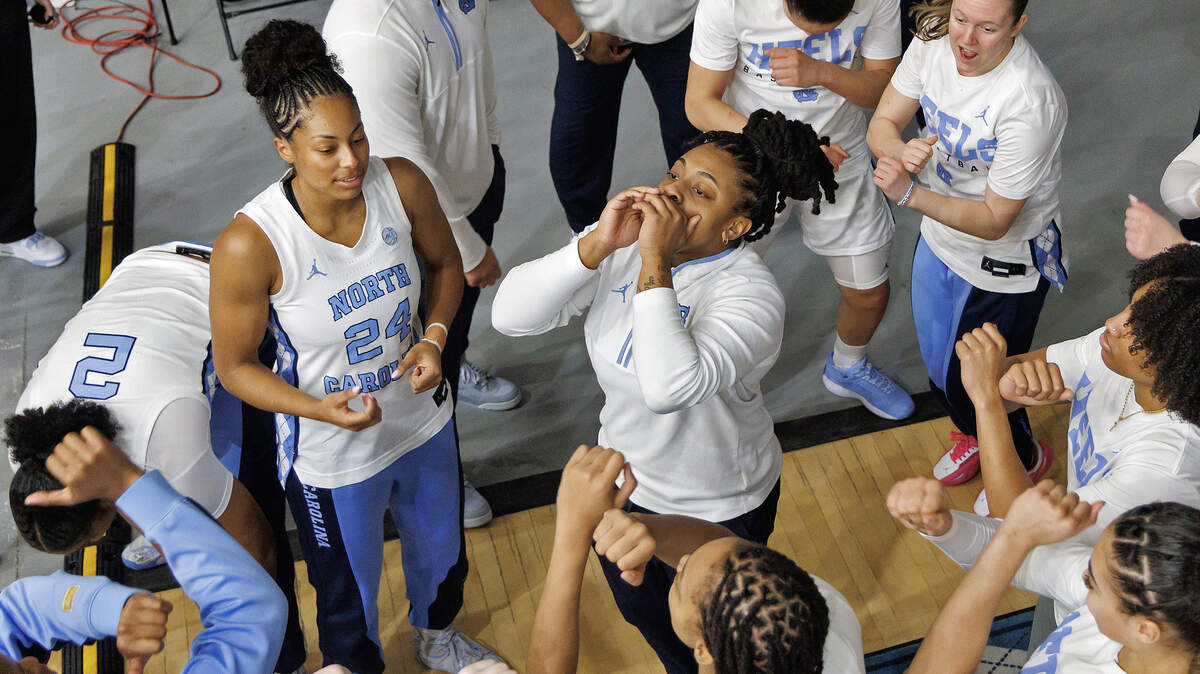
McPherson stands on the sidelines this season in a quarter-zip, sleeves rolled up, a sheet of paper held in her hand or tucked into her back pocket like a rolled-up baton. She shouts over the bounce of basketballs and squeaks of sneakers, organizing pregame warmups, breaking down the huddle, pointing out spacing and rotations in-game.
If it looks like a natural fit for McPherson, that’s because it is.
“Kayla’s going to be one of the great women’s basketball coaches. You heard it from my mouth today,” Banghart said this week. “She’s going to prove me right. She’s got an incredible coaching mind. She’s got a great voice. It permeates. She’s authentically her.”
Her teammates — some just a year or two younger, or even the same age as her at 22 — turn to her for guidance, and she embraces every chance to help them grow.
“She’s amazing,” said sophomore guard Jordan Zubich in the preseason. “I think she would be an amazing coach. I think if I was to go through the recruitment process again, and she was a coach, I would love talking to her.
“She’s just really enthusiastic, and she just has a really high basketball IQ. So anytime I mess up, I feel like she has a great perspective.”
As the No. 3-seeded Tar Heels open ACC Tournament play this week in Duluth, just an hour and a half from her hometown of Hull, Georgia, McPherson will experience a homecoming of a different kind. She won’t be on the court, but in every shout, adjustment and word of advice, the game — and her mark on it — is still hers.
This story was originally published March 6, 2026 at 5:30 AM.