
UNC basketball hired a director of community engagement last summer. Here’s why
AI-generated summary reviewed by our newsroom.
- UNC created a Director of Community Engagement to coordinate sustained outreach.
- Players built ongoing ties with Hargraves and Boys & Girls Club through events.
- Team outreach aims to teach service, strengthen neighborhood relationships.
When 7-year-old Ayden Woodford first told his mom he was tight with the UNC basketball team, she didn’t believe him.
It sounds, after all, like a figment of a child’s imagination. Just like the made-up games Ayden runs around playing with his fellow classmates at Chapel Hill’s Hargraves Community Center.
Except the Tar Heels, who will begin their NCAA Tournament campaign on Thursday night against VCU in Greenville, S.C., do know Ayden. One piece of evidence, in Ayden’s defense: at a meet-and-greet earlier this year at a local Verizon store, UNC guard Seth Trimble spotted him in the crowd, called out to him by name and asked how he was doing.
“He’s like, ‘Mom, don’t you know I’m famous? You know these are my friends,’” his mother, Yushekia Woodford, told the N&O. “And I’m like, ‘Sure they are.’”
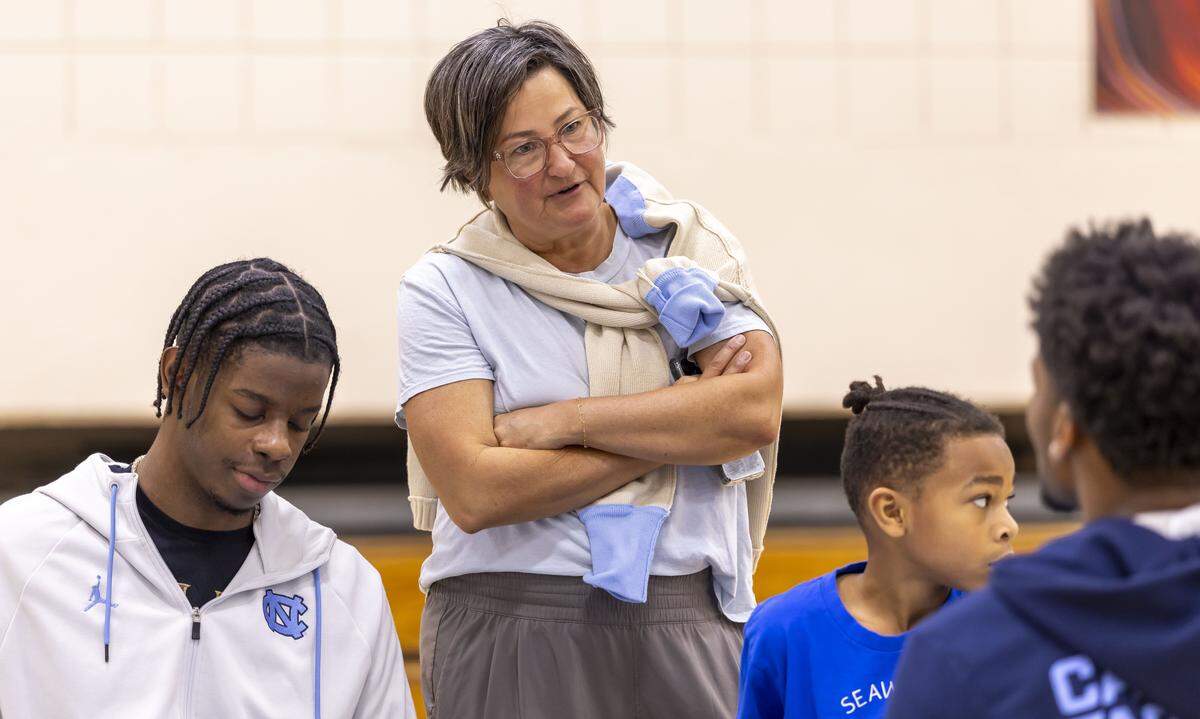
But Ayden’s right. He knows Trimble and plenty of the other Tar Heels, too, from the time the team has spent in the community this season — specifically at Hargraves and the Chapel Hill Boys & Girls Club.
“He looks up to them like mentors,” Yushekia Woodford said.
That’s all Hubert Davis and his wife, Leslie, could have hoped for when they created the men’s basketball program’s first-ever director of community engagement role this past offseason. The position, filled by former student manager Ragan Copeland, was designed to bring more structure and intentionality to the team’s community service, ensuring players could give back in meaningful ways rather than one-off appearances or only through NIL engagements.
“It’s very important to us,” Hubert Davis said during a February radio show. “One of the things that I tell the guys all the time is that you’ve been put on this platform not just for you.”
“You’re not just here just to play basketball,” he later added. “You’re here to serve and help other people.”
Life outside the comfort zone
Elijah Davis grew up hearing stories about his dad’s visits to Central Prison.
Dean Smith’s UNC teams regularly stepped outside the basketball bubble to engage with the community. During Hubert Davis’ days as a Tar Heel, that included annual visits to Raleigh’s maximum-security institution — trips that helped shape Davis’ perspective on community service to this day.
Many of the inmates, it turned out, were huge North Carolina fans who knew the players’ names, the team’s record and kept up with the games.
“After practice, we hung out with the inmates,” Hubert Davis said. “Coach Smith went and sat in cells with people that were on death row, and had conversations and spent time with them. What an impactful thing as an 18-year-old kid to be able to do that.”
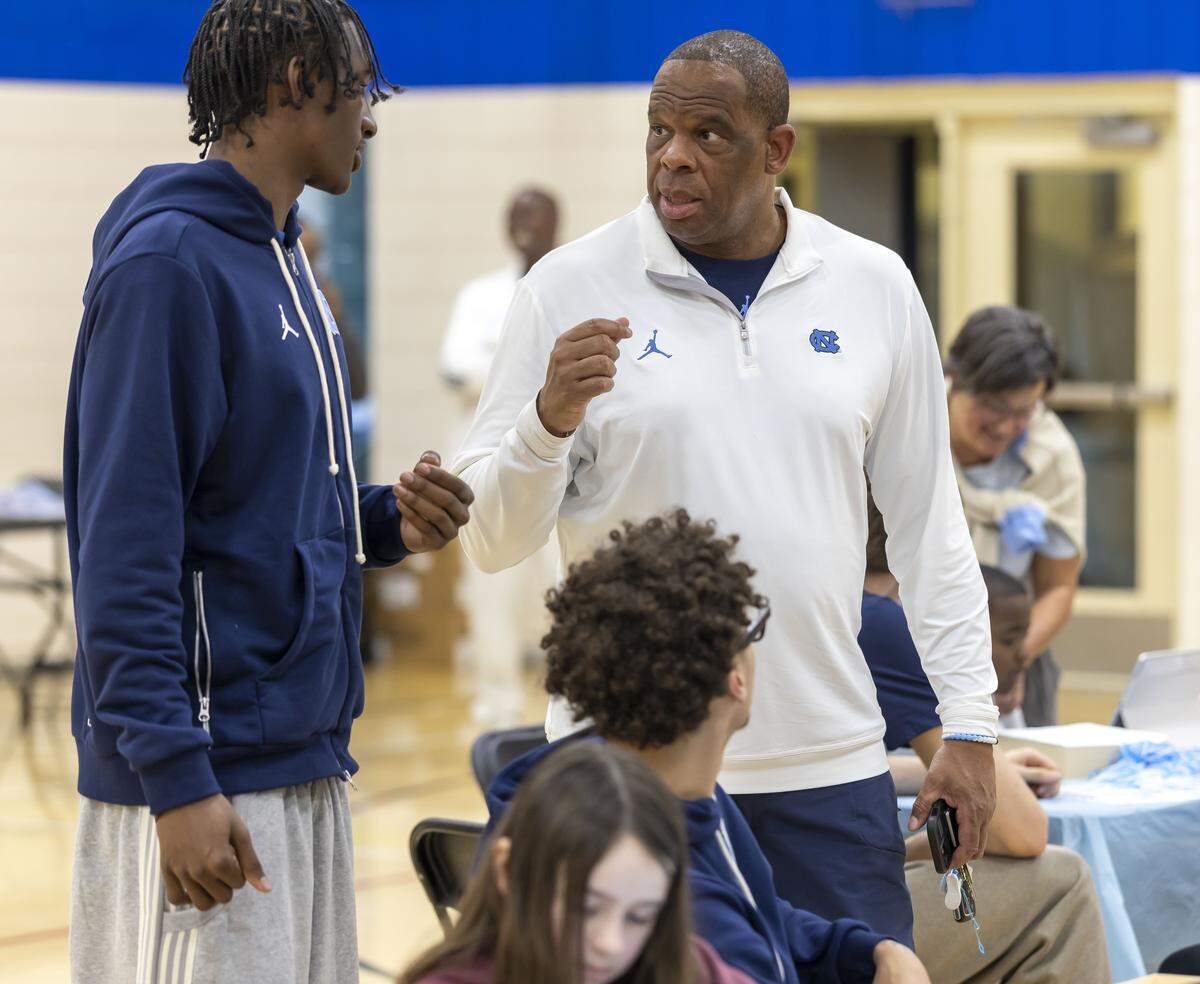
Hubert Davis later recounted those memories to his family — down to the details of the highly-physical games between his teammates and the inmates.
“I was like, ‘Dang, I can’t even imagine doing something like that,’” Elijah Davis said. “And I remember being amazed that it was something they did annually… I thought it was really cool and it changed my perspective on a lot of things.”
Those visits were not one-off appearances, either. Smith maintained relationships with inmates, even exchanging letters with some of them for years. His opposition to the death penalty became a defining part of his public life — and legacy after his death. In 1998, Smith personally urged North Carolina Gov. Jim Hunt to commute the sentence of a death-row inmate, John Noland, he had befriended during those prison visits.
“He really wanted us to be involved in the community and give back,” Phil Ford said of Smith. “That was just the type of person he was. He had a great heart. He really cared about his fellow man, and anything that he could do to help someone else, he always did… I know he took stances in the 60s and 70s that weren’t popular stances.”
Those memories still resonate with Hubert Davis and his family now.
“Coach Smith was so great about reminding the guys that you are one decision removed from where these young men were,” Leslie Davis said. “And I think for us, recognizing the privilege that we have, especially in today’s sports market with NIL and all of the many perks that occur as a college athlete... we really do believe it’s important to teach that you share that and you give back.”
Ties to forgotten Chapel Hill history
Take a stroll around Chapel Hill’s Northside district and you’ll see carefully-curated lawn displays, children playing in yards and neighbors
But look closer, and there’s history everywhere. On McDade Street, an old rock wall marks where Lincoln High School students planned some of the first Chapel Hill sit-ins of the 1960s. Northside Elementary now stands where a segregated school once educated generations of Black children.
Nestled between downtown Chapel Hill and Carrboro, Northside is one of the oldest historically Black neighborhoods in the area. Through the mid-19th century, enslaved Black people lived there on lease or loan from white residents. Those early Northside residents “constructed the University buildings, laid the rock walls, maintained the grounds, hauled water from the iconic Old Well, and cooked and cleaned for the administration, faculty, and students,” according to the Marion Cheek Jackson Center, whose oral history project works to keep the stories of Northside alive.
“Around our campus, you have these beautiful stone masonry walls and structures everywhere,” Leslie Davis said. “Who built that? You don’t think about the fact that slaves built that, but they were not allowed to be on campus. And so I think that’s a very important part of who we are, and it informs a lot about how our university began.”
“The community that has grown up together in Northside, the family legacies that they have there are beautiful,” she later added. “And I wish that everybody knew their stories.”
For Leslie and Hubert Davis, Northside’s history and community of diverse multi-generational communities made it a natural focus for their outreach. Specifically, through two community centers in the heart of the neighborhood, Chapel Hill Boys & Girls Club and Hargraves Community Center.
“It’s been here for the longest of time, just right off of Rosemary (Street),” Davis said of Hargraves during a Dec. 15 radio show. “It’s a community center that serves African American and Hispanic communities. They have a number of different programs there for tutoring and after school programs for kids… just being able to spend time with them is really huge.”
A personal connection helped too. John French, a longtime mentor and former basketball coach to Elijah Davis, directs the Hargraves Community Center.
“It’s where Elijah first played basketball, and we loved the gym and the community there,” Leslie Davis said. “As far as getting our family and the team involved in that area…I personally feel like and I can speak for Hubert in this — we think Hargraves should be the crown jewel of Chapel Hill.”
‘The kids just kind of lit up’
In September 2024, a small group of Tar Heels, led by former player and current graduate assistant Creighton Lebo connected with the Chapel Hill Boys & Girls Club through one of Lebo’s classes. During their first visit, the players — a group that included Trimble and Elliot Cadeau — noticed the club’s portable basketball goal in the backyard. The kind weighed down by sand.
“It was not completely broken down, but the kids had definitely given it a lot of wear and tear,” said Charlotte Makoyo, the director of CHBGC. “They were trying to hang on the rim and just all kinds of things.”
But it was good enough for the Tar Heels and the club’s kids to play that day.
“The kids just kind of lit up,” Makoyo said. “And they had an amazing day. They had an amazing time.”
Soon after, Makoyo received a call from Andrew Borresen. the local Boys & Girls Club director of Resource Development. The Tar Heels wanted to buy Makoyo’s kids a new goal — a permanent one complete with cement stabilization.
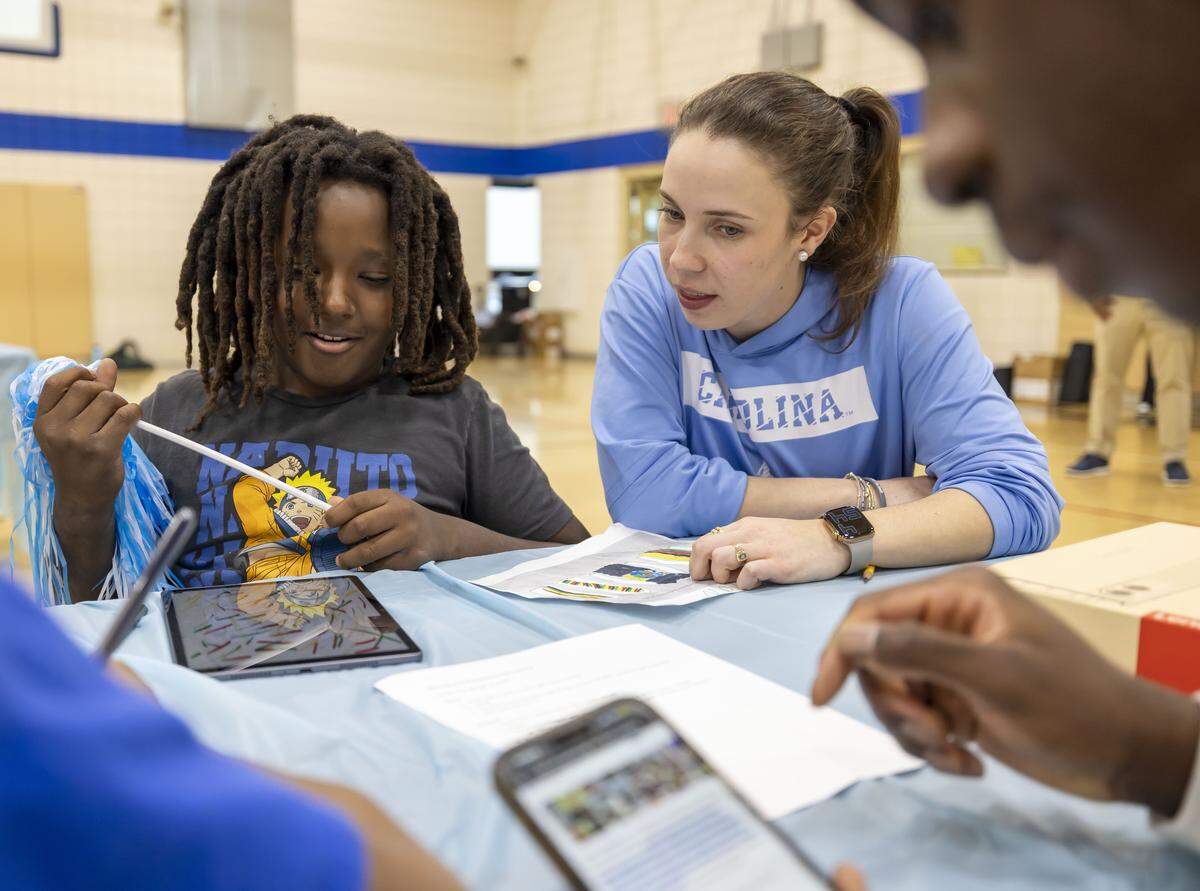
While gestures like the basketball goal were meaningful, Leslie and Hubert Davis wanted the team’s outreach to go deeper — to focus on building relationships, creating consistent touchpoints. In other words, something long-lasting and concrete.
And so, this past offseason, they created a new position — the men’s basketball program’s first-ever Director of Community Engagement — and tapped former manager Ragan Copeland to take point.
“Service is something that meant a lot to coach Dean Smith, and is something that he instilled in Coach Davis and all of our assistant coaches,” Copeland told the N&O. “And so Hubert really just wanted to bring that back and keep that alive in our program.”
That’s what they’ve done.
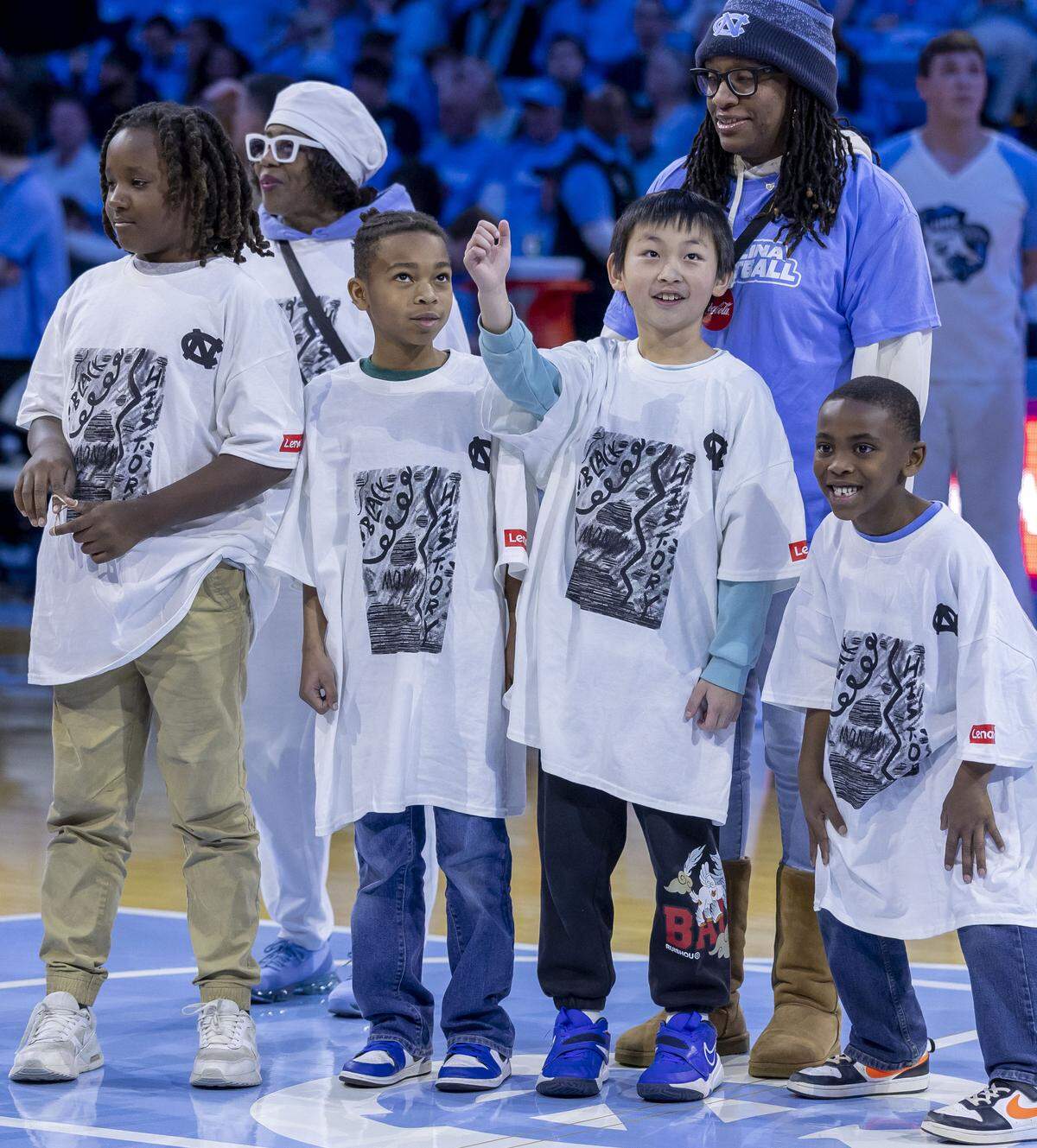
During the annual Holiday Heels shopping trip, UNC players paired with children from Hargraves to shop for gifts for their parents — followed by surprise gifts for the kids themselves. Players later collaborated with students at Hargraves to design Black History Month warm-up shirts. The winning design, created by fourth-grader Jinghe Liu of Glenwood Elementary, was worn by the Tar Heels before their win over Louisville on Feb. 23.
“I got the opportunity to go to the game, which my parents happily signed,” Liu told the N&O. “My dad even bought a ticket. Then we got to go on the court, throw some T-shirts.”
But Liu said the game — outside of Trimble “cooking” with a career-high 30 points — wasn’t as exciting as you might think.
“I can’t lie, mostly because I’ve already seen these guys, like, five times,” Liu said.
Talk to the directors at Hargraves and the Boys & Girls Club and they’ll tell you: the Tar Heels feel like friends to these kids.
That’s a result of events and outings organized by Copeland, as well as individual excursions. Players like Trimble have used days off from practice to visit the centers, with the senior guard hosting an ice cream party in December and surprising children at the Boys & Girls Club with JBL headphones.
“The kids, they talk about Seth and the team, sometimes even when I’m teaching math, trying to get homework done,” Makoyo said. “The kids feel like he is a real person. I think that’s a huge thing, because everyone hears about LeBron and Jordan — who is the greatest of all time — but they can say like, ‘Seth came and he played with us, and he knew our names.’”
‘It’s just been a blessing’
When Ayden joined the N&O for an interview last week at the Hargraves Community Center gym, sitting still didn’t last long. He ran a quick lap around the court before taking his seat, at which point he was still fidgeting — bouncing atop a basketball excitedly.
The energy only settled when someone mentioned Caleb Wilson.
Ayden’s face lit up.
The two met during the team’s holiday shopping event at Target, when players paired with kids from the center to pick out gifts for their families. Ayden carefully chose a green-and-blue blanket for his mom — green is his dad’s favorite color — and a drone for his dad as well. His favorite part, though, was playing Fruit Ninja with the soon-to-be lottery pick.
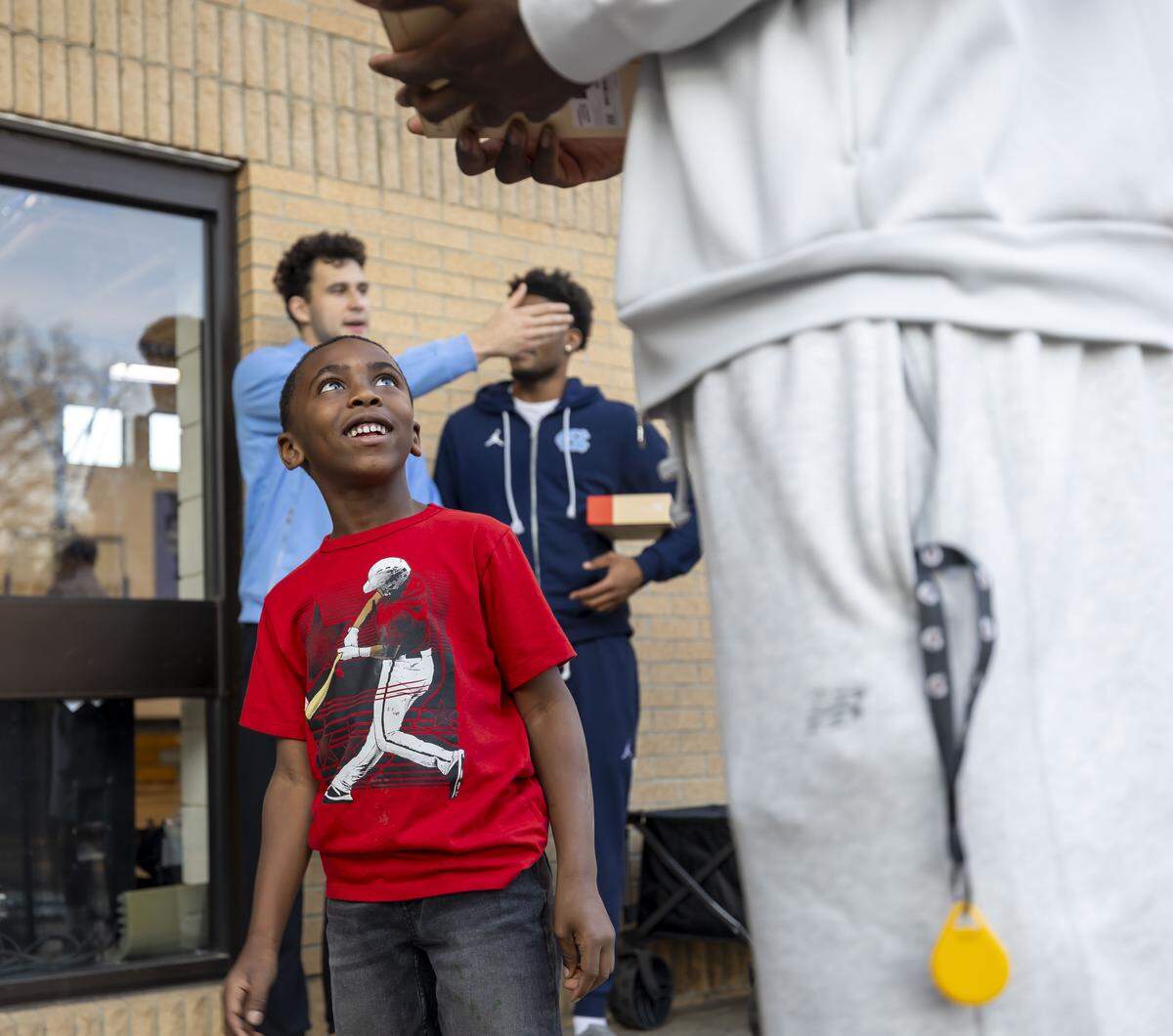
Ayden’s been at Hargraves for about a year and a half, his mom said. They discovered Hargraves at their Back to School Bash. Went and picked up a bookbag: Minecraft themed which he proudly tosses over his little shoulders now. His younger brother got a Mario backpack.
“It’s just been a blessing for us,” Yushekia Woodford said.
Last fall, former Hargraves director Andre Boynton was the first to tell Ayden’s parents about the December shopping trip, which he described as “a day to remember, a memory that Ayden will never forget.”
“That has been something that we’ve been holding on to as a piece of him,” Yushekia Woodford said. “He was absolutely right.”
In February, Andre and his wife, Carla, were killed in a car crash in Detroit. Both Andre and Carla invested into countless youth in the area — Andre at Hargraves and Carla as a teacher in Durham.
As the Hargraves community has coped, outings to see the Tar Heels play and special afterschool meals from the team have been bright spots. Memories like the shopping trip, Yushekia said, now hold more weight.
The day after the tragic accident, several children from Hargraves and a few chaperones made the short trip to the Smith Center to watch UNC play Louisville. Ayden, who attended alongside Liu, even saw his buddy Caleb. He waved at the star freshman, who waved back.
Their relationship continues to be, just as Andre predicted, something Ayden will never forget.
Leslie Davis can attest to this. At a visit she made to Hargraves earlier this season, Ayden demanded she record a video of him showing off a wasp diorama — a school project he made at Estes Hills Elementary.
“He walks him through the whole habitat,” Leslie Davis said. “I couldn’t even get him to be quiet. I was like, ‘OK! We’re going to wrap it up!’ And he’s like, ‘And I use mulch and dirt.’ It’s adorable.”
Ayden certainly knows a lot about wasps, but not so much about the basketball landscape. He doesn’t remember much about the Louisville game he attended, other than “Caleb Wilson’s team winning.” When someone tried to explain the NBA draft, he looked puzzled. But when he heard Wilson will likely be selected near the top, Ayden gasped and smiled.
Asked what he wants to be when he grows up, Ayden didn’t hesitate: a basketball player at UNC. Just like Caleb.
Ayden said he hasn’t asked his friend for any pointers. Most of the time, they don’t talk about hoops at all. Ayden’s favorite part about the UNC basketball players visiting Hargraves is much simpler.
“Probably just that they’re excited to see me.”
This story was originally published March 18, 2026 at 5:30 AM.